If you already know you want a hard, keen Japanese blade and you are spending flagship money once, buy the Miyabi Kaizen — it publishes a harder blade and a keener edge than the Shun Classic and it costs about the same. If you are not yet sure the category suits you, buy Shun, because Shun is the only one of the two that sells a cheap way to find out. That second sentence is the whole comparison, and almost nobody frames it that way.
The two brands look like direct rivals on a shelf. Both are Japanese, both are made in Seki, both land in the same price bracket in American kitchen stores, and both are owned by a Western parent — Shun by Kai, Miyabi by Zwilling J.A. Henckels of Solingen, which is the same company behind the German knives we rank in Zwilling vs Henckels. What separates them is not nationality or even steel. It is how far down each brand's ladder you can step and still get the thing you came for.
Everything below is judged from published manufacturer specifications — steel and hardness on the Rockwell scale, edge angle, cladding, handle material, blade length and weight — and the value math against the live price. See how we review: we do not have a test lab and we do not claim one. The Miyabi figures on this page come from Zwilling's own product page for the Kaizen 8-inch, fetched while writing, and where that page contradicts itself we say so instead of quoting the flattering number.
What each brand actually publishes
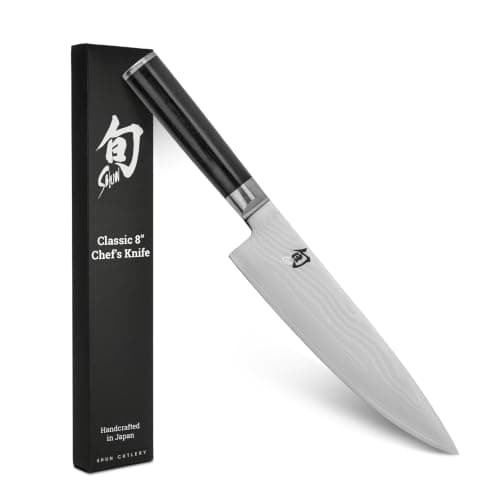
Shun Classic.A VG-MAX core at a stated 60-61 HRC, ground to about 16 degrees per side, clad in 68 layers of Damascus, on a D-shaped pakkawood handle. Kai publishes all of it consistently, and it runs a re-sharpening service for its own knives — which is a real answer to the brittleness of a 61 HRC edge rather than a marketing line.
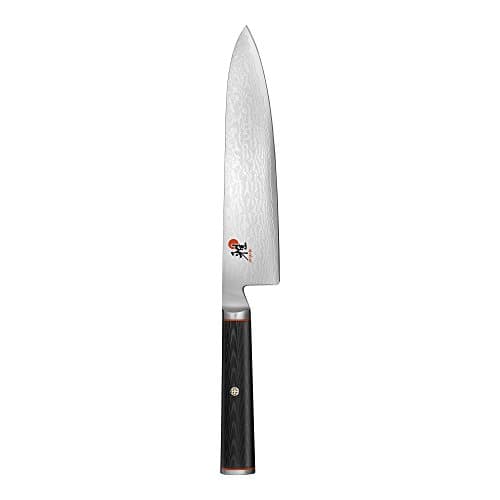
Miyabi Kaizen. Zwilling publishes a CRYODUR ice-hardened blade at 60-62 HRC in its specification table, hand-honed through a three-step Honbazuke process to a stated 9.5 to 12 degrees, in 64-layer flower Damascus, on a D-shaped black linen Micarta handle, 7.87 inches of blade at 0.44 lb, handcrafted in Seki.
Two caveats on that Miyabi list, because they are the kind of thing we would want told to us. The page describes a “resilient core of VG10 super steel” in its feature list while the specification table underneath names the substance as CMV60 — those are not the same designation, and we are not going to resolve a maker's own inconsistency on its behalf. The layer count appears as both 64 and 65 on the same page. Neither discrepancy changes how the knife cuts; both are a reminder that a published number is only as good as the publisher's proofreading, which is the standing argument of how to tell if a knife is good quality.
The edge angle is the one real specification gap
9.5 to 12 degrees against roughly 16. That is the single largest published difference between these two knives and it is not a small one — a Miyabi arrives with an edge ground substantially finer than a Shun, which is finer again than the roughly 20 degrees a German knife carries. Finer means it enters food with less force and feels dramatically sharp out of the box.
It also means the edge is more fragile, and that the maintenance question gets harder rather than easier. A 20-degree Western edge comes back on a rod. A 16-degree Japanese edge wants a stone. A 10-degree edge wants a stone, a known angle and a steady hand, because every degree you accidentally add is a larger proportion of the bevel you are replacing. If you do not already sharpen, the keener edge is a depreciating asset — read knife sharpening angles before you treat it as a reason to buy.
Hardness, by contrast, is close enough to be noise. 60-61 against 60-62 is within the tolerance of published nominal figures, as knife hardness HRC explained sets out: these are targets for a product line, not measurements of the knife in the box. Do not buy on a one-point difference in either direction.
Is Miyabi a good knife brand?
Yes, and specifically it is a brand that publishes real process rather than adjectives. CRYODUR ice-hardening and the three-step Honbazuke hand-honing are both named, documented steps rather than “precision engineered” filler, and the published edge angle is finer than anything else we rank. Made in Seki, distributed and serviced by Zwilling.
Two honest qualifications. First, the documentation is less careful than Kai's — the contradictions in the Kaizen's own spec sheet are not a cutting problem but they are a trust problem, and this site weights published specifications heavily enough that it matters. Second, the brand name carries a premium that the engineering does not entirely explain: you are buying a Zwilling-owned Japanese line, and part of the price is the shelf it sits on in an American kitchen store. The same is true of Shun.
Are Miyabi knives worth it?
If you sharpen, yes. The 9.5-12 degree Honbazuke edge is the keenest factory grind of any knife we rank, and a finer bevel is the one specification difference on this page you can feel on the first cut rather than infer from a table. For a cook who owns a stone and knows the angle, it is a real upgrade over a 16-degree edge.
If you do not sharpen, no — and more strongly than for most premium knives. The finer the bevel, the shorter the distance between “scary sharp” and “worse than a Victorinox”, and the less forgiving the recovery. A 10-degree edge put through a 20-degree pull-through sharpener is not dulled, it is reprofiled, and getting it back is a stone-and-patience job. The honest alternative for that cook is in best chef knives for the money, and the reason is laid out in are expensive chef knives worth it.
The ladder, which is the argument nobody makes
Brands are usually compared one knife against one knife. That is the wrong frame for a first Japanese purchase, because what you are really buying is an entry point into a maintenance habit you have not formed yet.
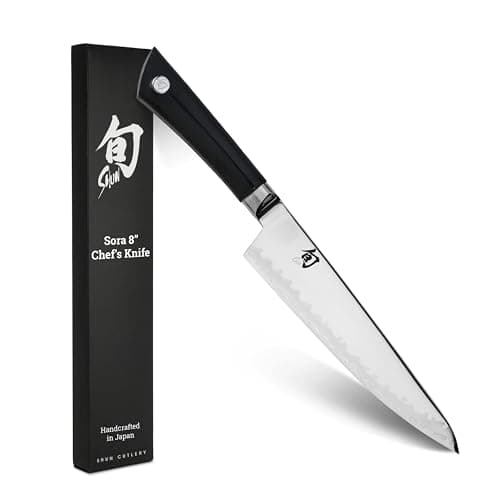
Shun's range runs from the composite-blade Sora at the bottom through the Classic in the middle to its premium lines, and the cutting philosophy is continuous across it: hard edge, keen grind, treat it carefully. You can buy the bottom rung, live with it for a season, and know with confidence whether the Classic is money well spent. Miyabi's range is premium throughout as far as this site can verify — its entry 8-inch chef knife is still sold on Amazon but its maker page is retired, which leaves us nothing to rank it on.
So the practical sequence we would actually recommend, for someone starting from a German knife: buy the Sora, use it for a few months alongside what you own, buy a 1000/6000 stone and learn the angle on the cheap blade. If you love it, the Kaizen is the better flagship and this page says so plainly. If you do not, you are out very little and you have learned something no review could have told you.
Handles: Micarta versus pakkawood
Both flagships here use a D-shaped handle contoured for a right hand, so left-handed cooks should read left-handed chef knives before committing to either. Where they differ is material, and it is a real if undramatic difference.
Pakkawood is resin-impregnated hardwood: stable, warm in the hand, and the category standard for a reason. Linen Micarta — layers of linen cloth set in resin, which is what Zwilling publishes for the Kaizen — is denser, less affected by water, and grippier when wet, which is a genuine advantage on a knife used on wet produce and raw protein. It also looks like industrial material rather than furniture, which some buyers like and some do not. The broader comparison is in knife handle materials.
Neither handle should decide this purchase on its own. If one of them does, hold the knives first — and if that is not possible, the Sora's symmetrical polymer handle is the one option here with no handedness at all.
What about Miyabi vs Wusthof?
A fair question, because both are Zwilling-family brands in the same stores, and it is a live autocomplete variant. Short answer: that is the Japanese-versus-German decision rather than a brand decision, and it is settled by how you cook rather than by which badge you prefer. Miyabi is hard, thin and keen at 60-62 HRC; Wusthof Classic is forged, tougher and more forgiving in the high 50s at roughly 20 degrees. One chips, one rolls.
That whole argument is already laid out at Japanese vs German chef knives, and the German side of it is ranked at best German chef knives. If you are choosing between a Miyabi and a Wusthof rather than between Miyabi and Shun, read those two first — the answer is about your board, your habits and whether you hit bone, not about Seki versus Solingen.
If neither of these is the answer, the wider shortlist is alternatives to Shun, which adds a VG-10 value option, two symmetrical-handled Japanese knives for anyone the D-handle does not suit, and the cheapest Kai-made blade in our registry. The Shun line itself is ranked at best Shun knives.