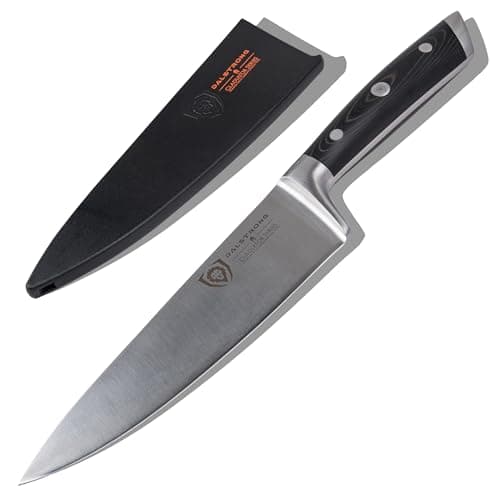
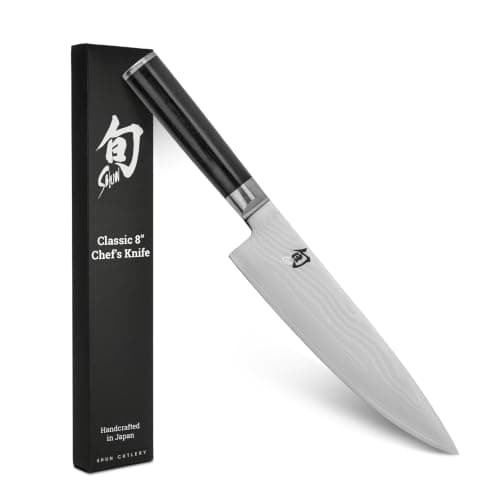
The Shun Classic 8-inch wins this on the numbers, 8.4 to the Dalstrong Gladiator's 7.8 — and the more useful answer is that these two knives are not in the same category, so most people asking the question are comparing the wrong pair. The Shun is a Japanese san-mai knife: a VG-MAX core at roughly 60-61 HRC, clad in 68 layers of Damascus stainless, ground to about 16 degrees per side. The Dalstrong Gladiator is forged German X50CrMoV15-family steel at around 56 HRC, ground finer than German knives usually are at 16-18 degrees per side, with a G-10 handle. It looks like a Japanese-style knife and it is priced like a mid-range Western one, because that is what it is.
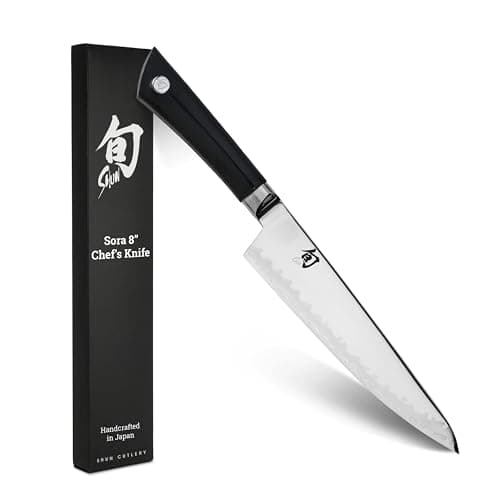
Which means the honest recommendation splits two ways. If you want the hard-steel edge the Shun is selling, the cheaper route is not the Dalstrong — it is Shun's own entry line, the Sora, which welds a VG10 cutting edge to a 420J stainless upper blade and scores 8.0 here. If what you actually want is a tough Western knife with presence and a grippy composite handle, the Gladiator is a legitimate buy, and the comparison that tells you whether it is a good one is Dalstrong vs Wusthof, not this page.
The scores here are reproduced, not re-rated. Each knife's five metrics come verbatim from the page on this site where it is already ranked — the Shun Classic from Shun vs Global, the Sora from best Japanese chef knives for beginners, the Gladiator from our Gladiator review — and all three use the same rubric, which is what makes the averages comparable rather than three separate opinions. The rubric and its limits are on how we review: these are judgments from published specifications and the value math, not measurements from a lab we do not have.
The one specification that decides this comparison
Hardness. Everything else follows from it. The Shun's VG-MAX core runs at roughly 60-61 HRC; the Gladiator's forged German steel runs at around 56 HRC and up. Four or five points on the Rockwell C scale is not a rounding difference — it is the line between two maintenance regimes and two failure modes, which is the whole argument of what HRC means for knives.
Harder steel holds a keener edge for longer and can be ground thinner behind the edge without folding over, which is why Japanese knives feel the way they do. It also chips rather than rolls when you abuse it, dislikes bones and frozen food, and needs a stone or a guided system rather than a ridged steel rod. Softer steel dulls sooner, but it dulls gracefully: it rolls, a honing rod stands the edge back up in ten seconds, and it tolerates a cook who is not careful. See high carbon vs stainless and sharpening vs honing for the mechanics.
So the Gladiator's 16-18 degree grind is doing something slightly odd: it is a Japanese-ish edge angle on Western-hardness steel. That is not a defect — a finer edge cuts better at any hardness, and Wusthof grinds its Classic to about 14 degrees per side on steel of the same family at around 58 HRC. It just means the Gladiator's thin edge needs the honing discipline a German knife needs, and you should not read the angle on the spec sheet as evidence that you are buying Japanese cutting.
Construction: a three-layer sandwich against a single billet
The Shun Classic is san-mai— a hard core with softer stainless cladding on both sides, so the brittle steel that takes the edge is only a thin layer of the blade. The 68-layer Damascus is in that cladding, which makes the pattern structurally real and cosmetically bought at the same time: the edge itself is one homogeneous core steel. That is covered properly in Damascus steel knives explained.
The Gladiator is a conventional Western forged knife: one piece of steel, full tang, tapered bolster, a G-10 composite scale riveted on. The G-10 is a genuine advantage over wood or polished pakkawood — it is dimensionally stable, it does not mind water, and it grips when your hands are wet. Dalstrong's weak spot is not the build; it is the steel and the continuity, which is the subject of how to tell if a knife is good quality.
The Sora sits between the two ideas and is the most interesting knife on this page for anyone shopping on value: Kai welds a VG10 edge section to a 420J stainless upper blade, so the hard, expensive steel is only where it cuts. You get Japanese edge behavior and Kai's service network for materially less than the Classic. What you give up is the Damascus, the pakkawood, and the ability to thin the blade dramatically over decades of sharpening, because eventually you sharpen into the weld region.
So which one, in one paragraph
Buy the Shun Classic if you want the sharpest knife here, you are right-handed, and you will keep it off bones and out of the sink. Buy the Shun Soraif you want the Japanese edge and the Kai service network without the Classic's price — it is the sensible answer for most people who arrived at this comparison because of money. Buy the Dalstrong Gladiator if, having read the hardness section, you would rather have a tough forged Western knife with a grippy composite handle and weekly honing than a hard Japanese one. All three are real knives. Only one of them is the knife the product photography implies.
Are Dalstrong knives worth it?
On the specification, yes, at the right price and for the right job. The Gladiator is forged, full tang, NSF certified, with a G-10 handle and a finer-than-usual Western grind. Nothing in that sentence is a corner cut. What you are not getting is hard steel, a published hardness in the Japanese band, a Solingen service network, or the decades of continuity that make a Wusthof a safe purchase in twenty years' time.
The complaint that holds up is about positioning rather than quality: Dalstrong markets in the vocabulary of Japanese knives — profiles, cladding patterns, hand-polished edges — around steel that is Western. If you buy one knowing it is a tough mid-price Western knife, you will probably be happy. If you buy one expecting the cutting feel in a Shun review, you will not. Our brand-by-brand view is at best chef knife brands, and the Gladiator's own page is here.
Is Dalstrong a good brand?
It is a marketing-led brand that specifies and sources its knives rather than forging them in a house with its own name on the building, and it is transparent about the materials: steel family, hardness band, edge angle, handle composite, NSF status. That is more than several heritage brands publish. The practical consequences are that quality is line-dependent rather than uniform, the premium lines are priced against a feeling of luxury rather than against a measurable cutting gain, and there is no sharpening service behind the purchase. Judge the line, not the logo — how to tell if a knife is good quality is the checklist we would apply, and it applies to knives we rank as well as ones we do not.
Are Shun knives better than Wusthof?
Different, and the autocomplete that brought you here pairs the question with this one for a reason: it is the same decision with different brand names on it. Shun cuts better out of the box and holds that edge longer; Wusthof survives more abuse and asks less of you. We have run that comparison properly at Shun vs Wusthof, and the underlying category question is at Japanese vs German chef knives. If you want one sentence: buy German if you rock-chop, hit bones and clean up in a hurry; buy Japanese if you push-cut, respect the edge and own a stone.
What to buy alongside whichever one you choose
For either Shun, a 1000/6000 whetstone or a guided system with a 15-degree setting, because the ridged rod that came with your knife block will damage a hard edge — best sharpening systems ranks the guided options and best sharpening stones ranks the stones. For the Gladiator, a honing rod and the habit of using it: best honing steels. For all three, a board that is softer than the edge — board hardness is the single largest determinant of how long a knife stays sharp, which is why best cutting boards for knives exists. And if the knife is going in a drawer, edge guards, not a loose drawer: best knife storage.
One more thing worth saying to anyone spending this much on a single blade: the next improvement after any of these three knives is usually not a better chef's knife, it is a second knife in a different shape. The cheapest version of that upgrade is covered in is a santoku knife worth it, and Shun and Dalstrong both sell one.