Yes, if you buy it as a second knife. No, if you are buying it to replace your chef's knife. A santoku is a short, flat, blunt-tipped blade built to push-cut straight down. On the job that fills most of the time anyone spends at a cutting board — onions, carrots, cabbage, peppers, herbs, anything that gets reduced to small pieces — it is faster, lighter and easier to control than an 8-inch chef's knife, and a good one costs less than dinner out. What it cannot do is pierce, carve around a bone, or reach across a large roast, because it has no usable tip and not enough length.
So the honest framing is not “santoku or chef's knife.” It is: you own a chef's knife, you use it for everything, and roughly three quarters of that everything is vegetable prep that a santoku does better. Adding one is the single cheapest improvement available to a home kitchen that already owns one decent knife. Replacing your chef's knife with one leaves you unable to do four or five jobs you currently do without thinking about it.
Everything below is judged from published specifications — steel and hardness, edge angle, blade length and weight, construction — and the value math against the live price. See how we review: we do not have a test lab and we do not claim one. If you have already decided you want one, the full seven-knife ranking is at best santoku knives and this page is the question that comes before it.
What a santoku is actually good for
Three things, and they are worth being specific about because “versatile” is how every knife is marketed.
Push-cutting vegetables.The santoku's edge is nearly straight with only a shallow curve, so the whole edge meets the board at once. That suits a straight downward cut rather than the rocking motion a curved French-profile chef's knife wants. If you have ever wondered why your dice comes out uneven, this is usually why: a rocking stroke on a flat-ish edge leaves accordion slices still joined at the bottom. A santoku removes the technique problem instead of asking you to fix it.
Control on a crowded board.At 165-180mm the blade is two to three inches shorter than a standard chef's knife and usually a couple of ounces lighter. On a small board in a small kitchen, that is the difference between working and negotiating. It is also noticeably safer near your guiding knuckles, which is why it is a common recommendation for cooks who are nervous with a big blade and for smaller hands.
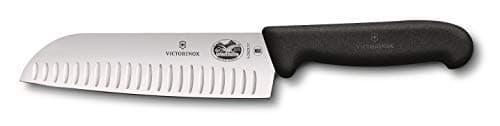
Clean slicing of soft, wet food.Most santokus are thinner behind the edge than a German chef's knife, and many have a Granton hollow-ground edge — the row of oval dimples — which reduces the suction that makes potato and cucumber slices cling to the blade. It is a small effect, honestly described, and it is real.
The three jobs it is bad at
Anything that needs a tip.The santoku's sheepsfoot profile curves down to a blunt nose. You cannot score skin, split a chicken joint from the inside, cut out the core of a tomato or pierce a squash with it. That is not a small gap — it is the reason this is a second knife. A paring knife covers most of it, and breaking down a chicken needs a real point or a boning knife.
Anything long.A 7-inch blade will not slice a brisket, carve a roast or cross a large watermelon in one stroke. For that you want length — see best knives for brisket and chef knife sizes.
Anything hard, if the knife is Japanese.Most santokus worth owning are thin, and the better ones are hard — around 59-61 HRC. Thin and hard means the edge chips rather than rolls on bone, frozen food or a hard winter squash. That is a characteristic, not a defect, but it decides which of the three knives below you should buy. The mechanism is in what HRC means for knives.
Is a santoku better than a chef's knife?
At its job, yes. Overall, no, and the asymmetry is the whole point: a chef's knife is a generalist that is good at everything and best at nothing, while a santoku is a specialist that is excellent at the single highest-volume task and incapable of several others. If you could only own one knife, own the chef's knife. Almost nobody is in that situation, because a second knife here costs less than a mid-range chopping board.
The shape-by-shape version of this comparison, with the profiles drawn out, is chef's knife vs santoku. If you are weighing a santoku against the other flat Japanese shapes, read santoku vs nakiri— the nakiri is the more committed vegetable knife and does even less of everything else — and santoku vs gyuto, which is the question of whether you want a Japanese chef's knife instead of a Japanese specialist.
When the answer is genuinely no
If you do not own a sharpening setup and will not get one.A blunt santoku is worse than a blunt chef's knife, because the flat edge offers no rocking technique to compensate with. If the honest answer is that no knife in your kitchen has been sharpened in three years, buy a sharpenerfirst and a santoku second — that is the purchase that will change your cooking.
If you break down a lot of protein.If most of your board time is meat and fish, the second knife you want is a boning or fillet knife, not a santoku — see best boning knives and best chef knives for cutting meat.
If what you actually want is a sharper knife.A lot of santoku purchases are really an attempt to buy the feeling of a sharp knife. If your chef's knife is a decent one, a stone will get you there for less money, and best sharpening stones for beginners is the page to read. A santoku will feel transformative for two months and then be as dull as everything else.
If you only have room for one more knife and you cook whole birds. A 6-inch utility or a boning knife earns its drawer space faster. See what knives a kitchen actually needs.
What to look for, before the picks
Hardness decides the maintenance, so pick it deliberately. A Western santoku in the mid-50s HRC is forgiving: it rolls rather than chips and a honing rod brings it back in seconds. A Japanese santoku at 59-61 HRC holds a keener edge much longer and wants a stone or a guided system set to 15-16 degrees. Both are correct answers; only one of them matches a cook who will not maintain a knife.
Length: 165mm or 180mm, and that is the whole range.180mm (7 inches) is the more versatile of the two and the one to buy if you only buy one. 165mm (6.5 inches) is the better choice for small hands, small boards or anyone who found a chef's knife unwieldy in the first place. Anything longer stops being a santoku and becomes a gyuto.
The handle matters more on a short blade than people expect, because your hand is closer to the work and the knife is doing less of the pushing. A textured synthetic handle grips when wet; a polished wooden handle looks better and does not. If you cook with wet hands, weight that heavily.
Granton dimples are a nice-to-have, not a reason to choose. They reduce sticking on wet starchy food. They do not make the knife sharper and they do not survive being sharpened away over many years.
Three picks below, one per approach, reproduced from our full santoku ranking so the scores are directly comparable with the rest of that field.
What size santoku knife is best?
180mm (7 inches) if you are buying one santoku and nothing else changes. It is long enough to handle a cabbage, a pile of carrots or a large onion without running out of edge, and short enough to keep the control advantage that made you want a santoku in the first place. Two of the three picks above are this length, and it is the length most of the category is built around.
165mm (6.5 inches) if your hands or your boards are small, or if the reason you are reading this page is that your chef's knife feels unwieldy. The shorter blade is more maneuverable and noticeably lighter, and for a cook who is nervous with a big knife it is the one that gets used rather than avoided. The cost is reach: you will work in two passes where a 180mm blade works in one.
There is no useful santoku above 180mm. Once a Japanese blade gets longer than that it takes on a curved tip and becomes a gyuto— a Japanese chef's knife — which is a different purchase with different strengths. And there is nothing meaningful below 165mm either; a 5-inch santoku is a utility knifewith the wrong profile. The broader length argument, including why 8 inches became the chef's knife default, is in chef knife sizes.
Are santoku knives good? The honest version
Good santokus are very good and the category has an unusual amount of junk in it, because the shape photographs well and sells on the strength of a word that means “three virtues.” The failure mode is a thick, soft, badly ground blade in a santoku outline — all of the limitations of the shape with none of the thin-and-keen advantage that justifies it. What separates a good one from a bad one is exactly what separates any good knife from a bad one: a published steel and hardness, a stated edge angle, a blade that is thin behind the edge, and a handle that stays put when wet. The checklist is how to tell if a knife is good quality, and it is the page to read before buying any santoku that is not one of the three above.
Do I need a santoku knife?
No. Nobody needs one, and any page that tells you otherwise is selling something. What is true is narrower and more useful: if you already own a working chef's knife, a santoku is the cheapest second knife that will change how a weeknight feels, because it is better than your chef's knife at the thing you do most. That is a genuine upgrade and it is also entirely optional.
The order we would actually buy in, for a kitchen starting from nothing: a good 8-inch chef's knife, a paring knife, a serrated bread knife, then a santoku or a nakiri as the fourth. That sequence is argued out properly in what knives a kitchen actually needs, and if you are tempted to shortcut it with a block set, read are knife sets worth itfirst — the santoku in a set is usually the filler piece.
What it costs to own one properly
The knife is not the whole purchase, and this is where santoku buyers most often come unstuck. A Western santoku needs a honing rod and the habit of using it — best honing steels and how to use a honing steel. A Japanese santoku needs a stone or a guided system that will hold 15-16 degrees, because a ridged rod will damage a hard thin edge rather than straighten it: best sharpening stones for beginners and best sharpening systems cover both routes.
Both want a board softer than the edge, because board hardness is the largest single determinant of how long any knife stays sharp — best cutting boards for knives. And a flat santoku edge is the one most easily ruined by a drawer, so if it is not going on a rail, use edge guards: best knife storage. The running cost of a knife is covered in knife care and maintenance.
So, in one paragraph
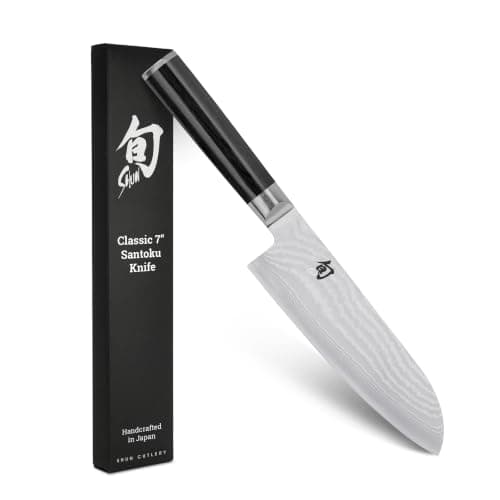
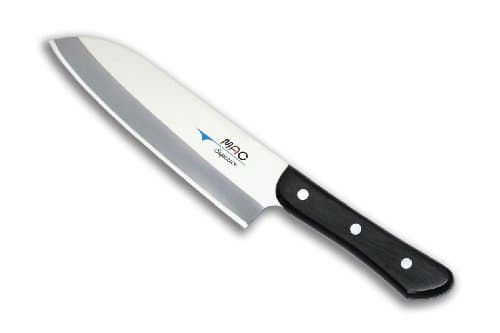
Buy the Victorinox if you want to find out whether the shape suits you without spending much, or if nobody in your kitchen will ever use a stone. Buy the MAC if you want real Japanese cutting at a sane price, or if 6.5 inches is the length your hands want. Buy the Shunif you already know you like the shape, you keep your knives properly, and you want the nicest one. And if, having read the three jobs a santoku is bad at, the shape sounds like a solution to a problem you do not have — keep the chef's knife, buy a stone, and put the difference toward a better board.