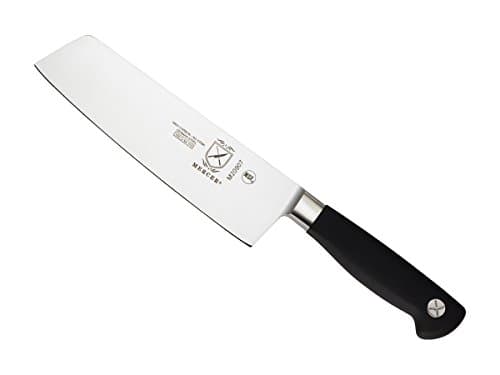
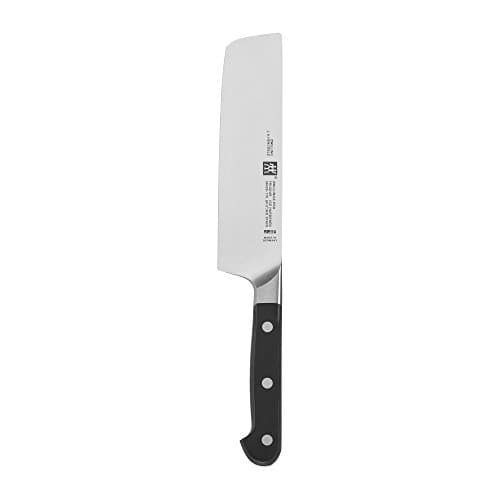
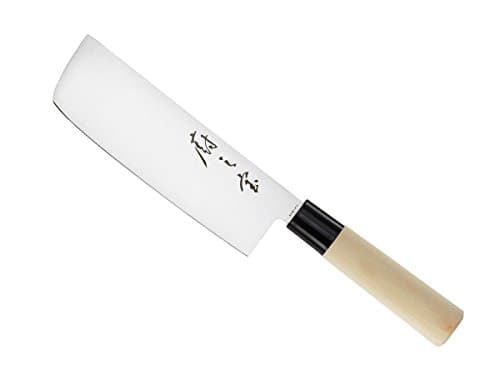
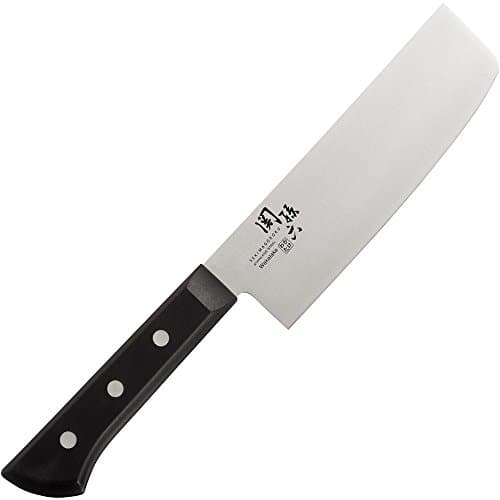
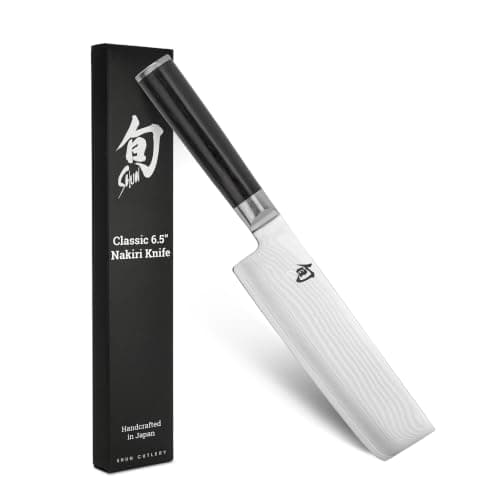
A nakiri is the most honest knife in a kitchen: it does one job, it does it better than anything else, and it makes no pretense of being versatile. The blade is tall and rectangular with a completely flat edge and a blunt end, so a single downward stroke severs everything under it and reaches the board along the entire length — no rocking, no sawing, no last strand of skin holding a slice together. On a large pile of vegetables it is genuinely faster than a chef's knife. On a chicken, a roast, or anything you need to pierce, it is the wrong tool entirely.
These scores are judgments from documented research — published specifications, established sharpening standards and the value math — not measurements we took. We do not run a test lab and will not pretend otherwise; the method page sets out exactly what we do. For the shape question, read chef's knife vs nakiri and santoku vs nakiri.
How we ranked these
Edge and steel, from the published alloy and hardness. Sharpness, from the ground angle and how thin the blade is behind the edge — on a nakiri this matters more than on any other shape, because a thick blade wedges in a dense root vegetable no matter how sharp the apex is. Handling, meaning weight, blade height and knuckle clearance. Build. And valueagainst the live price. A nakiri is a second or third knife for most people, which makes the value question sharper than usual — it has to earn its drawer space.
Blade height is the spec nobody lists
A nakiri is tall — typically 45 to 55mm from spine to edge. That height is doing two things. It gives your guiding knuckles clearance so you can cut fast without watching your fingers, and it gives the blade enough face to push a slice aside cleanly as it descends. Shorter nakiri-shaped knives exist and they lose most of the advantage. If a listing does not state blade height, the photographs usually tell you: the profile should look distinctly rectangular, not like a slightly squared-off santoku. The Chinese vegetable cleaver takes the same idea considerably further, at roughly twice the blade height — the cleaver roundup ranks that field, and explains why it is a slicer rather than a chopper.
Nakiri or santoku? The question everyone actually has
A santoku is a generalist with a mostly-flat edge; a nakiri is a specialist with a completely flat edge and a taller blade. If you want one knife that handles vegetables, boneless protein and general prep, buy the santoku — see best santoku knives. If you already own a good all-rounder and want something that makes a mountain of vegetables disappear, buy the nakiri. Owning both is reasonable; owning only a nakiri is not. Santoku vs nakiri has the full comparison.
Why thinness matters more here than anywhere else
When you push a blade straight down through a large carrot or a swede, the food has to separate around the blade. A thin blade parts it; a thick one wedges and the vegetable cracks apart rather than slicing. This is the reason a very sharp but thick knife still feels bad on dense produce, and it is why the Japanese picks here rank as they do. If you are choosing between two nakiri and can only see one spec, choose the thinner one. Spine thickness and distal taper are covered in chef knife anatomy.
What a nakiri cannot do
It has no point, so it cannot pierce, score, or do any tip work. It has no belly, so it cannot rock through herbs — you chop them with repeated straight strokes instead. It is not built for bone or joints, and using a hard Japanese one on either will chip it. And it is a poor carving or slicing knife, because the tall blade and short length work against long strokes. None of that is a criticism; it is a specialist, and specialists are supposed to be bad at other things.
Technique: it is not a chef's knife motion
Lift the whole blade clear of the board and bring it straight down — do not try to rock, and do not push forward. Because the edge is flat and lands all at once, you can move much faster than with a curved blade once the motion clicks, and your guiding knuckles stay in constant contact with the tall blade face. The one habit to unlearn is dragging the tip along the board on the return, which does nothing and dulls the edge. Push-cutting technique is also what makes the santoku and gyuto feel different from a Western knife.
Sharpening a flat edge is easier, with one catch
A completely flat edge is the simplest possible thing to sharpen on a stone: no sweeping motion to follow a curve, no tip to raise, just consistent pressure along the length. The catch is that a flat edge shows any error. If your stone is dished, or your angle wanders, you get a visibly uneven edge that fails the paper test in the middle and passes at the ends. Keep the stone flat — how to flatten a whetstone — and this is the easiest knife in your kitchen to maintain well.
What we would skip
Skip the very cheap unbranded nakiri that flood marketplace listings with dramatic Damascus-pattern photographs and no steel specification. A pattern etched onto the surface is not cladding, and unspecified steel at that price is soft and thick behind the edge — the two properties this shape most needs to avoid. Skip nakiri-shaped knives under about 40mm of blade height, which give up the knuckle clearance that makes the shape fast. And skip buying a nakiri before you own a good chef's knife or santoku; it is a second knife, and the order matters more than the brand.
One caveat on how to read this page: it judges nakiris against nakiris, so the ranking is about blade quality rather than about what to own. If you want the best vegetable knife to buy rather than the best nakiri, our best knives for cutting vegetables page re-scores the same blades against santokus, a chef's knife and a Chinese vegetable cleaver on one rubric that prices upkeep and money in - and reaches a different answer.