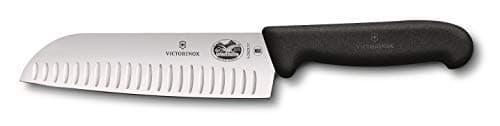
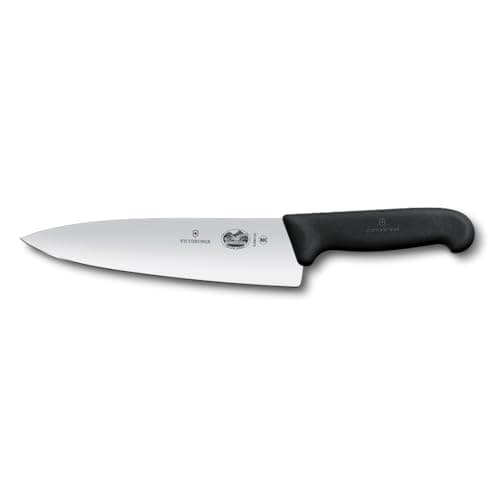
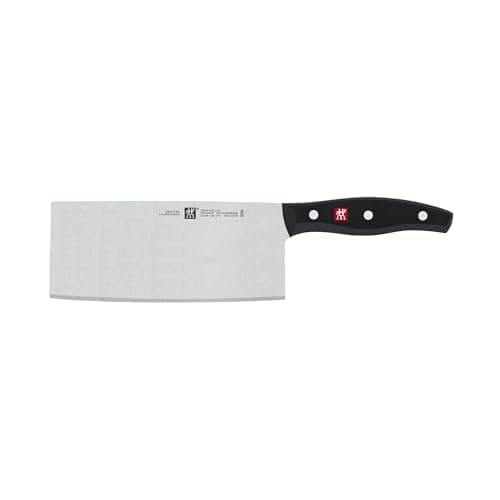
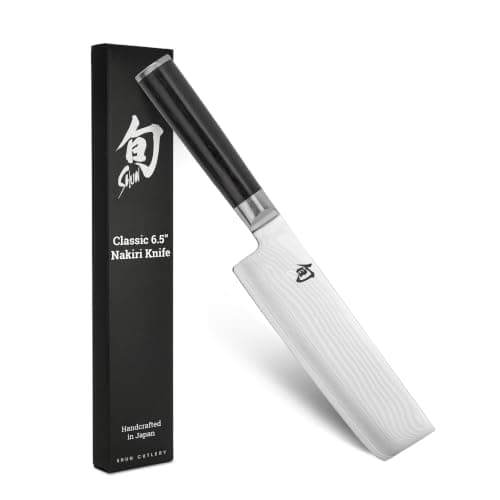
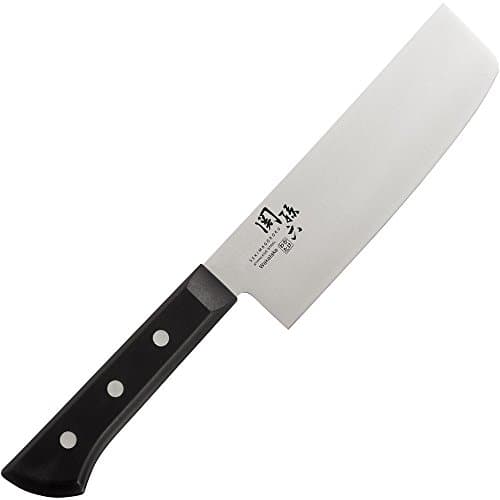
Buy the Kai Seki Magoroku 165mm nakiri. It is the cheapest knife on this page and it wins because the shape is right. If you chop vegetables most days and you want one knife for it, a tall flat blade with thin stock behind the edge is the tool — not a curved chef's knife, which is a generalist that happens to be the default recommendation everywhere. The nakiri above is for anyone doing volume vegetable prep in a home kitchen. If you want one knife for everything including meat and a chicken, skip to the Victorinox 8-inch further down and accept a worse vegetable knife.
Three properties decide whether a knife is good on vegetables, and none of them is the brand. Thin behind the edge means the blade parts a dense carrot instead of wedging and cracking it. A flat edgemeans the whole cutting edge lands on the board at once in a push cut, so nothing is left joined at the end of the stroke — the thing that makes a curved chef's knife feel like hard work on a pile of celery. Blade height buys knuckle clearance, which is what lets you keep your hand on the board and the blade moving. Everything below is scored on those mechanisms plus the two that decide whether the knife is still good in a year: how easily it comes back to sharp, and what it cost. We work from published specifications and the value math, exactly as how we review sets out. We have not cooked with these knives and we do not have a test lab.
Why this page ranks differently from our nakiri roundup
Our nakiri roundup judges nakiris against nakiris, and there the Shun Classic wins outright: it has the hardest steel, the thinnest grind and the keenest published angle in the category. On this page the Shun finishes fifth. Nothing changed about the knife — the rubric changed. This page spans four blade shapes, so it re-scores every pick on one set of five metrics that apply to all of them, and two of those five are maintenance and value. A 60-61 HRC Japanese blade that chips on a hard board and needs a stone rather than a rod loses points that it simply is not asked about in a field of its peers. If what you want is the best vegetable blade regardless of price or upkeep, buy the Shun and read the nakiri roundup instead. If you want the best vegetable knife to own, read on.
What actually makes a knife good on vegetables
Thinness behind the edge, not sharpness. Sharpness is the first thousandth of an inch; thinness is the next tenth. A thick blade can be razor sharp and still crack a carrot, because once the edge is through, the shoulders of the blade have to push the two halves apart. This is why a cheap thin Japanese knife outcuts an expensive thick German one on a parsnip and loses to it on a chicken joint. It is also why blade grind tells you more than the price does.
A flat edge, so the push cut works.Push cutting is the efficient motion for vegetables: the blade goes forward and down, through the food, onto the board, with no wrist rotation. It only works if the edge is flat enough to land along its length. The curve on a chef's knife exists to support a rocking motion, which is excellent on herbs and wasteful on a board of dice. How to hold a chef's knife covers the grip that makes either motion safe.
Height, for knuckles and for scooping. A 50mm-tall blade keeps your guiding hand clear of the edge on a full board, and a tall blade carries what you have cut. This is the entire reason a Chinese vegetable cleaver exists and most of the reason people who switch to one do not switch back.
The two things that are not on this page
A board that does not slide.Every one of these knives is more dangerous on a board that moves, and a sliding board makes you grip harder and cut worse. Wood or soft composite, large enough to hold a board's worth of prep — our cutting board guide ranks them, and a hard board is also the single biggest cause of chipped Japanese edges.
A honing rod.On vegetables a dull knife does not fail dramatically, it just quietly asks for more force and bruises what it cuts. Ten seconds on a rod before you start is the whole maintenance routine for four of the five picks here — how to use a honing steel has the method and honing rodsranks the field. The Shun is the exception: hard Japanese steel wants a stone, which is why it loses this page's maintenance metric.
Vegetables in volume are a different problem from vegetables at dinner. If you batch-cook, best knives for meal prep ranks the same shapes on stamina and grip security instead of on cutting alone, and makes the case for a two-knife setup.
How we picked
We did not lab-test these knives
Everyone in this category says they tested twenty knives in a professional kitchen. We have not hands-on tested any of these, and we say so. What we did instead: compiled the published specifications — steel type and hardness (HRC), edge angle, blade geometry, weight and build — applied established sharpening standards, ran the value math (spec quality ÷ live price), and scored each product against a published rubric. The scores are judgments from documented research — not measurements we took, because we do not have a test lab and we will not pretend we do. Where a number came from someone else's work, we name them in Sources.