
Skip to content
The Edge Bench

Decision guides · Buying Guides

The best knife for cutting tomatoes, ranked

A tomato is a slick skin over soft flesh, which is the one combination that exposes a dull edge instantly. Four picks ranked - plus the honest answer, which is cheaper than any of them.

By Stephen V.Updated How we review
#ad

We earn a commission when you buy through our Amazon links, at no extra cost to you. It never changes a verdict, and we say so when the cheaper knife is the better buy. How this works.

Buy the Victorinox Swiss Classic tomato and table knife. It costs about fourteen dollars and it is the right answer for most kitchens. A tomato is the test that exposes a dull edge: a taut slick skin over flesh with no structure, so a blunt blade skates across the surface and then crushes through. A wavy edge bites that skin regardless of how well maintained it is, which is exactly why a cheap serrated knife beats an expensive dull one. This page is for anyone whose tomatoes come out squashed. If your knives are genuinely sharp, read the last section first — you may not need to buy anything.

The honest version of this recommendation, before the ranking: a sharp knife cuts a tomato perfectly.Serrations are a workaround for an edge that is not keen, and they come with a real cost — they cannot be honed, they are awkward to sharpen, and they leave a slightly ragged cut face. If you own a honing rod and use it, the best tomato knife in your house is the chef's knife you already have. If you do not, a serrated blade removes the problem permanently for the price of a sandwich, and there is no shame in that. Both answers are ranked below, scored on the same five metrics: how reliably the edge bites skin, the quality of the cut face, control on a small round object, how maintainable the edge is, and value. We work from published specifications and the value math — see how we review. We have not cooked with these knives and we have no test lab.

The short answer

Quick picks

#KnifeBest forScorePrice
01
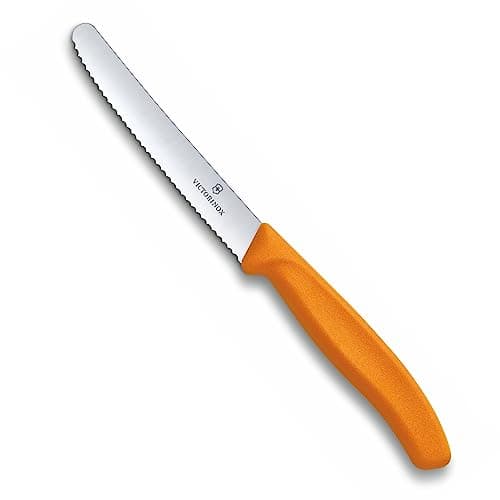
Victorinox Victorinox Swiss Classic Tomato and Table Knife (6.7836)
Victorinox Swiss Classic Tomato and Table Knife (6.7836)

The overall pick, and Victorinox named it after the job. A 4.3-inch wavy edge on a one-ounce handle, Swiss made, dishwasher safe and covered by the lifetime warranty. It bites tomato skin without crushing what is under it, and it costs so little that keeping one in the drawer purely for tomatoes, peppers and rolls is not a decision you have to think about.

Best overall
8.8
$13.82Amazon
02
Victorinox Victorinox Swiss Classic 3.25" Serrated Paring Knife
Victorinox Swiss Classic 3.25" Serrated Paring Knife

The pick for cherry tomatoes and in-hand work. The same Swiss steel and grippy handle as the winner on a shorter 3.25-inch serrated blade, which trades reach for precision - the right call if what defeats you is halving a punnet of cherry tomatoes rather than slicing beefsteaks.

Best for cherry tomatoes and in-hand cuts
8.7
$11.00Amazon
03
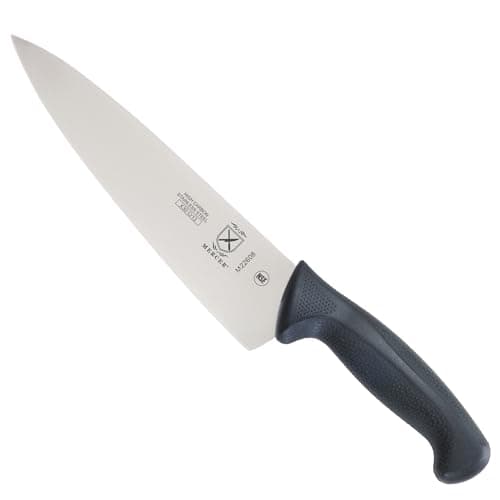
Mercer Culinary Mercer Culinary Millennia 8"
Mercer Culinary Millennia 8"

The honest answer if you will keep it sharp. Stamped Japanese steel at around 56 HRC on a Santoprene grip, NSF certified, and the cheapest proper chef's knife we rank - a keen straight edge slices a ripe tomato with no tearing at all, which no serrated blade can do. The catch is in the first four words.

Best cut face, if you hone
8.3
$30.98Amazon
04
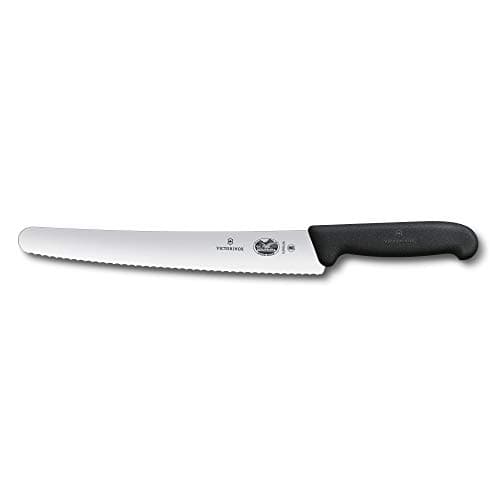
Victorinox Victorinox Fibrox 10.25" Serrated Bread Knife
Victorinox Fibrox 10.25" Serrated Bread Knife

The pick if you already own one, and the one to buy if you also want it for bread and melons. Ten and a quarter inches of Swiss serrated blade crosses the largest beefsteak tomato in a single pull with no pressure at all - it is overkill for a tomato and it is the best overkill available.

Best for big tomatoes (and everything else)
7.8
$55.75Amazon

#ad · Live prices from the Amazon Product API, as of October 17, 2026. Where we have no verified live price, we show none — a gap beats a number that has rotted.

In detail

The picks, in full

01
Victorinox Victorinox Swiss Classic Tomato and Table Knife (6.7836)

Best overall

Victorinox Swiss Classic Tomato and Table Knife (6.7836)

4.3 in wavy edge1 ozSwiss madeDishwasher safe
8.8/10

The overall pick, and Victorinox named it after the job. A 4.3-inch wavy edge on a one-ounce handle, Swiss made, dishwasher safe and covered by the lifetime warranty. It bites tomato skin without crushing what is under it, and it costs so little that keeping one in the drawer purely for tomatoes, peppers and rolls is not a decision you have to think about.

Skin bite
9.5
Cut-face quality
7.5
Control on a round object
9
Edge maintenance
8
Value
10

Pros

  • The wavy edge bites slick skin without pressure, which is the whole problem solved
  • Short blade and round tip make it easy to steer around a small round object
  • One ounce: it is the only knife here that is pleasant to use one-handed over a bowl
  • Dishwasher safe per Victorinox, so it survives the way cheap knives are actually treated
  • Swiss made with a lifetime warranty at a price that makes replacement a non-event

Cons

  • A wavy edge cannot be honed and is a nuisance to sharpen - in practice you replace it
  • The round tip removes piercing and detail work entirely
  • Victorinox publishes no steel designation or hardness for it, so the geometry is less verifiable than the forged knives elsewhere on this site
  • Leaves a slightly ragged cut face compared with a keen straight edge

Don't buy this if…

…you want one knife for board work generally - this is a soft-skin and table knife, and it is clumsy at everything else.

Re-scored on this page's rubric; it also wins our utility knife roundup, which judges it against pointed utility knives. It leads here on the two metrics that decide a tomato — skin bite and control — and on value, which nothing else can touch. Cut-face quality is 7.5 rather than higher because serrations tear rather than slice; on a tomato going into a salad nobody will notice, and on a carpaccio-thin slice for a sandwich you will.

One caution we would give anyone buying this knife: it is a tableknife too, round-tipped and light, so it tends to live loose in a drawer. Serrated edges survive that better than straight ones, but drawer contact is still the main way knives go dull — see knife storage.

$13.82View on Amazon

Price as of October 17, 2026. Prices change — Amazon's at checkout is the one that counts.

#ad · we may earn a commission from this link to Victorinox Swiss Classic Tomato and Table Knife (6.7836)

02
Victorinox Victorinox Swiss Classic 3.25" Serrated Paring Knife

Best for cherry tomatoes and in-hand cuts

Victorinox Swiss Classic 3.25" Serrated Paring Knife

Stamped Swiss stainless3.25 in. serrated bladeMolded polypropylene handleWavy edge
8.7/10

The pick for cherry tomatoes and in-hand work. The same Swiss steel and grippy handle as the winner on a shorter 3.25-inch serrated blade, which trades reach for precision - the right call if what defeats you is halving a punnet of cherry tomatoes rather than slicing beefsteaks.

Skin bite
9.5
Cut-face quality
7
Control on a round object
9.5
Edge maintenance
8
Value
9.5

Pros

  • Bites tomato, pepper and citrus skin that defeats a straight edge, in a blade short enough to control in the hand
  • Serrations dull extremely slowly, so it stays useful for years with no maintenance at all
  • Grippy molded handle stays secure with wet, juicy fingers
  • Cheap enough that owning this and the straight-edge version still costs less than one mid-range paring knife

Cons

  • Too short to cross a large beefsteak tomato in one stroke
  • Serrated edges cannot practically be sharpened at home
  • Less precise than a straight edge for peeling and fine trimming
  • Leaves a ragged cut face on very ripe fruit

Don't buy this if…

…you want one tomato knife - the 4.3-inch winner above covers more sizes of tomato for about the same money.

Re-scored here rather than carried over from our paring knife roundup, where it is the dedicated serrated pick. It finishes a tenth behind the winner purely on reach — everything else about the two knives is close enough that choosing between them is a question of which tomatoes you cut most.

$11.00View on Amazon

Price as of October 17, 2026. Prices change — Amazon's at checkout is the one that counts.

#ad · we may earn a commission from this link to Victorinox Swiss Classic 3.25" Serrated Paring Knife

03
Mercer Culinary Mercer Culinary Millennia 8"

Best cut face, if you hone

Mercer Culinary Millennia 8"

Stamped Japanese steel~56 HRCSantoprene gripNSF certified
8.3/10

The honest answer if you will keep it sharp. Stamped Japanese steel at around 56 HRC on a Santoprene grip, NSF certified, and the cheapest proper chef's knife we rank - a keen straight edge slices a ripe tomato with no tearing at all, which no serrated blade can do. The catch is in the first four words.

Skin bite
7
Cut-face quality
9.5
Control on a round object
7
Edge maintenance
8.5
Value
9.5

Pros

  • A sharp straight edge leaves a clean cut face, so slices hold their shape and do not weep
  • Long enough to cross any tomato in one stroke, which is what makes thin slices possible
  • Soft steel hones back in seconds with no technique, so the sharpness is genuinely achievable
  • It is a full chef's knife, so it is not a single-purpose purchase
  • NSF certified with a molded finger guard that suits newer cooks

Cons

  • Dull, it is the worst knife on this page - it skates on the skin and then crushes
  • Mercer's steel is soft, so honing is a habit rather than an occasional job
  • The molded finger guard gets in the way of a pinch grip for some cooks
  • Institutional styling even by budget standards

Don't buy this if…

…you do not own a honing rod and are not going to buy one - the serrated picks above exist precisely for that situation and they are better in it.

Re-scored on this page's rubric; our Millennia reviewjudges it as a general chef's knife. It is here to make a point rather than to pad the list: the best tomato cut in your kitchen comes from a sharp straight edge, and the knife that delivers it costs less than the serrated workarounds in total. Skin bite is 7 because that score is conditional on maintenance in a way the serrated scores are not — this is the one pick on the page whose rank depends on your habits.

If this is the route you want, how to tell if a knife needs sharpening has the tomato test itself, and how often to sharpen knives has the cadence for soft Western steel.

$30.98View on Amazon

Price as of October 17, 2026. Prices change — Amazon's at checkout is the one that counts.

#ad · we may earn a commission from this link to Mercer Culinary Millennia 8"

04
Victorinox Victorinox Fibrox 10.25" Serrated Bread Knife

Best for big tomatoes (and everything else)

Victorinox Fibrox 10.25" Serrated Bread Knife

Stamped Swiss stainless10.25 in. serrated bladeFibrox non-slip handleNSF certified
7.8/10

The pick if you already own one, and the one to buy if you also want it for bread and melons. Ten and a quarter inches of Swiss serrated blade crosses the largest beefsteak tomato in a single pull with no pressure at all - it is overkill for a tomato and it is the best overkill available.

Skin bite
9
Cut-face quality
7.5
Control on a round object
6.5
Edge maintenance
8
Value
8

Pros

  • Long enough to slice a beefsteak tomato in one draw, which is the cleanest serrated cut available
  • Fibrox handle grips reliably with wet or juicy hands
  • Does bread, melon and pineapple too, so it is not a single-purpose knife
  • Professional-kitchen durability at a home-kitchen price

Cons

  • Far too long for a cherry tomato or anything held in the hand
  • Needs real storage - it will not fit many drawers safely
  • Serrations cannot be honed and are awkward to sharpen
  • Costs about four times the winner to do the same job slightly differently

Don't buy this if…

…tomatoes are the reason you are buying - the 4.3-inch winner does the job in a fraction of the space for a fraction of the money.

Re-scored here; it wins our bread knife roundupon its own rubric. It finishes last on this page only because a tomato is a small object and ten inches of blade is a lot of lever for it. If you own one already, stop reading — you have a perfectly good tomato knife in the drawer.

$55.75View on Amazon

Price as of October 17, 2026. Prices change — Amazon's at checkout is the one that counts.

#ad · we may earn a commission from this link to Victorinox Fibrox 10.25" Serrated Bread Knife

Why a tomato is the knife test

Cutting anything has two phases: starting the cut and continuing it. On most food the start is easy — a carrot has a flat cut face, an onion has layers that catch. A tomato has neither. The skin is under tension and slippery, and the flesh behind it offers no resistance at all, so an edge that is not keen enough to initiate a cut has nothing to grip. It slides, you push, and the moment it does break through, the lack of support behind the skin means the blade crushes rather than slices.

That is why a tomato is the field test for a dull knife, and it is the test we point to in how to tell if a knife needs sharpening. It is also why the fix can come from either direction: make the edge keen enough to bite (sharpen it), or replace biting with sawing (serrate it). Both work. They produce different cuts.

Serrated or straight: the actual trade

A wavy or scalloped edge concentrates force on the tips of the scallops, so it punctures skin at a fraction of the pressure a straight edge needs, and it keeps working long after a straight edge has gone dull, because the points sit recessed and never touch the board. That is the whole case for it, and it is a strong one for a knife that lives in a drawer.

The costs are real too. A serrated edge tears a microscopically ragged face, which shows on thin slices and makes a tomato weep faster. It cannot be maintained with a honing rod, and sharpening one properly means a tapered rod and a scallop-by-scallop pass — see how to sharpen a serrated knife. In practice these knives are consumables. At fourteen dollars that is a sane trade; applied to a two-hundred-dollar bread knife it is less so. Serrated vs straight edge works through the full comparison.

The thing that matters more than which knife you buy

If your tomatoes are being crushed, the diagnosis is almost always a dull knife, not a wrong knife — and that same dullness is making every other cut in your kitchen worse without being as obvious about it. Ten seconds with a honing rod before you start is the whole routine for a soft Western blade (how to use a honing steel), and when honing stops reviving the edge it needs actual sharpening — how to sharpen kitchen knives has the method, beginner sharpening stones has the cheapest competent gear, and a local serviceis a legitimate answer that costs a few dollars a knife. Buy the serrated knife as well if you like — but if a tomato is defeating your chef's knife, the tomato is not the problem.

How we picked

We did not lab-test these knives

Everyone in this category says they tested twenty knives in a professional kitchen. We have not hands-on tested any of these, and we say so. What we did instead: compiled the published specifications — steel type and hardness (HRC), edge angle, blade geometry, weight and build — applied established sharpening standards, ran the value math (spec quality ÷ live price), and scored each product against a published rubric. The scores are judgments from documented research — not measurements we took, because we do not have a test lab and we will not pretend we do. Where a number came from someone else's work, we name them in Sources.

Questions

Frequently asked

What knife do you use to cut a tomato?
A short serrated knife — a tomato knife or a serrated paring knife — or any genuinely sharp straight-edged knife. The serrated version works regardless of upkeep, which is why it is the default recommendation; a keen straight edge gives a cleaner cut face if you keep your knives honed.
Is a serrated knife better for tomatoes?
Better if your knives are not reliably sharp, worse if they are. Serrations puncture the skin at low pressure and stay functional for years, but they tear the cut face slightly and cannot be honed. A sharp straight edge slices cleanly and needs maintaining.
Why does my knife squash tomatoes instead of slicing them?
It is dull. A tomato is the first thing a blunt edge fails at, because the skin is slick and the flesh gives no support. Hone it, sharpen it, or use a serrated blade. If it still crushes after honing, the edge needs real abrasive work — why is my knife still dull after sharpening covers the usual causes.
Can I sharpen a tomato knife?
Properly, only with a tapered rod worked through each scallop from the ground side, and on a fourteen-dollar knife that is rarely worth the time. Treat a cheap serrated knife as a consumable and replace it. How to sharpen a serrated knife has the method if the knife justifies it.
What about cherry tomatoes?
A 3.25-inch serrated paring knife, held in the hand or against a board — a long blade is unusable on something that small. A fork through the tomato to hold it steady is worth more than any knife upgrade here.
Will a tomato knife cut anything else?
Yes — peppers, citrus, crusty rolls, sausage and anything else with a tough skin over soft flesh. Victorinox calls this shape a tomato and table knife for exactly that reason. It is poor at board work and precision cuts, so it supplements a chef's knife rather than replacing one. Our utility knife roundup covers the category it really belongs to.

Keep reading

Receipts

Sources

We do not run a testing lab, and we do not pretend to. Where a spec or a measured number came from someone else's work — a manufacturer's page, a published standard — we name them and link them. Where we could not verify something, we say so on the page rather than quietly leaving it out. Read our full method.