Skip to content
The Edge Bench

Roundups & reviews · Chef Knives

The best serrated knives, ranked

Nothing you own can sharpen a serrated edge properly - which changes what a good one is. Judge these on tooth geometry and on what replacing them costs, not on steel.

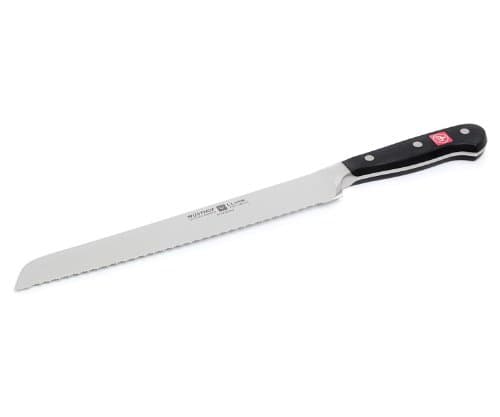
Wusthof Wusthof Classic 9" Double Serrated Bread Knife

Our top pick · Sourdough crust and twenty years of it

Wusthof Classic 9" Double Serrated Bread Knife

8.2

The best serrated knife and the one that stays good longest. Forged X50CrMoV15 at a published 58 HRC with a double-serrated edge - two scales of scallop, the larger ones breaking a crust and the smaller ones continuing the cut - plus a full tang and Solingen manufacture. The only knife here you buy expecting to keep.

$150.00Amazon

#ad · Full ranking below

By Stephen V.Updated How we review
#ad

We earn a commission when you buy through our Amazon links, at no extra cost to you. It never changes a verdict, and we say so when the cheaper knife is the better buy. How this works.

The Wusthof Classic 9-inch double-serrated bread knife is the best serrated knife, and it is for someone who bakes and wants one knife to last twenty years. Forged X50CrMoV15 at a published 58 HRC, full tang, and a double-serrated edge — two sizes of scallop working together — which keeps cutting cleanly for longer than a single-scallop edge does. The budget pick is the Mercer Millennia 10-inch wide wavy edge bread knife, and it finishes second on this page at roughly a tenth of the price.

That result is the most useful thing here, so we will state it before the rankings rather than bury it. A serrated edge is the one edge in your kitchen that you cannot properly maintain at home. No honing rod, pull-through or bench stone reaches into the scallops the way it reaches a straight bevel. A serrated knife is therefore a consumable in a way a chef's knife is not — which means value carries far more weight on this page than steel does, and a sixteen-dollar stamped bread knife is a genuinely strong buy.

We do not print a price in the prose. The Quick Picks table carries the live price and the date we pulled it, with a Check price button on every row.

Why this page is not another bread-knife roundup

The autocomplete cluster for this query is wider than bread: "best serrated knife for bread" sits fourth, but "best serrated knife set" is third, "for vegetables" sixth, "for tomatoes" ninth and "for sourdough" tenth. People searching for a serrated knife are not all buying a bread knife, and the registry holds serrated blades in five different jobs.

So this page spans them: long bread knives, a short serrated utility knife, a tomato and table knife, a serrated paring knife and a set of micro-serrated steak knives. If bread specifically is the job, best bread knives is the narrower page and ranks only that shape.

The four tooth geometries, and what each is for

This is the organizing fact of the page. "Serrated" covers several genuinely different edges and they are not interchangeable.

Wavy, or scalloped. Shallow rounded scallops, usually ground on one side only. The common bread-knife edge. Rounded scallops present a series of curved cutting surfaces that bite into a crust without crushing the crumb, and because the scallops are relatively large, a tapered rod can actually reach some of them.

Double-serrated.Two scales of scallop on the same edge — larger ones to grip and break a crust, smaller ones along them to continue the cut. More engineering than a plain wavy edge, and the reason the top pick keeps working after the cheaper knives have gone glassy.

Pointed, or tooth-type. Sharp triangular points rather than curves. Grips aggressively, tears more, and is the usual edge on cheap serrated steak knives.

Micro-serrated.Very small teeth, close together. Cuts almost like a straight edge, grips skin and sinew better than one, and is completely beyond home sharpening — the teeth are smaller than anything you can get an abrasive into.

Serrated vs straight edge knives covers why serrations work at all, and how to sharpen a serrated knife is the honest account of what can and cannot be done about a dull one.

How we ranked them

Five metrics, the same five across all seven picks, and they are judgments from published specifications rather than lab measurements — how we review says so. Cutting performance is how well it does its job. Tooth geometry is how well-designed the edge is for that job. Build is construction and durability. Maintainabilityis whether anything can be done when it dulls — and almost nothing here scores well, which is the point. Value is what it costs against how long it will last.

The short answer

Quick picks

#KnifeBest forScorePrice
01
Wusthof Wusthof Classic 9" Double Serrated Bread Knife
Wusthof Classic 9" Double Serrated Bread Knife

The best serrated knife and the one that stays good longest. Forged X50CrMoV15 at a published 58 HRC with a double-serrated edge - two scales of scallop, the larger ones breaking a crust and the smaller ones continuing the cut - plus a full tang and Solingen manufacture. The only knife here you buy expecting to keep.

Sourdough crust and twenty years of it
8.2
$150.00Amazon
02
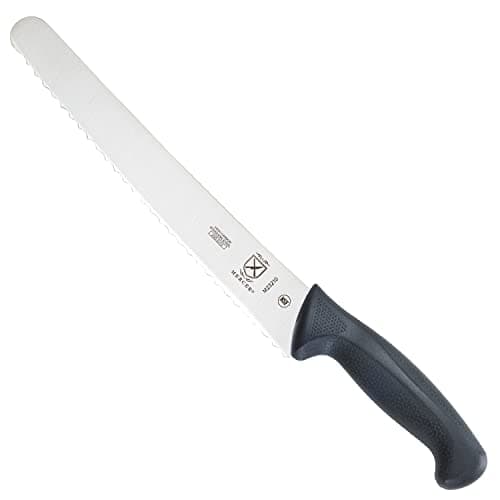
Mercer Culinary Mercer Culinary Millennia 10" Wide Wavy Edge Bread Knife
Mercer Culinary Millennia 10" Wide Wavy Edge Bread Knife

The budget pick, second place, and the most sensible purchase on this page. A stamped high-carbon Japanese steel blade with a wide wavy edge, a Santoprene grip and NSF certification - a professional-kitchen bread knife at a price that makes replacing it in five years a non-event.

Budget pick and the honest default
8.1
$16.15Amazon
03
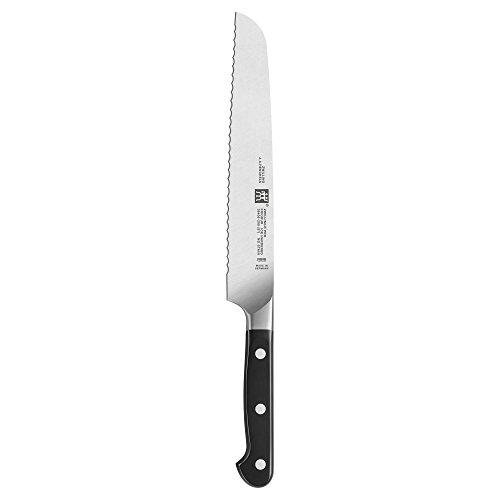
Zwilling Zwilling Pro 8" Bread Knife
Zwilling Pro 8" Bread Knife

The forged German bread knife for a kitchen that already owns Zwilling, and the best-built serrated knife here after the Wusthof. Forged as a single piece in Germany with FRIODUR ice-hardening at a published 55-58 HRC, a curved bolster and an exposed full tang - and a conventional single-scallop serration rather than Wusthof's double.

Matching a forged German block
7.6
$103.95Amazon
04
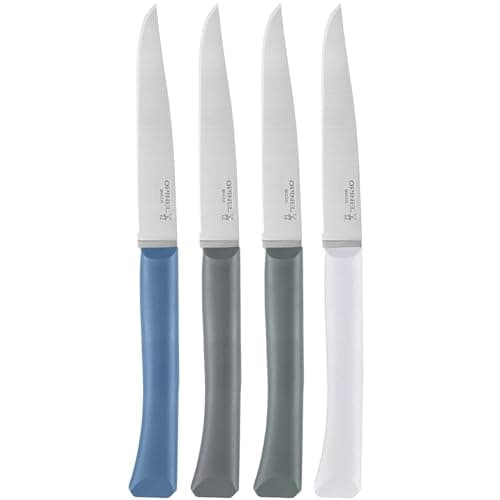
Opinel Opinel Bon Appetit+ Serrated Steak Knives, Set of 4
Opinel Bon Appetit+ Serrated Steak Knives, Set of 4

The answer to the 'best serrated knife set' query, and a genuinely good use of micro-serration. Four 4-inch micro-serrated blades in Sandvik 12C27 Mod stainless with polymer handles, dishwasher rated - small teeth that cut meat cleanly rather than shredding it, and never need sharpening because they cannot be sharpened.

A serrated set for the table
7.3
$72.00Amazon
05
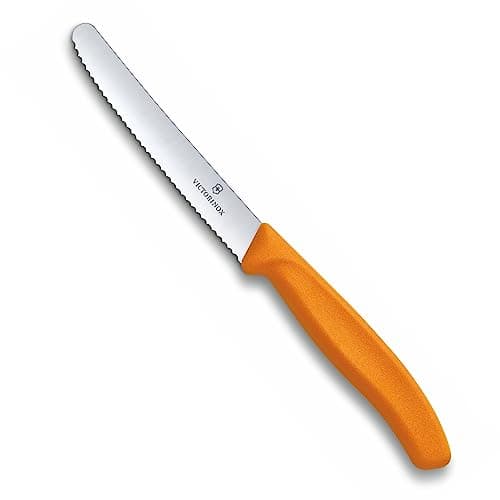
Victorinox Victorinox Swiss Classic Tomato and Table Knife (6.7836)
Victorinox Swiss Classic Tomato and Table Knife (6.7836)

The answer to the 'best serrated knife for tomatoes' variant, and the cheapest genuinely useful knife on this page. A 4.3-inch wavy edge weighing one ounce, Swiss made and dishwasher safe - it goes through tomato skin, citrus peel and bread rolls without pressure, and it costs almost nothing.

Tomatoes, citrus and everything a paring knife slips off
7.8
$12.99Amazon
06
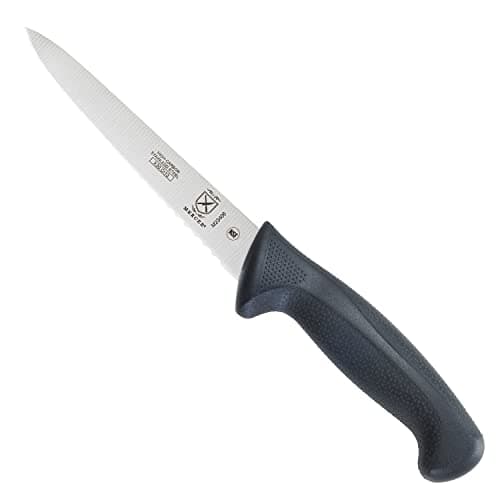
Mercer Culinary Mercer Culinary Millennia 6" Wavy Edge Utility Knife
Mercer Culinary Millennia 6" Wavy Edge Utility Knife

The mid-size serrated knife most kitchens are actually missing - longer than a tomato knife, shorter than a bread knife. A 6-inch wavy edge at a published 53-54 HRC with a stated 15-degree edge and NSF certification, for sandwich rolls, bagels, melons and anything a paring knife is too small for.

Rolls, bagels and melon
7.5
$14.99Amazon
07
Victorinox Victorinox Swiss Classic 3.25" Serrated Paring Knife
Victorinox Swiss Classic 3.25" Serrated Paring Knife

The smallest serrated edge worth owning, and the one to keep in the fruit bowl. A 3.25-inch stamped Swiss blade with a wavy edge and a molded polypropylene handle - it tops and tails anything with a tough skin, and it costs so little that losing one is not an event.

Fruit, soft skins and small jobs
7.3
$10.50Amazon

#ad · Live prices from the Amazon Product API, as of November 23, 2026. Where we have no verified live price, we show none — a gap beats a number that has rotted.

In detail

The picks, in full

01
Wusthof Wusthof Classic 9" Double Serrated Bread Knife

Sourdough crust and twenty years of it

Wusthof Classic 9" Double Serrated Bread Knife

Forged X50CrMoV15~58 HRCDouble-serrated edgeFull tang, riveted handle
8.2/10

The best serrated knife and the one that stays good longest. Forged X50CrMoV15 at a published 58 HRC with a double-serrated edge - two scales of scallop, the larger ones breaking a crust and the smaller ones continuing the cut - plus a full tang and Solingen manufacture. The only knife here you buy expecting to keep.

Cutting performance
9.5
Tooth geometry
9.5
Build
9.5
Maintainability
5.5
Value
7

Pros

  • Double serration is real engineering, not a marketing word - two scallop scales means the edge keeps cutting after a single-scallop edge has gone smooth
  • Published 58 HRC on a forged Solingen blade is the hardest, best-specified steel on this page by a clear margin
  • Full tang and riveted construction, so the handle will outlast the useful life of the teeth
  • 9 inches handles a large sourdough loaf in one stroke without sawing
  • The one pick here worth the effort of professional serration service rather than replacement

Cons

  • Costs roughly ten times the Mercer below, which scores only three tenths lower
  • Double serration is harder for any rod to reach than a plain wavy edge, so home maintenance is effectively out
  • Heavy for a bread knife, which some cooks dislike on a long slicing stroke
  • Overkill for anyone who buys sliced bread and wants the knife for tomatoes

Don't buy this if…

…you slice bread twice a week - a serrated edge is a consumable, and the Mercer below does 95 per cent of this job for a tenth of the money.

It wins on cutting performance, tooth geometry and build, and it is beaten on value by a knife that costs a tenth as much. That is the honest shape of this category and we would rather show it than hide it.

What the money buys is duration. Every serrated edge eventually goes smooth at the tips of its teeth, and when it does, the knife stops biting and starts sliding. A double-serrated edge has more cutting geometry to lose before that happens, and a 58 HRC forged blade holds its tips longer than a stamped 53–54 HRC one. If you bake, this is the knife that is still good in a decade.

It is also the only knife here where professional serration sharpening is worth paying for rather than simply replacing the knife — local knife sharpening services covers who does that work. For everything else on this page, replacement is cheaper than service.

$150.00View on Amazon

Price as of November 23, 2026. Prices change — Amazon's at checkout is the one that counts.

#ad · we may earn a commission from this link to Wusthof Classic 9" Double Serrated Bread Knife

02
Mercer Culinary Mercer Culinary Millennia 10" Wide Wavy Edge Bread Knife

Budget pick and the honest default

Mercer Culinary Millennia 10" Wide Wavy Edge Bread Knife

Stamped high-carbon Japanese steel10 in. wide wavy edgeSantoprene textured grip, finger guardNSF certified
8.1/10

The budget pick, second place, and the most sensible purchase on this page. A stamped high-carbon Japanese steel blade with a wide wavy edge, a Santoprene grip and NSF certification - a professional-kitchen bread knife at a price that makes replacing it in five years a non-event.

Cutting performance
8.5
Tooth geometry
8.5
Build
7
Maintainability
7
Value
9.5

Pros

  • Scores three tenths below a knife costing roughly ten times as much, which is the entire argument for buying it
  • A wide wavy edge is the right geometry for bread and the large scallops are the easiest here for a tapered rod to reach
  • 10 inches is long enough for any domestic loaf
  • NSF certification and a Santoprene wet-grip handle - specified for commercial kitchens, not for a gift box
  • Cheap enough that a serrated edge being a consumable simply stops mattering

Cons

  • Stamped and thin - it flexes on a hard crust in a way the forged Wusthof does not
  • Published hardness for the Millennia line sits below the forged German knives here, so the tooth tips go smooth sooner
  • Plain plastic looks and feels like catering equipment, because that is what it is
  • No bolster and a light blade, so it does less of the work for you on a dense loaf

Don't buy this if…

…you want one knife that lasts decades and you bake weekly - the Wusthof above is the knife for that, and it is the only pick here that justifies the word 'investment'.

Second on the rubric, highest value score on the page, and the knife we expect most readers should actually buy. The logic is specific to serrated edges: if the edge cannot be properly restored at home, then the right question is not "which lasts longest" but "which costs least per useful year", and a stamped commercial bread knife wins that comfortably.

The wide wavy edge is also the most serviceable geometry here. Its scallops are large enough that a tapered diamond rod can touch the inside of each one, which is as close as home serrated maintenance gets to working. It will not restore the knife to new, but it buys months.

It is already ranked second on best bread knives and appears on best Mercer knives, so this is a consistent verdict rather than a new enthusiasm.

$16.15View on Amazon

Price as of November 23, 2026. Prices change — Amazon's at checkout is the one that counts.

#ad · we may earn a commission from this link to Mercer Culinary Millennia 10" Wide Wavy Edge Bread Knife

03
Zwilling Zwilling Pro 8" Bread Knife

Matching a forged German block

Zwilling Pro 8" Bread Knife

Forged single piece, GermanyFRIODUR ice-hardened, 55-58 HRCSerrated edgeCurved bolster, exposed full tang
7.6/10

The forged German bread knife for a kitchen that already owns Zwilling, and the best-built serrated knife here after the Wusthof. Forged as a single piece in Germany with FRIODUR ice-hardening at a published 55-58 HRC, a curved bolster and an exposed full tang - and a conventional single-scallop serration rather than Wusthof's double.

Cutting performance
8.5
Tooth geometry
7.5
Build
9.5
Maintainability
5.5
Value
7

Pros

  • Forged in a single piece in Germany with a specified ice-hardening process - the best-documented manufacture here alongside the Wusthof
  • The curved bolster is the detail Zwilling gets right: it does not block the heel of the edge the way a full bolster does
  • Exposed full tang and a published 55-58 HRC band
  • 8 inches suits a standard loaf and is more manageable than a 9 or 10 inch blade
  • Matches a Zwilling Pro block, which is a real reason people buy a specific bread knife

Cons

  • Single-scallop serration rather than double, so it loses its bite sooner than the Wusthof for a similar outlay
  • 8 inches is short for a large sourdough - a long loaf needs a sawing stroke
  • Costs several times the Mercer for a knife that cannot be maintained at home either
  • Published hardness band sits slightly below the Wusthof's stated 58 HRC

Don't buy this if…

…you are buying on merit rather than matching a set - the Wusthof is better-engineered at the edge and the Mercer is better value, and this sits between them.

Third, and the ranking tells a clear story: it matches the Wusthof on build and loses to it on the only thing that decides a serrated knife's working life, which is the edge geometry. A single scale of scallop has less cutting structure to lose than two.

What it does better than the Wusthof is the bolster. Zwilling's curved bolster sweeps away from the heel rather than squaring across it, which on a straight-edged knife means a stone can reach the whole bevel. On a serrated knife that is largely moot, but it is a genuinely better piece of design and full bolster vs half bolster explains why it matters on the rest of the line.

It is ranked fourth on best Zwilling knives, where the same point is made: a serrated edge you cannot maintain is the weakest link in an otherwise excellent forged line.

$103.95View on Amazon

Price as of November 23, 2026. Prices change — Amazon's at checkout is the one that counts.

#ad · we may earn a commission from this link to Zwilling Pro 8" Bread Knife

04
Opinel Opinel Bon Appetit+ Serrated Steak Knives, Set of 4

A serrated set for the table

Opinel Bon Appetit+ Serrated Steak Knives, Set of 4

4 in micro-serratedSandvik 12C27 ModPolymer handleDishwasher safe
7.3/10

The answer to the 'best serrated knife set' query, and a genuinely good use of micro-serration. Four 4-inch micro-serrated blades in Sandvik 12C27 Mod stainless with polymer handles, dishwasher rated - small teeth that cut meat cleanly rather than shredding it, and never need sharpening because they cannot be sharpened.

Cutting performance
8
Tooth geometry
8.5
Build
7.5
Maintainability
4
Value
8.5

Pros

  • Micro-serration is the right geometry for steak: it grips and slices rather than tearing the way pointed teeth do
  • Sandvik 12C27 Mod is a named, published steel, which is rare in a steak set at this price
  • Dishwasher rated, which is what actually happens to steak knives
  • A set of four at a per-knife price that makes them effectively disposable
  • Already ranked on our steak-knife pages, so this is a consistent verdict

Cons

  • Micro-serration is completely beyond home sharpening - the teeth are too small for any abrasive to enter
  • Polymer handles are functional and look it, next to a riveted wooden set
  • 4-inch blades are short for a large steak, so it is a sawing job on a thick cut
  • Only useful for one task, where the bread knives above work on tomatoes, melons and cakes too

Don't buy this if…

…you want steak knives you can maintain - a straight-edged steak knife can be sharpened forever, and our steak roundup ranks those too.

Fourth, and the pick that answers the third-position autocomplete query directly. Its maintainability score of four is the lowest on the page and it is not a criticism of the knife — micro-serration simply cannot be sharpened at home, by anyone, ever. That is a design choice rather than a defect: the trade is an edge that stays acceptably sharp for years without any attention at all.

The reason micro-serration suits steak is worth stating. A pointed-tooth steak knife grips well and leaves a ragged cut surface, which on a rested steak means visibly more juice on the plate. Small, closely spaced teeth cut nearer to the way a straight edge does while still gripping a seared crust.

It is ranked on both best steak knives and best steak knife sets under $100, which are the right pages if a steak set specifically is what you came for.

$72.00View on Amazon

Price as of November 23, 2026. Prices change — Amazon's at checkout is the one that counts.

#ad · we may earn a commission from this link to Opinel Bon Appetit+ Serrated Steak Knives, Set of 4

05
Victorinox Victorinox Swiss Classic Tomato and Table Knife (6.7836)

Tomatoes, citrus and everything a paring knife slips off

Victorinox Swiss Classic Tomato and Table Knife (6.7836)

4.3 in wavy edge1 ozSwiss madeDishwasher safe
7.8/10

The answer to the 'best serrated knife for tomatoes' variant, and the cheapest genuinely useful knife on this page. A 4.3-inch wavy edge weighing one ounce, Swiss made and dishwasher safe - it goes through tomato skin, citrus peel and bread rolls without pressure, and it costs almost nothing.

Cutting performance
8.5
Tooth geometry
8
Build
7
Maintainability
6
Value
9.5

Pros

  • A wavy edge is the correct answer to tomato skin, which a straight paring knife slides across until it bursts
  • One ounce - so light that it is the knife people reach for without thinking
  • Published Swiss manufacture and a dishwasher rating at a price that is almost incidental
  • Doubles as a table knife for bread and cheese, which is what the model name says
  • Already ranked first on our utility-knife roundup

Cons

  • 4.3 inches limits it to small work - it is not a substitute for any bread knife here
  • Stamped, light and plain: nothing about it feels special in the hand
  • Small scallops are harder to maintain than the large ones on a bread knife
  • A single-purpose shape, strictly speaking, even if that purpose comes up daily

Don't buy this if…

…you were looking for one serrated knife to do everything - this does small work beautifully and large work not at all.

Fifth on the rubric and one of the two knives on this page we would tell nearly anyone to own, the other being the Mercer bread knife. Between them they cover the whole serrated requirement of a normal kitchen for less than a restaurant lunch.

The specific thing it solves is a real and common annoyance. A tomato's skin is under tension and slick; a straight paring edge needs either real sharpness or real pressure to break it, and pressure crushes the fruit. A small wavy edge catches the skin immediately. Same mechanism on citrus peel and on a crusty roll.

It is ranked first on best utility knives and it appears on best knife for cutting tomatoes, which is the narrower page for that job.

$12.99View on Amazon

$13.826% off

Price as of November 23, 2026. Prices change — Amazon's at checkout is the one that counts.

#ad · we may earn a commission from this link to Victorinox Swiss Classic Tomato and Table Knife (6.7836)

06
Mercer Culinary Mercer Culinary Millennia 6" Wavy Edge Utility Knife

Rolls, bagels and melon

Mercer Culinary Millennia 6" Wavy Edge Utility Knife

6 in wavy edgeHRC 53-5415 degree edgeNSF certified
7.5/10

The mid-size serrated knife most kitchens are actually missing - longer than a tomato knife, shorter than a bread knife. A 6-inch wavy edge at a published 53-54 HRC with a stated 15-degree edge and NSF certification, for sandwich rolls, bagels, melons and anything a paring knife is too small for.

Cutting performance
8
Tooth geometry
7.5
Build
6.5
Maintainability
6.5
Value
9

Pros

  • 6 inches is the genuinely useful gap between a 4-inch tomato knife and a 10-inch bread knife
  • Mercer publishes both a hardness figure and a 15-degree edge angle for this knife, which almost nothing else serrated here does
  • NSF certified with a Santoprene wet grip, specified for commercial work
  • Handles bagels and crusty rolls, which is where most home serrated knives are actually used
  • Cheap enough to be replaced without thought when the teeth go

Cons

  • A published 53-54 HRC is the softest steel on this page, so the tooth tips round off sooner
  • Stamped and thin, with noticeable flex
  • Too short for a loaf, so it does not replace a bread knife
  • Plain plastic handle and catering-equipment looks

Don't buy this if…

…you already own a long bread knife and a tomato knife - this sits between two knives you have, and the gap is smaller than it sounds.

Sixth, and the most interesting pick on the page from a specification point of view, because Mercer publishes figures the German makers do not. A stated 53–54 HRC and a stated 15-degree edge angle let us score this knife on numbers rather than on impressions, and the numbers are honest about what it is: a soft, thin, inexpensive blade with a keen factory grind.

On a serrated knife, a soft steel matters less than it would on a chef's knife. Serrations work by concentrating force on tooth tips, and a serrated blade stays usable long after a straight edge in the same steel would feel blunt. That is most of why cheap serrated knives are a reasonable buy and cheap straight-edged knives often are not.

The job it does is the one people forget to buy for. A 6-inch wavy edge is the right knife for a sandwich roll, a bagel or a melon — all things a paring knife is too small for and a bread knife is clumsy at.

$14.99View on Amazon

$15.996% off

Price as of November 23, 2026. Prices change — Amazon's at checkout is the one that counts.

#ad · we may earn a commission from this link to Mercer Culinary Millennia 6" Wavy Edge Utility Knife

07
Victorinox Victorinox Swiss Classic 3.25" Serrated Paring Knife

Fruit, soft skins and small jobs

Victorinox Swiss Classic 3.25" Serrated Paring Knife

Stamped Swiss stainless3.25 in. serrated bladeMolded polypropylene handleWavy edge
7.3/10

The smallest serrated edge worth owning, and the one to keep in the fruit bowl. A 3.25-inch stamped Swiss blade with a wavy edge and a molded polypropylene handle - it tops and tails anything with a tough skin, and it costs so little that losing one is not an event.

Cutting performance
7.5
Tooth geometry
7.5
Build
7
Maintainability
5.5
Value
9

Pros

  • A serrated paring knife beats a straight one on anything with a skin under tension - peppers, tomatoes, citrus
  • Small, light and cheap enough to own several, which is how paring knives are actually used
  • Published Swiss manufacture
  • Dishwasher tolerant in practice, which no wooden-handled paring knife is
  • Already ranked on our paring-knife roundup

Cons

  • Lowest score on this page - a 3.25-inch serrated blade does the smallest job here
  • Small scallops are effectively unmaintainable at home
  • A serrated paring knife cannot peel neatly or do fine tip work, which a straight one can
  • Stamped, plain and entirely unremarkable in the hand

Don't buy this if…

…you want one paring knife - buy a straight-edged one, because it peels and does tip work, and add this later for tough skins.

Last, and the reason it is here rather than omitted is that the autocomplete cluster asks about vegetables and tomatoes, and a serrated paring knife is the cheapest correct answer to both. It loses to the 4.3-inch tomato and table knife above on nearly every count, which is the honest comparison.

The one thing it does better is tip work on small produce: a 3.25-inch blade is more controllable in the fingers than a 4.3-inch one when you are coring a tomato or de-seeding a chilli.

A note on where it should not go. A serrated edge cannot peel — it drags and tears rather than gliding under the skin — so if you own only one small knife, it should be a straight-edged paring knife. Best paring knives ranks those.

$10.50View on Amazon

$11.005% off

Price as of November 23, 2026. Prices change — Amazon's at checkout is the one that counts.

#ad · we may earn a commission from this link to Victorinox Swiss Classic 3.25" Serrated Paring Knife

Which serrated knife should you actually buy?

You bake, and you want one knife for twenty years. The Wusthof Classic 9-inch double-serrated. It is the only pick here whose edge geometry justifies the price.

You want the sensible answer. The Mercer Millennia 10-inch wide wavy, plus the Victorinox tomato and table knife. Two knives, a trivial amount of money, and the whole serrated requirement of a normal kitchen covered.

You want a serrated set for the table. The Opinel Bon Appetit+ four-piece.

You are matching a forged German block. The Zwilling Pro 8-inch.

You keep bursting tomatoes. The Victorinox tomato and table knife, and it will be the cheapest fix to an everyday annoyance you buy this year.

The uncomfortable truth about serrated edges

A straight-edged knife is a long-term relationship: sharpen it properly and it is as good at twenty years as at one. A serrated knife is not. Every scallop has a tip, those tips round over with use, and no tool in a domestic kitchen restores them properly. A tapered diamond rod can touch the inside of large scallops and buy you months. Micro-serration cannot be touched at all.

What follows from that is the whole logic of this page. Spend money on serrated knives only where the geometry buys duration, and buy cheap everywhere else. The Wusthof's double serration and 58 HRC steel buy duration. A forged single-scallop bread knife at three times the Mercer's price mostly does not.

How to sharpen a serrated knife is the full account, including the one technique that genuinely helps, and how long does a chef knife last puts the replacement cycle in context.

One mistake to avoid

Do not put a serrated knife through a pull-through sharpener or an electric slot. The abrasive contacts only the outermost points of the teeth and grinds them flat, which converts a serrated edge into a bad straight one. Some electrics are specified for serrated blades and will tidy them; nothing restores them. If a serrated knife has stopped cutting, the realistic options are professional serration service on the Wusthof, or replacement on everything else.
How we picked

We did not lab-test these knives

Everyone in this category says they tested twenty knives in a professional kitchen. We have not hands-on tested any of these, and we say so. What we did instead: compiled the published specifications — steel type and hardness (HRC), edge angle, blade geometry, weight and build — applied established sharpening standards, ran the value math (spec quality ÷ live price), and scored each product against a published rubric. The scores are judgments from documented research — not measurements we took, because we do not have a test lab and we will not pretend we do. Where a number came from someone else's work, we name them in Sources.

Questions

Frequently asked

Can you sharpen a serrated knife?
Partly, and only on some geometries. A tapered diamond rod can reach inside large scallops one at a time and restore some bite. Micro-serrated edges — the Opinel steak knives here, for example — cannot be sharpened at home at all, because the teeth are smaller than any abrasive you can get into them.
What is a double-serrated knife?
An edge with two scales of scallop working together: larger scallops to grip and break a crust, smaller ones along them to continue the cut. It is the reason the Wusthof Classic 9-inch keeps cutting cleanly after a single-scallop edge has gone smooth, and it is the main thing its price buys.
Is an expensive serrated knife worth it?
Only when the extra money buys edge geometry or steel hardness that extends the knife's working life, because a serrated edge cannot be restored at home. A double-serrated 58 HRC forged blade clears that bar. A forged single-scallop bread knife at three times a stamped one's price largely does not.
What is the best serrated knife for tomatoes?
The Victorinox Swiss Classic tomato and table knife. A short wavy edge catches skin under tension immediately, where a straight paring edge slides until it bursts the fruit.

Keep reading

Receipts

Sources

We do not run a testing lab, and we do not pretend to. Where a spec or a measured number came from someone else's work — a manufacturer's page, a published standard — we name them and link them. Where we could not verify something, we say so on the page rather than quietly leaving it out. Read our full method.