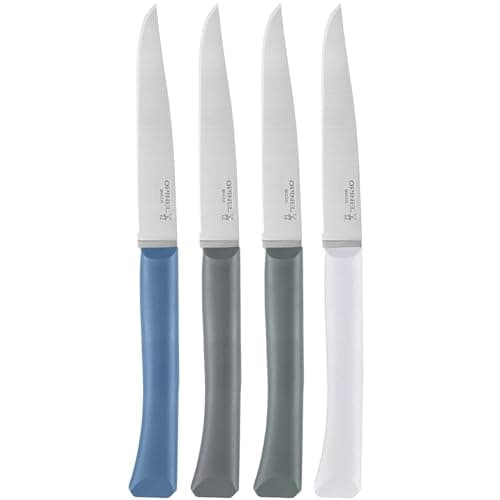
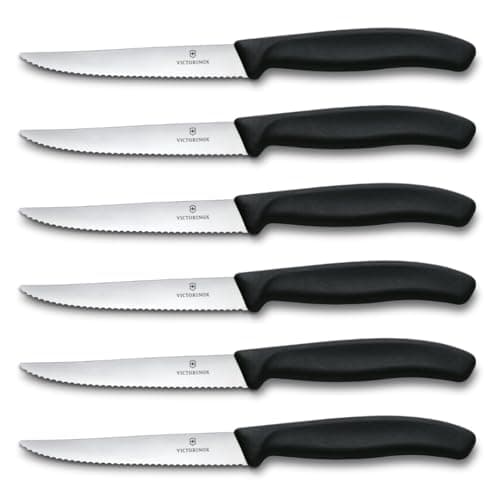
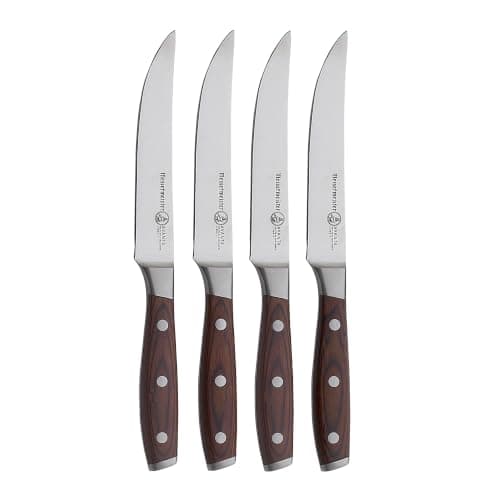
Buy the Messermeister Avanta Pakkawood 4-Piece — it is the best steak knife set under a hundred dollars, and it is for a table where the knives are part of the meal. Five-inch plain-edge blades in German X50 at a published 57 HRC, ground to 15 degrees, on full-tang pakkawood handles. It is the only set in the band that is genuinely sharpenable, and a plain edge slices a rested steak cleanly instead of tearing it. The budget pick is the Victorinox Swiss Classic 6-Piece— six serrated stamped blades with round tips and dishwasher-safe handles, the cheapest set here and the one that will still be working in ten years with no maintenance at all.
Every set here was in stock and inside the band at our last price check. We do not print a number in the prose: the Quick Picks table carries the live price and the date we pulled it, with a Check price button on every row.
The decision that matters in this category is plain edge or serrated, and almost nothing else. A serrated edge grips the crust of a seared steak and saws through it. It works immediately, it keeps working for a decade without being touched, it is effectively impossible to sharpen, and it tears the cut surface slightly, which on a well-rested steak is visible on the plate. A plain edge slices cleanly, looks right at a laid table, needs honing like any other knife, and goes dull if you ignore it. There is no third option and no set in this band is both.
The other thing worth knowing before you spend anything: steak knives are the filler in every block set. If you are tempted by a fifteen-piece block that includes eight of them, the eight are the cheapest items in the box and nobody would have chosen them on their own — see best knife sets under $200 for the arithmetic. Buying steak knives deliberately is why this page exists.
The method is on how we review: we have not hands-on tested these sets and we do not claim to have. The scores come from published specifications — edge type, blade length, steel family and hardness where stated, edge angle, tang and handle material — and from value arithmetic against the live price. Everything sits under the buying guides hub.
Plain edge or serrated: the whole decision
Serratedworks by gripping and sawing. The scallops concentrate force on small points, which is why a serrated blade bites through a seared crust with almost no pressure and why it keeps working for a decade untouched — the points wear slowly and the recesses never touch the plate. It is also why it tears: the cut surface of a steak sliced with a serrated knife is visibly rougher than one sliced with a plain edge, and on a properly rested piece of meat that difference shows on the plate.
Plain works by shearing, which is what a knife is supposed to do. The cut face is clean, the knife looks right at a laid table, and the edge can be honed and sharpened for as long as you own it. It also dulls, which means somebody has to maintain it. Serrated vs straight edge knives is the full mechanism.
Under a hundred dollars you get one plain-edge option and two serrated ones, so this is not a close-run comparison of similar things. Decide the edge first and the set follows.
Length, tip and tang
Length should be four to five inches. Longer than that and the knife is awkward on a plate; shorter and it will not cross a ribeye in one stroke.
Tip is worth a thought. A round tip is safer in a drawer and in a dishwasher basket and loses you nothing on a steak. A pointed tip is useful if the same knives double as table knives for other food.
Tangtells you whether you bought knives or implements. A full tang runs the length of the handle and is what lets a knife survive being levered, dropped and washed for twenty years — full tang vs partial tang explains why it matters more than the bolster. Only one set in this band publishes one.
Count the seats
This is the practical trap of the band. Two of the three sets here are four-piece and one is six-piece, and a four-piece set at a table of six is a problem no specification sheet mentions. If you regularly seat six, the Victorinox set is the only one in the band that does it in one purchase — or buy two four-piece sets and leave the band, which is a legitimate answer and the point at which best steak knives becomes the more useful page.
The stretch above the band
Just above a hundred dollars sits the Mercer Genesis 7-Piece Forged Steak Knife Set, which is forged with full tangs and seats seven. We have not ranked it here because it is over the ceiling, and it is the obvious thing to look at if your budget has any give — it is on best steak knives. Further up, the Wusthof Classic and Shun Classic four-piece sets are several times this band and are plain-edge, forged or Damascus-clad accordingly.
Looking after them
Serrated sets: hand-wash if you can be bothered, dishwasher if you cannot, and accept that they are consumables with a very long life. Do not try to sharpen them; how to sharpen a serrated knife explains why it is possible and rarely worth it.
Plain-edge sets:hand-wash, dry, and hone occasionally. At 57 HRC a ridged steel rod is the right tool — best honing steels— and a stone once every year or two will keep a 15-degree edge where it should be. How often to sharpen knives gives the cadence. Pakkawood handles should never go in a dishwasher.
Both: keep them off the plate edge. Cutting a steak on a ceramic or stoneware plate dulls a plain edge faster than anything else a table knife meets, which is one more quiet argument for serrations in a house that eats off china.
How we ranked this band
Five metrics. Cut qualityis the state of the cut face — shearing scores above sawing, and micro-serration above coarse serration. Steel & edge reads the published steel, hardness and edge angle, and penalises an unpublished figure rather than assuming one. Build & handle covers tang, handle material and construction. Upkeep & durabilityrewards a set that survives a household — which is why the serrated sets score highest here and the pakkawood set does not. Value per dollar is specification quality against the live price, counting knives rather than boxes. The overall is the mean of the five to one decimal place. None of these numbers came from a test lab, because we do not have one, and how we review says so in those words.