Skip to content
The Edge Bench

Roundups & reviews · Chef Knives

The best Victorinox knives

Victorinox makes one kind of knife very well: stamped Swiss stainless with a handle built for wet hands, at a price that makes the rest of the market look silly. Six knives from the range, ranked.

Victorinox Victorinox Fibrox Pro 8"

Our top pick · Best overall

Victorinox Fibrox Pro 8"

9.2

The best Victorinox knife and the one to buy first, for anyone from a first apartment to a professional line. Stamped Swiss X50CrMoV15 at roughly 55-56 HRC on a ~20 degree per side edge, about 7.4 ounces, NSF certified - and the Fibrox handle is the single best wet grip in the category at any price.

$48.20Amazon

#ad · Full ranking below

By Stephen V.Updated How we review
#ad

We earn a commission when you buy through our Amazon links, at no extra cost to you. It never changes a verdict, and we say so when the cheaper knife is the better buy. How this works.

Buy the Victorinox Fibrox Pro 8" — it is the best Victorinox knife and the right first purchase for almost anyone looking at the brand. Stamped Swiss X50CrMoV15 at roughly 55–56 HRC on a ~20 degree per side edge, about 7.4 ounces, NSF certified, with the most secure wet grip of any handle in its price territory. The budget pick is the Swiss Classic 3.25" paring knife — the cheapest knife in this list, and the one that turns a single chef's knife into a working kitchen for pocket change.

Every knife here was in stock and priced at our last price check. We do not print a number in the prose: the Quick Picks table carries the live price and the date we pulled it, with a Check price button on every row.

The thing to understand about Victorinox before you buy any of it is that the range is deliberately narrow in ambition and very wide in coverage. There is no forged line, no Damascus, no hard Japanese steel and no bolster. What there is instead is one steel — Swiss X50CrMoV15, stamped from sheet, heat treated to the mid-50s — applied to every blade shape a kitchen needs, with two handle families: the textured Fibrox thermoplastic that foodservice kitchens buy by the case, and the moulded polypropylene Swiss Classic handles that sell on supermarket shelves. That consistency is the brand's actual product. Once you know how one Victorinox behaves, you know how all of them behave, and you can buy the rest of the kitchen without reading another review.

Which also means the ranking below is not really about which knife is better. It is about which shapes earn their place. We have ordered them the way we would actually buy them: chef's knife first, paring knife second, and then the pieces that only make sense once those two are in the drawer.

The method is on how we review: we have not hands-on tested these knives and we do not claim to have. The scores come from published specifications — steel composition and hardness, edge angle, blade length and geometry, handle material, NSF certification — and from value arithmetic against the live price. Everything sits under the chef knives hub.

The short answer

Quick picks

#KnifeBest forScorePrice
01
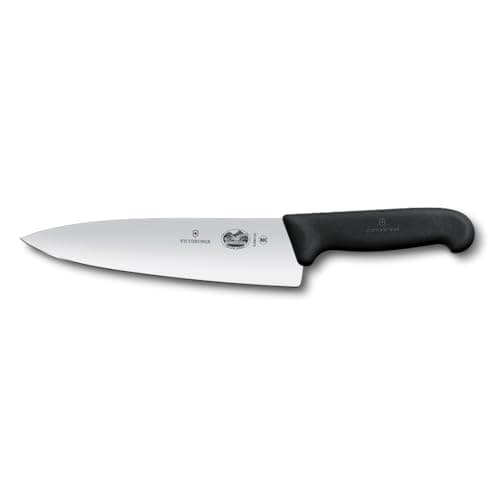
Victorinox Victorinox Fibrox Pro 8"
Victorinox Fibrox Pro 8"

The best Victorinox knife and the one to buy first, for anyone from a first apartment to a professional line. Stamped Swiss X50CrMoV15 at roughly 55-56 HRC on a ~20 degree per side edge, about 7.4 ounces, NSF certified - and the Fibrox handle is the single best wet grip in the category at any price.

Best overall
9.2
$48.20Amazon
02
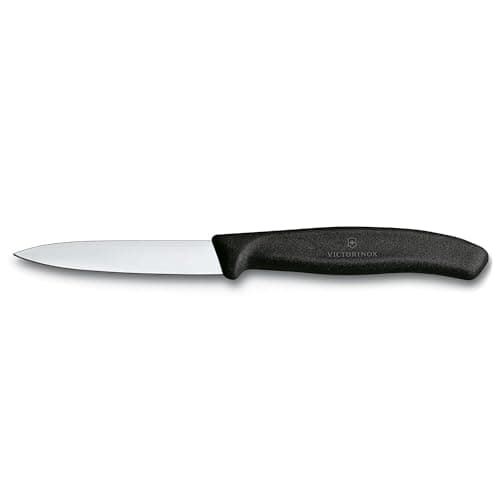
Victorinox Victorinox Swiss Classic 3.25" Paring Knife
Victorinox Swiss Classic 3.25" Paring Knife

The budget pick, and the second knife every kitchen should own. A stamped Swiss stainless spear point on a moulded polypropylene handle, for less than a sandwich - it is the knife that handles everything an 8-inch blade is clumsy at, and it costs so little that buying two is a sensible decision rather than an indulgence.

Budget pick
8.4
$8.00Amazon
03
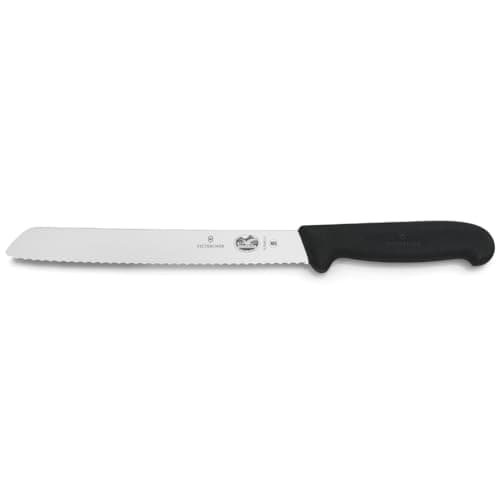
Victorinox Victorinox Fibrox 10.25" Serrated Bread Knife
Victorinox Fibrox 10.25" Serrated Bread Knife

The third knife, and the one shape a chef's knife genuinely cannot replace. Ten and a quarter inches of stamped Swiss serrated steel on a Fibrox handle, NSF certified - long enough for a sourdough boule and the only knife here that stays useful without ever being sharpened.

Best bread knife
8.6
Check price →
04
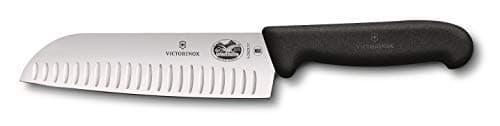
Victorinox Victorinox Fibrox Pro 7" Santoku (Granton)
Victorinox Fibrox Pro 7" Santoku (Granton)

The alternative main knife, for cooks who push down rather than rock. Same stamped X50CrMoV15 at ~55-56 HRC and the same Fibrox handle, in a flatter seven-inch santoku profile with a Granton hollow edge that helps release sticky slices. Buy it instead of the 8-inch chef's knife, not alongside it.

Best alternative main knife
8.5
$52.24Amazon
05
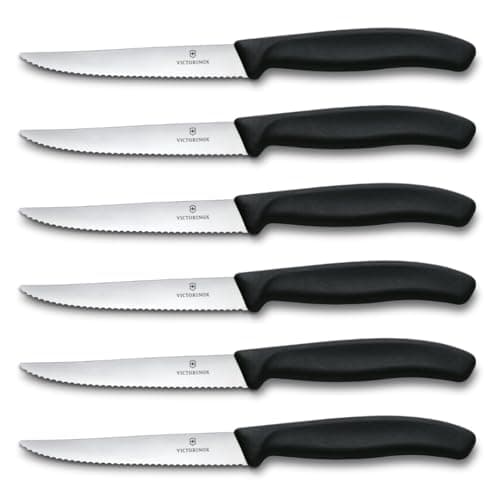
Victorinox Victorinox Swiss Classic 6-Piece Steak Knife Set
Victorinox Swiss Classic 6-Piece Steak Knife Set

The best-value steak knives anyone makes, and the right table knives for a house that uses them. Six 4.3-inch serrated stamped stainless blades with round tips and dishwasher-safe handles - no forging, no pakkawood, no presentation box, and no reason to spend five times as much unless the box is the point.

Best for the table
8.1
$58.99Amazon
06
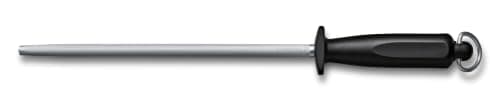
Victorinox Victorinox 10 in Kitchen Honing Steel (7.8303)
Victorinox 10 in Kitchen Honing Steel (7.8303)

The accessory that matters more than a second knife, and the one most people skip. A medium-fine cut steel rod with a plastic handle, guard and hang ring - it realigns a rolled Victorinox edge in under a minute, and a honed Fibrox outcuts an unmaintained knife costing four times as much.

Best upkeep buy
8.3
$24.95Amazon

#ad · Live prices from the Amazon Product API, as of November 12, 2026. Where we have no verified live price, we show none — a gap beats a number that has rotted.

In detail

The picks, in full

01
Victorinox Victorinox Fibrox Pro 8"

Best overall

Victorinox Fibrox Pro 8"

Stamped X50CrMoV15~55-56 HRC~20 deg/side edgeLight ~7.4 oz, NSF certified
9.2/10

The best Victorinox knife and the one to buy first, for anyone from a first apartment to a professional line. Stamped Swiss X50CrMoV15 at roughly 55-56 HRC on a ~20 degree per side edge, about 7.4 ounces, NSF certified - and the Fibrox handle is the single best wet grip in the category at any price.

Cutting ability
8
Grip security
10
Edge upkeep
9
Versatility
9.5
Value per dollar
9.5

Pros

  • The reference knife in its price territory - foodservice kitchens buy it by the case for a reason
  • Fibrox handle keeps its grip with wet, greasy or starchy hands, which is when a knife gets dangerous
  • Light enough to use for an hour without your forearm complaining
  • Soft steel comes straight back on a honing rod with no technique to learn
  • Swiss made, NSF certified and sold with a lifetime warranty against defects

Cons

  • Roughly 20 degrees per side is a wide Western edge - it will never feel as keen as hard Japanese steel
  • ~55-56 HRC means honing is a habit rather than an occasional chore
  • Stamped, with no bolster and no heft - it feels like a tool because it is one
  • The handle is unapologetically plain and will not impress anyone

Don't buy this if…

…you want a knife that feels like an object rather than a tool - this is the most capable knife Victorinox makes and the least romantic one.

Re-scored on this page's rubric rather than carried over: it also wins under $50, best for the money and best for beginners, each against a different field, and it is reviewed in full at our Victorinox Fibrox Pro review.

On a brand page it takes a metric the other pages do not score: versatility. One eight-inch Victorinox will do ninety per cent of what a home kitchen asks, and the reason to buy anything else in this list is that the remaining ten per cent is annoying rather than impossible. It gives up cutting ability to harder steel — an 8 is the honest number for a wide-angle stamped blade in the mid-50s — and takes grip security outright at a 10, which we award sparingly, because a textured thermoplastic handle that does not go slippery is a safety property rather than a comfort one. If you want to know what the brand gives up against forged German steel, that is Victorinox vs Wusthof.

$48.20View on Amazon

Price as of November 12, 2026. Prices change — Amazon's at checkout is the one that counts.

#ad · we may earn a commission from this link to Victorinox Fibrox Pro 8"

02
Victorinox Victorinox Swiss Classic 3.25" Paring Knife

Budget pick

Victorinox Swiss Classic 3.25" Paring Knife

Stamped Swiss stainless3.25 in. spear point bladeMolded polypropylene handleDishwasher-safe (hand-wash still advised)
8.4/10

The budget pick, and the second knife every kitchen should own. A stamped Swiss stainless spear point on a moulded polypropylene handle, for less than a sandwich - it is the knife that handles everything an 8-inch blade is clumsy at, and it costs so little that buying two is a sensible decision rather than an indulgence.

Cutting ability
8
Grip security
8
Edge upkeep
9
Versatility
7
Value per dollar
10

Pros

  • The cheapest knife on this page and the one that adds the most capability per dollar
  • Spear point is the right paring shape - it does both in-hand work and board work
  • Same Swiss steel as the chef's knife, so it sharpens and hones identically
  • Light, short and genuinely controllable for fiddly work
  • Cheap enough to own several and keep one in a drawer, a bag and a camping box

Cons

  • The moulded Swiss Classic handle is smaller and less grippy than a Fibrox one
  • Short enough that it is useless for anything over about an inch thick
  • Thin stamped blade will flex under force, which is a feature until it is not
  • No bolster, no heft, no pretence of being a nice object

Don't buy this if…

…you have not bought a chef's knife yet - a paring knife is the second knife in a kitchen and never the first.

Re-scored here; it is also ranked on best paring knives, where it is judged against Shun and Wusthof paring knives rather than against the rest of the Victorinox range. It takes value per dollar outright on this page — a 10 — because nothing else in the lineup changes what you can do in a kitchen for so little.

The job it does is specific and it is the job people most often try to do with a chef's knife and should not: hulling strawberries, coring tomatoes, peeling in the hand, deveining, trimming fat off a chop. An eight-inch blade can be made to do all of those and none of them are safe. What knives does a kitchen actually need makes the case that this plus a chef's knife plus a bread knife is the entire honest answer, which is also why the next two picks are what they are.

$8.00View on Amazon

Price as of November 12, 2026. Prices change — Amazon's at checkout is the one that counts.

#ad · we may earn a commission from this link to Victorinox Swiss Classic 3.25" Paring Knife

03
Victorinox Victorinox Fibrox 10.25" Serrated Bread Knife

Best bread knife

Victorinox Fibrox 10.25" Serrated Bread Knife

Stamped Swiss stainless10.25 in. serrated bladeFibrox non-slip handleNSF certified
8.6/10

The third knife, and the one shape a chef's knife genuinely cannot replace. Ten and a quarter inches of stamped Swiss serrated steel on a Fibrox handle, NSF certified - long enough for a sourdough boule and the only knife here that stays useful without ever being sharpened.

Cutting ability
9
Grip security
10
Edge upkeep
9.5
Versatility
6
Value per dollar
8.5

Pros

  • Ten and a quarter inches clears a full boule in one stroke, which a 9-inch blade does not
  • Serrations stay useful for years with no sharpening at all
  • Same Fibrox handle as the chef's knife - the best wet grip in the range
  • Also the best tool in the kitchen for melons, squash skin and layer cakes
  • NSF certified and priced like a tool rather than a centrepiece

Cons

  • A serrated edge is awkward to sharpen and most people never will
  • The long thin blade flexes, which takes getting used to on a dense crust
  • No use for anything a straight edge should be doing
  • Takes up more drawer or block space than anything else here

Don't buy this if…

…you do not eat much bread - this is a single-purpose knife and it is honest about that. Buy the santoku instead.

Re-scored here; it is ranked on best bread knives against Shun and Wusthof serrated blades. It takes edge upkeep almost outright on this page, which is a slightly funny result and a real one: a serrated knife degrades so slowly that the maintenance question effectively does not arise.

Length is the specification that matters and the one buyers skip. A ten-inch blade cuts a round loaf in a single stroke; a shorter one requires a second pass, and the second pass is where the slice tears. The flex that comes with a thin stamped blade this long is the trade, and on bread it is mostly harmless. Serrated vs straight edge knives covers why you cannot substitute, and the best knife for cutting tomatoes is the other job this shape quietly wins.

Check price on Amazon →

No buyable offer at the last price check (November 12, 2026). We show nothing rather than a stale number.

#ad · we may earn a commission from this link to Victorinox Fibrox 10.25" Serrated Bread Knife

04
Victorinox Victorinox Fibrox Pro 7" Santoku (Granton)

Best alternative main knife

Victorinox Fibrox Pro 7" Santoku (Granton)

Stamped X50CrMoV15~55-56 HRCGranton hollow edgeFibrox non-slip handle, NSF certified
8.5/10

The alternative main knife, for cooks who push down rather than rock. Same stamped X50CrMoV15 at ~55-56 HRC and the same Fibrox handle, in a flatter seven-inch santoku profile with a Granton hollow edge that helps release sticky slices. Buy it instead of the 8-inch chef's knife, not alongside it.

Cutting ability
8
Grip security
10
Edge upkeep
9
Versatility
7.5
Value per dollar
8

Pros

  • A flatter profile suits a push-cut stroke, which is how most home cooks naturally cut
  • Granton dimples genuinely reduce sticking on potato, cucumber and cheese
  • Shorter blade feels more controllable than the 8-inch for nervous hands
  • Identical steel, handle and certification to the chef's knife - no new habits required

Cons

  • The flat profile is poor at rock-chopping herbs, which the curved 8-inch does well
  • Seven inches is not enough blade for a large squash or a watermelon
  • Costs more than the 8-inch chef's knife despite being shorter
  • A santoku is a second main knife for most people, not a complement

Don't buy this if…

…you already own and like the 8-inch - these two knives do the same job with different strokes, and owning both is a preference rather than a kit.

Re-scored here; it is ranked on best santoku knives against Japanese santokus with far harder steel. On this page the interesting question is not whether it is a good santoku but whether it is the Victorinox you should buy instead of the 8-inch, and the answer depends entirely on how you cut. Chef knife vs santoku is the decision laid out properly.

The Granton edge is the one specification here worth paying attention to, because it is the only functional difference Victorinox offers inside the same steel. Those oval hollows break the suction between the blade face and a wet slice, which on potato, cucumber and semi-firm cheese is a real improvement rather than a styling detail. It does nothing for sharpness.

$52.24View on Amazon

Price as of November 12, 2026. Prices change — Amazon's at checkout is the one that counts.

#ad · we may earn a commission from this link to Victorinox Fibrox Pro 7" Santoku (Granton)

05
Victorinox Victorinox Swiss Classic 6-Piece Steak Knife Set

Best for the table

Victorinox Swiss Classic 6-Piece Steak Knife Set

4.3 in serratedRound tipStamped stainlessDishwasher safe
8.1/10

The best-value steak knives anyone makes, and the right table knives for a house that uses them. Six 4.3-inch serrated stamped stainless blades with round tips and dishwasher-safe handles - no forging, no pakkawood, no presentation box, and no reason to spend five times as much unless the box is the point.

Cutting ability
7
Grip security
7.5
Edge upkeep
9.5
Versatility
6.5
Value per dollar
10

Pros

  • Six knives for less than a single knife from most premium steak sets
  • Serrated and round-tipped, which is the sensible specification for table knives
  • Dishwasher safe, which for table knives genuinely matters
  • Stays functional for years without ever being sharpened
  • Replaceable without regret if one goes missing after a dinner party

Cons

  • Serrated edges tear a steak surface slightly rather than slicing it cleanly
  • Moulded handles look like what they cost on a laid table
  • Not sharpenable in any practical sense
  • A plain-edge forged set is a better knife, at many times the money

Don't buy this if…

…the set is a gift or the table is the point - a pakkawood plain-edge set looks and cuts like an occasion, and these look like cutlery.

Re-scored here; it is the value pick on best steak knives and on best steak knife sets under $100, where it sits against plain-edge pakkawood sets. It takes value per dollar outright here for the same reason it does there.

The honest trade is serration. A micro-serrated edge grips and tears, which is why it keeps working for a decade without maintenance and why a plain-edge forged knife gives a cleaner cut on a rested steak. For a household that eats steak occasionally and owns a dishwasher, that is a trade worth making. For a table where the knives are part of the meal, it is not.

$58.99View on Amazon

Price as of November 12, 2026. Prices change — Amazon's at checkout is the one that counts.

#ad · we may earn a commission from this link to Victorinox Swiss Classic 6-Piece Steak Knife Set

06
Victorinox Victorinox 10 in Kitchen Honing Steel (7.8303)

Best upkeep buy

Victorinox 10 in Kitchen Honing Steel (7.8303)

Medium-fine cut steel rod10 in / 25 cmPlastic handle, guard, hang ringRealigns, does not sharpen
8.3/10

The accessory that matters more than a second knife, and the one most people skip. A medium-fine cut steel rod with a plastic handle, guard and hang ring - it realigns a rolled Victorinox edge in under a minute, and a honed Fibrox outcuts an unmaintained knife costing four times as much.

Cutting ability
7.5
Grip security
8
Edge upkeep
9.5
Versatility
7
Value per dollar
9.5

Pros

  • A ridged steel rod is exactly right for mid-50s HRC Swiss stainless, which bends rather than chips
  • Ten inches covers every blade in this list including the 10.25-inch bread knife
  • Essentially indestructible - no ceramic to crack, nothing to wear out
  • Turns the single highest-return habit in a kitchen into a one-minute job
  • Costs a fraction of any of the knives it maintains

Cons

  • It realigns and does not sharpen - a genuinely worn edge still needs a stone
  • Ridged steel is the wrong rod for hard Japanese knives, which chip rather than bend
  • Plain plastic handle, with no pretence otherwise
  • Requires learning a stroke, which takes about ten minutes

Don't buy this if…

…your knives are hard Japanese steel - a ridged rod is a hazard on a 60+ HRC edge and you want ceramic instead.

Re-scored here; it is ranked on best honing steels and on our honing rods roundup. It is on a brand page because it is the accessory Victorinox actually designed for its own steel, and because the single most common reason a Victorinox feels disappointing after six months is that nobody has honed it.

The match between rod and steel is the point. A ridged steel rod works by catching a rolled edge on raised ridges and bending it back, and mid-50s HRC Swiss stainless is exactly the steel that bends. On a 60 HRC Japanese edge the same rod chips the apex, which is why that kitchen wants a ceramic rod instead. How to use a honing steel is the ten-minute skill, and sharpening vs honing is why this is not a sharpener.

$24.95View on Amazon

Price as of November 12, 2026. Prices change — Amazon's at checkout is the one that counts.

#ad · we may earn a commission from this link to Victorinox 10 in Kitchen Honing Steel (7.8303)

One steel, every shape — and why that is the whole point

Victorinox does not run a good line and a better line. It runs one steel in two handles. The steel is Swiss X50CrMoV15, stamped from rolled sheet and heat treated to roughly 55–56 HRC, with a published edge of about 20 degrees per side. The handles are Fibrox, a textured thermoplastic designed for wet foodservice hands, and Swiss Classic, a moulded polypropylene handle that is smaller, cheaper and less grippy. That is the catalogue.

The consequence is that you only need to make the quality decision once. Every blade in the range sharpens the same way, hones the same way, holds an edge for the same length of time and fails in the same way. Nobody buying a Victorinox bread knife needs to wonder whether it is as good as their Victorinox chef's knife; it is the same knife in a different shape. No other brand in the registry offers that, and it is why the sensible way to buy Victorinox is by shape rather than by line.

Fibrox or Swiss Classic?

Fibroxfor anything you use for more than a minute at a time, and for anything you use with wet hands. The grip is the brand's single best engineering decision and the reason commercial kitchens standardise on it. Swiss Classicfor small knives, table knives and anything where the handle barely matters — a 3.25-inch paring knife is held in a fist for ten seconds at a time, and the saving is real. Buying a Swiss Classic chef's knife to save a few dollars is the one mistake to avoid.

Where the range stops

No forged knives.Nothing Victorinox makes has a full bolster, a visible full tang or the heft that comes with forging. If that is what you want, the cheapest honest route is the Mercer Renaissance — see best Mercer knives— and the reference German version is on best German chef knives.

No hard steel.Mid-50s HRC means a working edge that comes back on a rod and a keen edge that does not last. A 60–61 HRC Japanese blade holds a finer edge for far longer and demands more care for it — Japanese vs German chef knives is the trade, and best Shun knives is the other end of it.

No sub-20-degree edge. Victorinox publishes ~20 degrees per side, which is the Western foodservice standard. You can thin a Victorinox edge on a stone if you want to, and the soft steel will not hold it as well as a harder knife would.

No presentation.These are plain tools. For a knife that is also an object — a gift, a counter piece, a wedding present — the range is the wrong place to look, and best knife gifts is the right one.

How to buy the range, in order

First:the Fibrox Pro 8-inch chef's knife, or the 7-inch santoku if you push-cut rather than rock-chop. One, not both. Second: the Swiss Classic paring knife, which costs almost nothing and removes the temptation to use the big knife for small jobs. Third: the honing steel, because an unmaintained Victorinox is the main reason people conclude the brand is mediocre. Fourth: the 10.25-inch bread knife, if you eat bread. Everything after that is specialisation, and are knife sets worth it explains why buying this sequence one piece at a time beats any block set at the same money.

How we ranked these

Five metrics, tuned for a single-brand lineup. Cutting ability reads blade geometry, published edge angle and blade height. Grip security is specifically about a wet or greasy hand, and it is where the Fibrox and Swiss Classic handles separate. Edge upkeeprewards steel and geometry that come back easily — which is why the serrated blades score highest. Versatility is how many jobs the shape genuinely covers, which is the metric that decides buying order on a brand page. Value per dollar is specification quality against the live price. The overall is the mean of the five to one decimal place. None of these numbers came from a test lab, because we do not have one, and how we review says so in those words.
How we picked

We did not lab-test these knives

Everyone in this category says they tested twenty knives in a professional kitchen. We have not hands-on tested any of these, and we say so. What we did instead: compiled the published specifications — steel type and hardness (HRC), edge angle, blade geometry, weight and build — applied established sharpening standards, ran the value math (spec quality ÷ live price), and scored each product against a published rubric. The scores are judgments from documented research — not measurements we took, because we do not have a test lab and we will not pretend we do. Where a number came from someone else's work, we name them in Sources.

Questions

Frequently asked

What is the best Victorinox knife?
The Fibrox Pro 8" chef's knife. Stamped Swiss X50CrMoV15 at roughly 55–56 HRC, a published ~20 degree per side edge, about 7.4 ounces, NSF certified, and the most secure wet grip of any handle in its price territory. It is also the knife foodservice kitchens buy in quantity.
Are Victorinox knives good quality?
Yes, within a clearly defined limit. They are stamped rather than forged and the steel is soft at mid-50s HRC, so they will not hold a keen edge like hard Japanese steel. What they do is cut well, sharpen easily, survive commercial use and cost very little — which is why professional kitchens standardise on them.
What is the difference between Fibrox and Swiss Classic?
The handle, not the blade. Fibrox is a textured thermoplastic handle designed for wet foodservice hands and is the better grip by a wide margin. Swiss Classic is a smaller moulded polypropylene handle that costs less. Buy Fibrox for anything you hold for more than a minute.
Which Victorinox knives do I actually need?
A Fibrox Pro 8-inch chef's knife, a Swiss Classic paring knife and a honing steel. Add the 10.25-inch bread knife if you eat bread. That is a complete working kitchen for less than the price of one premium chef's knife — see what knives does a kitchen actually need.
Is a Victorinox santoku better than the chef's knife?
Different, not better. The santoku is flatter and shorter, which suits a push-cut stroke and does not rock-chop well; the 8-inch chef's knife is curved and longer. Same steel, same handle, same upkeep. Buy one, not both — chef knife vs santoku is the decision.
How do I sharpen a Victorinox knife?
Hone it on a ridged steel rod every few uses, which fixes the rolled edge that makes it feel dull, and put it on a stone every few months at roughly 20 degrees per side. Soft mid-50s steel is the easiest steel there is to maintain — how to sharpen kitchen knives is the method.
Are Victorinox knives dishwasher safe?
The listings say several are, and we would still hand-wash them. Detergent dulls the finish and knocking against other steel in a basket does more visible damage in a month than a year of cutting — see can you put knives in the dishwasher.
Are Victorinox kitchen knives made in Switzerland?
Victorinox publishes Swiss manufacture for the Fibrox Pro cutlery line and sells it with a lifetime warranty against material and manufacturing defects. Where a specific listing does not state the country, we do not assume it — check the listing you are buying.

Keep reading

Receipts

Sources

We do not run a testing lab, and we do not pretend to. Where a spec or a measured number came from someone else's work — a manufacturer's page, a published standard — we name them and link them. Where we could not verify something, we say so on the page rather than quietly leaving it out. Read our full method.