Skip to content
The Edge Bench

Stones, sharpeners & how-to · Sharpening

The best ceramic honing rods

Ceramic is the right rod material for hard steel, and the only one that lightly sharpens as well as realigns. Five ceramic rods ranked on published grit, working length, angle control, build and value.

Sharpeak Sharpeak 12 in Ceramic Sharpening Steel with Built-In Angle Guides

Our top pick · Best overall and budget pick

Sharpeak 12 in Ceramic Sharpening Steel with Built-In Angle Guides

8.9

The best ceramic honing rod here and also the cheapest, which is why it wins twice. A 12-inch, 3000-grit ceramic rod with angle guides moulded into the body, so the blade meets the abrasive at a set angle whether or not your wrist agrees. For anyone with a hard Japanese knife and no confidence in their honing stroke.

$24.99Amazon

#ad · Full ranking below

By Stephen V.Updated How we review
#ad

We earn a commission when you buy through our Amazon links, at no extra cost to you. It never changes a verdict, and we say so when the cheaper knife is the better buy. How this works.

Buy the Sharpeak 12" ceramic sharpening steel — it is the best ceramic honing rod here, and it is for anyone who owns at least one hard Japanese knife. Twelve inches of 3000-grit ceramic with angle guides moulded into the body covers every blade in a normal kitchen, refreshes a keen edge instead of scratching it, and removes the one variable people actually get wrong. The budget pick is the same rod: it is also the cheapest ceramic rod we rank, and we are not going to promote a worse rod into a budget slot to make the list look tidier.

Every rod here was in stock and priced at our last price check. We do not print a number in the prose, because prices move and a sentence cannot: the Quick Picks table carries the live price and the date we pulled it, with a Check price button on every row.

The reason this page exists separately from best honing steels is that ceramic and steel are not two finishes of the same tool. A ridged steel rod works by catching a rolled edge on raised ridges and bending it back. That is fine on mid-50s HRC Western stainless, which bends. On a 60–62 HRC Japanese edge it is a liability, because hard steel does not bend — it chips. Ceramic has no ridges: it presents a smooth, fine abrasive surface that straightens the edge and removes a very small amount of metal while it does so. That second property is the one people underrate. A steel rod only ever buys back the edge you already had. A fine ceramic rod genuinely refreshes one, which is why the interval before you need a stone gets longer.

The cost of that is fragility. Ceramic is brittle, and a rod dropped onto a tile floor is usually finished. If you are hard on kitchen tools, buy a steel rod and accept the limits; honing rod materials lays out the full trade. And if your knives are all soft Western stainless, a ceramic rod is a luxury rather than a fix.

The method is on how we review: we have not hands-on tested these rods and we do not claim to have. The scores come from published specifications — grit where the maker states one, rod length, guide geometry, handle and cap construction — and from value arithmetic against the live price. Where a maker publishes no grit figure, we say so and score the gap down rather than guessing. Everything sits under the sharpening hub.

The short answer

Quick picks

#KnifeBest forScorePrice
01
Sharpeak Sharpeak 12 in Ceramic Sharpening Steel with Built-In Angle Guides
Sharpeak 12 in Ceramic Sharpening Steel with Built-In Angle Guides

The best ceramic honing rod here and also the cheapest, which is why it wins twice. A 12-inch, 3000-grit ceramic rod with angle guides moulded into the body, so the blade meets the abrasive at a set angle whether or not your wrist agrees. For anyone with a hard Japanese knife and no confidence in their honing stroke.

Best overall and budget pick
8.9
$24.99Amazon
02
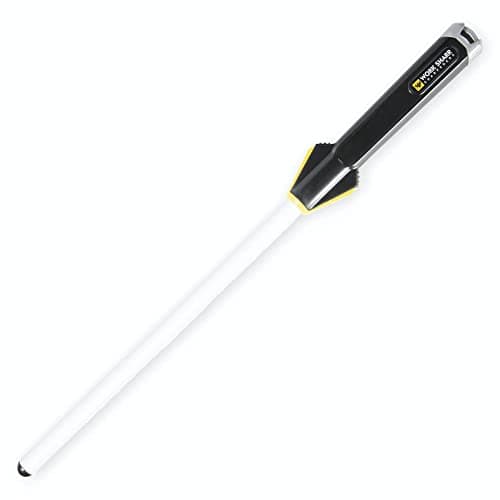
Work Sharp Work Sharp Kitchen Ceramic Honing Rod (Angle Guided)
Work Sharp Kitchen Ceramic Honing Rod (Angle Guided)

The rod to buy if a 20-degree Western edge is what you actually own. Roughly 1200-grit ceramic with a 20-degree guide moulded into the body and a rating for serrated edges too - a shorter working section than the Sharpeak, but a guide angle matched to German and foodservice knives rather than Japanese ones.

Best for Western 20-degree edges
8.5
$29.95Amazon
03
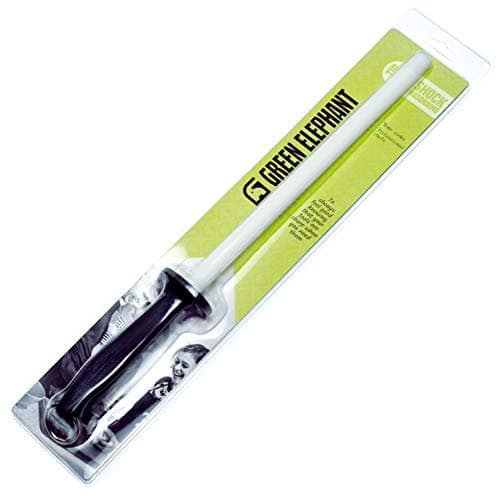
Green Elephant Green Elephant Ceramic Honing Rod, 11 in
Green Elephant Ceramic Honing Rod, 11 in

The middle position, and a real one rather than a fudge. Fifteen hundred grit is a touch finer than the 1200 standard and much less specialised than 3000, and eleven inches is nearly full reach. Buy it if you own a mix of German and Japanese knives and want one rod that is honest on both.

Best for a mixed knife drawer
7.6
$32.65Amazon
04
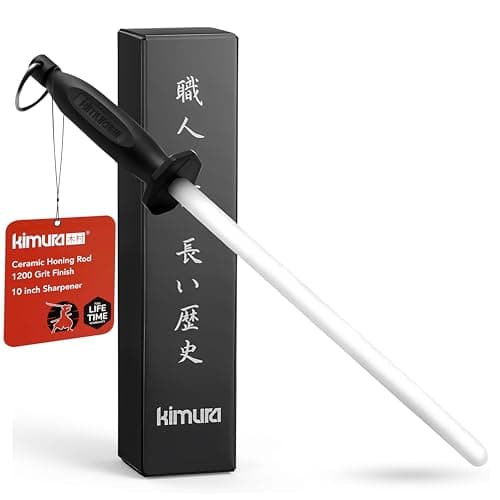
Kimura Kimura Professional Ceramic Honing Rod, 10 in
Kimura Professional Ceramic Honing Rod, 10 in

The conventional 1200-grit ceramic rod, and the most universal abrasive here. Fine enough to be safe on a 60 HRC apex and coarse enough to pull a rolled Western edge back quickly, which is more than the 3000-grit rod will do. Buy it if your knives are mostly soft stainless but one of them is not.

Best all-round grit
7.4
$29.99Amazon
05
Mercer Culinary Mercer Culinary Ceramic Rod Honing Steel, 12 in
Mercer Culinary Ceramic Rod Honing Steel, 12 in

The professional-line rod, bought for the handle and the reach rather than the abrasive. Twelve inches of ceramic from the brand that supplies culinary schools - a serious tool with a serious handle, and the only rod here whose grit the maker does not publish, which is the whole reason it finishes last.

Best build and reach
7.1
Check price →

#ad · Live prices from the Amazon Product API, as of November 12, 2026. Where we have no verified live price, we show none — a gap beats a number that has rotted.

In detail

The picks, in full

01
Sharpeak Sharpeak 12 in Ceramic Sharpening Steel with Built-In Angle Guides

Best overall and budget pick

Sharpeak 12 in Ceramic Sharpening Steel with Built-In Angle Guides

3000-grit ceramic12 in rod, 17.5 in overallBuilt-in angle guidesAnti-breaking cap
8.9/10

The best ceramic honing rod here and also the cheapest, which is why it wins twice. A 12-inch, 3000-grit ceramic rod with angle guides moulded into the body, so the blade meets the abrasive at a set angle whether or not your wrist agrees. For anyone with a hard Japanese knife and no confidence in their honing stroke.

Grit & finish
9
Length & reach
9.5
Angle control
9
Build
7.5
Value
9.5

Pros

  • Twelve inches of working rod covers every kitchen blade including a 10-inch slicer
  • 3000 grit is fine enough to refresh a hard Japanese edge rather than scratch it
  • Moulded guides remove the single thing beginners get wrong - the angle, not the pressure
  • The anti-breaking cap addresses the real failure mode of a ceramic rod
  • The lowest price of any ceramic rod we rank, which is why it also takes the budget slot

Cons

  • A fixed guide angle will not match every knife you own
  • Still ceramic, so it can chip or crack if it hits a hard floor
  • 3000 grit is very fine - it will not drag a badly rolled soft edge back quickly

Don't buy this if…

…you hone confidently by feel and all your knives are soft Western stainless - you would be paying for a guide you will not use and a grit finer than your steel can hold.

Re-scored on this page's rubric rather than carried over: it is also the angle-guided pick on best honing rods for Japanese knives, where it is judged against a field that includes steel rods. Here it is up against four other ceramics, and it takes length and value outright while finishing level on grit.

The interesting number is the 3000 grit, which is finer than the 1200 that most ceramic rods publish. On a 60–62 HRC edge that is the right direction to err: a coarser abrasive leaves scratches that become the starting points for micro-chipping, and the whole reason you reach for ceramic instead of steel is that hard edges fail by chipping. On soft stainless, 3000 grit is close to doing nothing, which is the honest limit of this rod and the reason the Kimura below still has a job. Whetstone grits explained covers why the same number means different things on different steel, and how to use a honing steel is the ten-minute skill the guides are standing in for.

$24.99View on Amazon

Price as of November 12, 2026. Prices change — Amazon's at checkout is the one that counts.

#ad · we may earn a commission from this link to Sharpeak 12 in Ceramic Sharpening Steel with Built-In Angle Guides

02
Work Sharp Work Sharp Kitchen Ceramic Honing Rod (Angle Guided)

Best for Western 20-degree edges

Work Sharp Kitchen Ceramic Honing Rod (Angle Guided)

9 in ceramic abrasiveBuilt-in 20-degree guideRoughly 1200 grit equivalentRated for serrated too
8.5/10

The rod to buy if a 20-degree Western edge is what you actually own. Roughly 1200-grit ceramic with a 20-degree guide moulded into the body and a rating for serrated edges too - a shorter working section than the Sharpeak, but a guide angle matched to German and foodservice knives rather than Japanese ones.

Grit & finish
8.5
Length & reach
7.5
Angle control
9.5
Build
8
Value
9

Pros

  • The guide is set at 20 degrees, which is the published Victorinox and foodservice standard
  • Ceramic rather than ridged steel, so it is still safe on harder blades
  • Rated for serrated edges, which most rods are not
  • Short enough to live in a drawer next to the board, which is how honing becomes a habit

Cons

  • The 9-inch ceramic section covers less blade than a 12-inch rod
  • A 20-degree guide is wider than a Japanese edge wants, so it is the wrong guide for a Shun
  • Work Sharp publishes a grit equivalence rather than a grit, which we score as the softer claim

Don't buy this if…

…your knives are Japanese - the guide angle is the whole point of this rod and 20 degrees per side is not the angle a 16-degree edge is ground to.

This is the rod that answers the most common honing failure, and it answers it for a different knife than the Sharpeak does. Honing goes wrong because the angle wanders, not because the rod was cheap — knife sharpening angles explains why holding 20 degrees freehand for twelve strokes is harder than it sounds. Work Sharp moulds the angle into the tool. The catch is that a guide is only useful if it matches your bevel, and 20 degrees per side is the Western number.

It takes angle control on this page and loses reach. Nine inches of abrasive is enough for a paring knife, a utility knife and an 8-inch chef's knife, and not enough for a carving slicer. If most of what you own is German or foodservice-grade stainless, this is the rod on the page for you and the Sharpeak is over-specified.

$29.95View on Amazon

$34.9514% off

Price as of November 12, 2026. Prices change — Amazon's at checkout is the one that counts.

#ad · we may earn a commission from this link to Work Sharp Kitchen Ceramic Honing Rod (Angle Guided)

03
Green Elephant Green Elephant Ceramic Honing Rod, 11 in

Best for a mixed knife drawer

Green Elephant Ceramic Honing Rod, 11 in

1500-grit ceramic11 inFine finishShatter-resistant claim
7.6/10

The middle position, and a real one rather than a fudge. Fifteen hundred grit is a touch finer than the 1200 standard and much less specialised than 3000, and eleven inches is nearly full reach. Buy it if you own a mix of German and Japanese knives and want one rod that is honest on both.

Grit & finish
9
Length & reach
8.5
Angle control
5
Build
7.5
Value
8

Pros

  • 1500 grit sits between refreshing soft steel and refining hard steel, which suits a mixed drawer
  • Eleven inches reaches more blade than the 10-inch and 9-inch rods here
  • One of the few ceramic rods marketed on impact resistance at all
  • No guide to fight if you already hone by feel

Cons

  • The shatter-resistant claim is the manufacturer's, not something we have measured
  • No angle guide, so the stroke is entirely on you
  • Neither the finest nor the longest rod here, which is the cost of the middle

Don't buy this if…

…you want the finest possible finish on a very hard blade - the 3000-grit Sharpeak is the specialist for that and costs less.

Re-scored here; it is the middle-ground pick on best honing rods for Japanese knives as well. The reason it drops two places on this page is the rubric: angle control is a scored metric here, because two of the five rods publish a moulded guide and three do not, and pretending that difference does not exist would make the page useless to the people searching for it.

What it genuinely wins is breadth of use. If your drawer holds a Wusthof, a Victorinox and one Japanese knife — which is the most common drawer there is — 1500 grit is the figure that does something useful on all three. Japanese vs German chef knives is the underlying argument about why one rod has to straddle two very different heat treatments.

$32.65View on Amazon

Price as of November 12, 2026. Prices change — Amazon's at checkout is the one that counts.

#ad · we may earn a commission from this link to Green Elephant Ceramic Honing Rod, 11 in

04
Kimura Kimura Professional Ceramic Honing Rod, 10 in

Best all-round grit

Kimura Professional Ceramic Honing Rod, 10 in

1200-grit ceramic10 inHones and lightly sharpensSuits hard Japanese steel
7.4/10

The conventional 1200-grit ceramic rod, and the most universal abrasive here. Fine enough to be safe on a 60 HRC apex and coarse enough to pull a rolled Western edge back quickly, which is more than the 3000-grit rod will do. Buy it if your knives are mostly soft stainless but one of them is not.

Grit & finish
8.5
Length & reach
8
Angle control
5
Build
7
Value
8.5

Pros

  • 1200 grit is the published standard for a reason - it works on both soft and hard steel
  • Safe on 60+ HRC edges where a ridged steel rod is not
  • Lightly abrades, so it extends the interval before stone work
  • Ten inches covers a paring knife up to a 10-inch chef's knife

Cons

  • No angle guide
  • Ceramic is brittle and a drop onto a hard floor usually ends it
  • Loads up with steel over time and needs cleaning with an abrasive pad

Don't buy this if…

…you are hard on kitchen tools - a dropped ceramic rod is a broken ceramic rod, and a steel one is essentially indestructible.

Re-scored here; it is the hard-steel pick on our honing rods roundup, judged there against steel and diamond rods rather than against four other ceramics. On this page it is the most conventional choice and the one with the fewest surprises: a published grit, a sensible length, no guide, no claims we cannot check.

The honest case for it over the Sharpeak is grit, not price. Twelve hundred grit removes more metal per stroke than 3000, which matters if your knives are mid-50s HRC and roll rather than chip — the edge comes back in three strokes instead of ten. The Sharpeak is the better rod for a hard Japanese edge; this is the better rod for a Victorinox you use every day. Sharpening vs honing is the distinction that decides which of those two you need.

$29.99View on Amazon

Price as of November 12, 2026. Prices change — Amazon's at checkout is the one that counts.

#ad · we may earn a commission from this link to Kimura Professional Ceramic Honing Rod, 10 in

05
Mercer Culinary Mercer Culinary Ceramic Rod Honing Steel, 12 in

Best build and reach

Mercer Culinary Ceramic Rod Honing Steel, 12 in

Ceramic rod12 inLongest reach hereMercer Culinary pro line
7.1/10

The professional-line rod, bought for the handle and the reach rather than the abrasive. Twelve inches of ceramic from the brand that supplies culinary schools - a serious tool with a serious handle, and the only rod here whose grit the maker does not publish, which is the whole reason it finishes last.

Grit & finish
6.5
Length & reach
9.5
Angle control
5
Build
9
Value
5.5

Pros

  • Twelve inches handles any blade you are likely to own, including slicers
  • Mercer's professional line - handle and build are a clear step above the budget rods
  • Ceramic, so it is correct for hard steel by construction
  • The brand is standard issue at a lot of culinary programmes, with the service to match

Cons

  • The most expensive rod here by a wide margin
  • The listing publishes no grit figure, so we cannot state one and will not invent one
  • No angle guide at a price where two cheaper rods include one

Don't buy this if…

…you are buying on specification - two rods above publish their grit, include a moulded angle guide and cost less. Buy this for the handle or do not buy it.

Re-scored here, and it finishes last on a page where it is plainly the best-built object. That is not a contradiction: four of the five metrics on this rubric are about the abrasive and the geometry, and Mercer publishes neither a grit nor a guide angle. We score an unpublished figure as an unpublished figure rather than assuming the generous reading, which is the same posture we take on knives whose makers publish steel but not hardness.

Where it earns its money is the hand. Twelve inches of rod with a professional handle and a proper guard is a different experience from a budget rod, and if you hone several knives at a time — which is what a culinary student or a line cook does — that difference is real. It is also the rod on this page most likely to survive being used by someone else. Best chef knives for culinary school is where that audience is served properly.

Check price on Amazon →

No buyable offer at the last price check (November 12, 2026). We show nothing rather than a stale number.

#ad · we may earn a commission from this link to Mercer Culinary Ceramic Rod Honing Steel, 12 in

Why ceramic instead of steel, in one paragraph

A honing rod does not sharpen in the usual sense. The edge of a used knife is still there; it has rolled over to one side. A rod pushes it back. A ridged steel rod does that mechanically, by catching the rolled metal on raised ridges, and it works brilliantly on steel that bends. A ceramic roddoes it abrasively, with a smooth fine surface that straightens the edge and shaves a tiny amount of metal off it at the same time. On a 60–62 HRC Japanese edge the ridged rod is a genuine hazard, because hard steel does not bend under a ridge — it breaks. That is the entire argument, and grooved vs smooth honing steel goes through it properly.

What grit to buy

Grit is the specification that matters and the one most listings hide. 1200 grit is the conventional ceramic figure: enough bite to fix a rolled soft edge in a few strokes, fine enough to be safe on a hard one. 1500 is a slightly finer compromise. 3000is a refining grit — close to doing nothing on mid-50s HRC stainless, and exactly right on a hard Japanese apex where a coarser scratch becomes the start of a chip. If a rod does not publish a grit, you are buying the handle. That is a legitimate thing to buy; it is just not what the question “best ceramic honing rod” is usually asking.

Length, guides, and the one thing that actually breaks

Working length should be at least as long as your longest blade, which for most kitchens means ten inches and for anyone who owns a carving slicer means twelve. A short rod forces you to hone in two passes, and the join is where the edge gets uneven.

A moulded angle guide is worth more than most people expect, because the failure mode of honing is not pressure, it is a wandering angle. Two rods here include one. Check which angle: a 20-degree guide is correct for Western and foodservice knives and wrong for a 16-degree Japanese bevel, which is why there are two guided rods on this page rather than one winner.

Brittleness is the real risk. Every ceramic rod on this page can be ended by one drop onto tile. One carries an anti-breaking cap and one is marketed as shatter-resistant, and neither claim is something we have tested. If the rod will live in a busy kitchen with other people in it, a steel rod from best honing steels is the more sensible purchase and we would rather say so than sell you a ceramic rod you will break.

A rod is not a sharpener

This is the most common mistake in the category. A rod of any material restores an edge that has rolled. It will not restore an edge that has worn away, and no number of strokes turns a genuinely blunt knife into a sharp one — how to tell if a knife needs sharpening is the test for which of the two you are looking at. When the answer is “blunt”, you need a stone, a guided system or an electric sharpener. The rod is what keeps you away from those for months at a time, and how often to sharpen knives gives the cadence.

How we ranked these

Five metrics. Grit & finish reads the published grit and penalises a missing one. Length & reach is working abrasive length against the blades a normal kitchen owns. Angle control rewards a moulded guide and notes which angle it is set to. Build reads handle, guard and cap construction plus any stated impact resistance, marked as a maker claim where that is what it is. Value is specification quality against the live price. The overall is the mean of the five to one decimal place. None of these numbers came from a test lab, because we do not have one, and how we review says so in those words.

How we picked

We did not lab-test these knives

Everyone in this category says they tested twenty knives in a professional kitchen. We have not hands-on tested any of these, and we say so. What we did instead: compiled the published specifications — steel type and hardness (HRC), edge angle, blade geometry, weight and build — applied established sharpening standards, ran the value math (spec quality ÷ live price), and scored each product against a published rubric. The scores are judgments from documented research — not measurements we took, because we do not have a test lab and we will not pretend we do. Where a number came from someone else's work, we name them in Sources.
Questions

Frequently asked

What is the best ceramic honing rod?
The Sharpeak 12" ceramic sharpening steel. It publishes 3000 grit, gives twelve inches of working rod, moulds angle guides into the body and carries an anti-breaking cap — and it is the cheapest ceramic rod we rank, so it is the budget pick as well as the top one.
Is a ceramic honing rod better than steel?
Better for hard steel, not better in general. Ceramic has no ridges and works abrasively, so it is safe on a 60+ HRC Japanese edge that a ridged steel rod would chip, and it lightly sharpens as well as realigns. A steel rod is faster on soft Western stainless and essentially unbreakable. See honing rod materials.
What grit ceramic honing rod should I buy?
1200 grit if your knives are mostly Western stainless, because it has the bite to pull a rolled edge back in a few strokes. 3000 grit if you own hard Japanese knives, because a coarser scratch on a brittle apex is where micro-chipping starts. 1500 is the sensible compromise for a mixed drawer.
Can a ceramic rod sharpen a dull knife?
No. It removes a very small amount of metal, which extends the interval between sharpenings, but it cannot rebuild an edge that has worn away. For that you need a stone, a guided system or an electric sharpener — see sharpening vs honing.
Do ceramic honing rods break easily?
They break if dropped on a hard floor, yes. Ceramic is brittle by nature. One rod here ships with an anti-breaking cap and one is marketed as shatter-resistant; both are maker claims we have not tested. If the rod will be used by several people in a busy kitchen, buy steel.
How often should I use a ceramic honing rod?
Every few uses for a knife in regular service, and before any job where a clean cut matters. It takes under a minute. Because ceramic also abrades lightly, you can over-thin an edge by honing many times a day on a very fine rod — that is a rare problem and a far smaller one than never honing at all.
Does a ceramic rod work on serrated knives?
Only if the maker says so, and only on the flat back of the serrations rather than inside the scallops. The Work Sharp rod here is rated for serrated edges; the others are not. For the proper method see how to sharpen a serrated knife.
How do I clean a ceramic honing rod?
Grey streaks on the rod are steel, not damage. A ceramic rod loads up as it works and a loaded rod stops cutting, so scrub it with an abrasive kitchen pad and a little detergent when the streaking gets heavy, then dry it. Never put one in a dishwasher.

Keep reading

Receipts

Sources

We do not run a testing lab, and we do not pretend to. Where a spec or a measured number came from someone else's work — a manufacturer's page, a published standard — we name them and link them. Where we could not verify something, we say so on the page rather than quietly leaving it out. Read our full method.