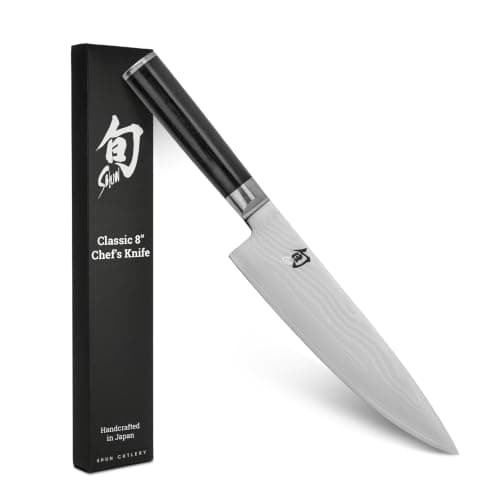
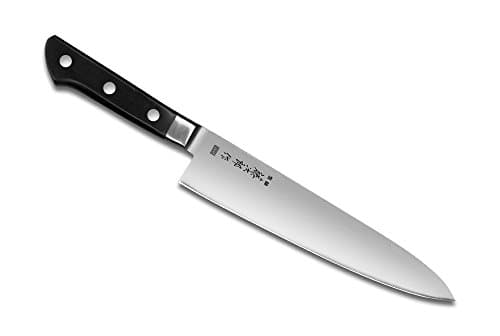
Buy the Tojiro Professional VG10. It scores 8.6 against the Shun Classic's 8.4 on the same five-metric rubric, and it is the better purchase for most people who are deciding between these two. Both knives do the same structural thing — a hard VG-10-family core clad in softer stainless, so you get a keen edge without a blade that rusts if you look at it wrong. The Shun then spends a great deal of money on a VG-MAX core, a 68-layer Damascus jacket and a contoured pakkawood handle. The Tojiro spends almost none and gives you a Western bolster handle instead. If what you want is the cutting, the Tojiro is the rational answer. If you want the knife to also be an object, the Shun is genuinely beautiful and we are not going to pretend that is worthless.
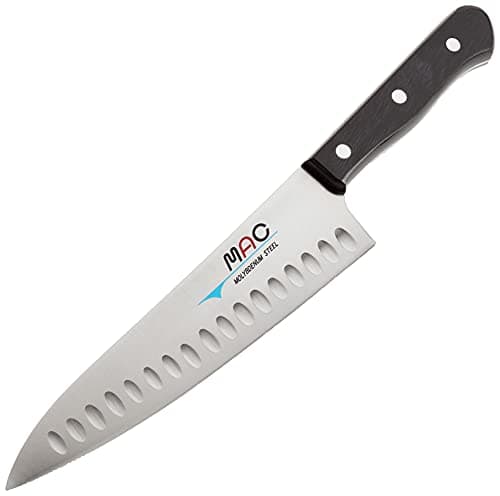
The scores here are reproduced from the pages where each knife is already ranked, not re-derived, so they are directly comparable: the Shun from Shun vs Global, the Tojiro from our Japanese ranking, the MAC from best under $200. The rubric and its limits are on how we review: these are judgments from published specifications, not measurements from a lab we do not have.
The construction is the same idea, executed at two prices
Both of these are san-maiknives — a three-layer sandwich. A hard, high-carbon stainless core takes the edge; two softer stainless outer layers give the blade toughness and keep the brittle core from being the whole knife. This is the standard construction for mid-and-upper Japanese kitchen knives and it is the reason a 60 HRC edge can exist on a blade you are allowed to use daily.
Shun publishes a VG-MAX core at roughly 60-61 HRC, ground to about 16 degrees per side, clad in 68 alternating layers of stainless that are etched to show the Damascus pattern. Tojiro publishes a VG-10core, also clad in stainless, in a 210mm gyuto profile with a Western-style handle and a visible bolster. VG-MAX is Kai's own proprietary variant of the VG-10 family with additional carbon and vanadium; both land in roughly the same hardness territory and both behave like hard Japanese steel. Anyone telling you there is a night-and-day cutting difference between a VG-10 core and a VG-MAX core is selling one of them.
The Damascus cladding is the part worth understanding properly, because it is where the money goes. On a clad knife the pattern is in the jacket, not in the cutting edge — the edge is a single homogeneous core steel. The layers are structurally real and cosmetically lovely, and they do not make the knife cut better. There is no deception in this: Shun says what the construction is. But it is an aesthetic purchase, and Damascus steel knives explained is the page that unpicks what the pattern does and does not buy you.
The handle is the real decision
This is where the two knives genuinely diverge and where we would send you to make the call.
The Shun Classic uses a contoured D-shaped pakkawood handle. It is handsome, it is warm in the hand, and it is shaped with a slight asymmetry that suits a right-handed grip — which is excellent if you are right-handed and a real consideration if you are not. See left-handed chef knives for who that actually affects.
The Tojiro Professional uses a plain Western handle with a bolster. It is symmetrical, it has no handedness, and it is deliberately anonymous. If you have used German knives your hand already knows it. It is also the handle that makes the Tojiro feel “unglamorous”, which is the single most common criticism of this knife and is entirely about looks.
Neither handle is better in the abstract. The honest framing is this: the Shun handle is the nicer object and the slightly riskier purchase if you cannot hold one first; the Tojiro handle is the safer bet and the duller one. Handle material and shape get their own treatment at knife handle materials.
What both of them demand of you
Hard steel is a contract, and it reads the same for both knives. No bones, no frozen food, no joints, no twisting, no prying.A 60 HRC edge chips where a soft German edge would simply roll over — and a chip needs metal removed on a coarse stone to fix, which is a different order of work from a honing rod. If that sounds like your kitchen, buy a German knife instead; we say so in the same words on Japanese vs German chef knives, and how to fix a chipped knife is the page you will need if you ignore it.
Both also want sharpening at their ground angle, which is in the 15-16 degree region rather than the 20 degrees a Western knife expects. A pull-through sharpener set for a Western edge will grind the shoulders off a Japanese bevel. Use a stone, or a guided system with an angle setting — the best sharpeners for Japanese knives ranks the ones that can hold the angle, and knife sharpening angles explains why the number matters more than the brand.
And both are stainless-clad, which means neither is a maintenance nightmare. This is not a carbon-steel knife that patinas overnight. Wash and dry it, keep it off the glass board, keep it out of the dishwasher, and it will behave. Knife care and maintenance covers the routine.
So which one, in one paragraph
Buy the Tojiro if you want the sharpest practical knife for the money and you do not care what it looks like. Buy the Shun if you want the nicest knife you will own, you are right-handed, you will keep it off bones and out of the sink, and the price does not hurt. Buy the MAC if you want hard-steel cutting with a couple of points less brittleness and a conventional handle. All three are good knives; only one of them is cheap, and the cheap one won.
Is Shun worth the money over Tojiro?
On cutting alone: no, and the specifications say so. Both are clad knives with a hard VG-10-family core in the same hardness territory, ground within a degree or two of each other. The Shun's core is harder and its grind is a touch finer, which is why it takes our only pair of 10s for edge and sharpness — but the gap in cutting is a fraction of the gap in price.
On everything else: it depends what you are buying. You are paying for the Damascus cladding, the pakkawood handle, Kai's sharpening service and the fact that it feels like a serious object in the hand. Those are real things. They are not cutting things. The site's general position on this question is at are expensive chef knives worth it, and the short version is that the returns flatten hard above the Tojiro's price point.
What about Shun vs Miyabi, or the other Shun comparisons?
We rank what we can buy and verify. Miyabi and Cangshan are not in our registry, so we do not have published specifications in front of us to compare and we are not going to write a comparison from memory. For the Shun pairings we do cover: Shun vs Global is the other hard-Japanese head-to-head, and Shun vs Wusthof is the Japanese-versus-German version of the same decision, which is a bigger question than either brand.
If you are buying your first Japanese knife
Buy the Tojiro, and buy a stone at the same time. The failure mode for a first Japanese knife is not buying the wrong one — it is buying a good one, blunting it in four months, running it through a Western pull-through sharpener, and concluding that Japanese knives are overrated. Our best Japanese chef knives for beginners page is written specifically around that trap, and best sharpening stones for beginners is the other half of the purchase. If you would rather not learn freehand at all, a guided system with a 15-degree setting is a legitimate answer — best sharpening systems ranks them.