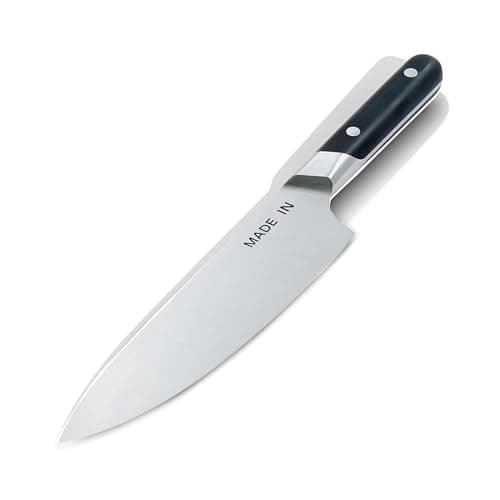
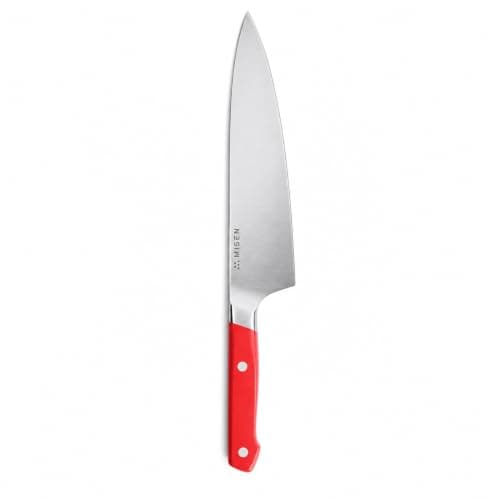
The direct-to-consumer knife brands are usually lumped together as one phenomenon, which obscures the interesting thing about them: having removed the same layer of retail margin, they spent it in opposite directions. Misen bought hardness— AUS-10 at 60–61 HRC, a Japanese-style keen grind, a sloped bolster. Made In bought provenance and toughness — forging in Thiers, France, in X50CrMoV15 at around 58 HRC. Those are not two versions of the same knife. They are the Japanese and German bets, made by two companies with similar business models.
A generation note before the table. Misen has since moved its own range to a different steel: the 8-inch chef's knife it sells direct today is an AICHI ACUTO440 blade — higher chromium, chosen for corrosion resistance — with a rounded spine and bolster. The AUS-10 knife compared below is still listed on Amazon, which is where our link points, but it is the outgoing design. We have kept it in the comparison because Misen published its steel and hardness; it publishes very little about ACUTO440, and we do not score knives from marketing copy.
| Feature | Misen 8" Chef Knife | Made In 8" Chef Knife |
|---|
| Steel | AUS-10 stainless | X50CrMoV15 |
| Published hardness | ~60–61 HRC | ~58 HRC |
| Edge angle | ~15° per side, symmetrical | 18° asymmetric — 14° front, 4° back |
| Origin | Japanese steel, Asian manufacture | Forged in Thiers, France |
| Bolster | Sloped bolster | Bolsterless, full tang |
| How the edge fails | Micro-chips | Rolls |
| Correct maintenance | Whetstone or fine ceramic | Honing rod, occasional stone |
Hardness is the whole comparison
Three points of Rockwell hardness sounds trivial and is not. At 60–61 HRC the Misen holds a keen apex substantially longer than the Made In will, and it cuts more cleanly for more of its sharpening cycle. At 58 HRC the Made In gives that up and gets back forgiveness: it rolls instead of chipping, it responds to a honing rod, and a mistake with a chicken bone is annoying rather than expensive. The two grinds are not identical — Misen publishes a symmetrical edge at roughly 15° per side, while Made In publishes an 18° asymmetric edge, a 14° primary bevel on the front and a 4° polishing bevel on the reverse — but both are keener than the German 20° norm, so the decisive difference is still what the steel does when that edge meets something hard.
The bolster difference follows from the same thinking. Misen's sloped bolster and Made In's bolsterless build both leave the entire edge accessible to a stone, which is exactly what you would design if you expected owners to sharpen properly. Neither company fitted a full bolster, and that is a quiet signal about who they think is buying.
What "made in Thiers" actually means
Thiers is to France roughly what Solingen is to Germany: a town with several centuries of cutlery manufacture and a real concentration of forging capacity. Made In naming it is a verifiable claim about where the knife is produced rather than a vague "European craftsmanship" gesture, and it is one of the few genuine provenance stories in the DTC space. Whether that provenance is worth money to you is a separate question from whether it is true — it is true, and it does not by itself make the knife cut better than a specification-equivalent blade from anywhere else.
Where both brands are the same
Both publish their steel and hardness, which is the bar the marketplace house brands fail. Both sell direct, which means their prices are less volatile than marketplace listings but also less frequently discounted. Both are young enough that the multi-generation service networks of Wusthof or Kai simply do not exist behind them — if you care about being able to send a knife back for factory sharpening in fifteen years, that is a real consideration and it favors the established names. See best chef knife brands for where both sit in the wider field.
Which should you buy?
Buy the Misen if you own or will buy a whetstone, your knives are hand-washed, and you keep something cheaper around for bones and frozen food. You will get a keener knife that needs sharpening far less often. Buy the Made In if you want a forged knife with a real origin story, you maintain with a rod, and your kitchen occasionally does things a hard blade would not survive. The two are close enough on price that the decision should be made on maintenance habits, not budget.
How both compare to the established names
On specification, both hold up well. The Misen sits in the same hardness band as Japanese knives costing considerably more, and the Made In matches Solingen's steel and beats the German standard on stated edge angle. What you give up in both cases is the service infrastructure and the decades of consistency behind Wusthof, Zwilling or Kai. If a knife is a twenty-year purchase for you, weigh that. If it is a five-year purchase, the DTC brands are offering more specification per dollar. Cross-reference Shun vs Wusthof and Wusthof vs Zwilling for what the established side of that trade looks like.
Both have a Damascus sibling
Made In also sells a Damascus gyuto with a VG-10 core at 60–61 HRC — effectively the Misen's hardness in Made In's range, which complicates the neat story above. If you like Made In as a brand but want the harder steel, that is the knife to look at; we cover it in the flagship roundup and in its own full review.
Return windows are the DTC advantage
Both companies sell direct with return periods, and a handle either suits your hand or it does not. Order, hold it, do one onion, and send it back if it fights you. That is worth more than any specification comparison, including this one — no amount of published data tells you how a handle feels in your grip.
How we picked
We did not lab-test these knives
Everyone in this category says they tested twenty knives in a professional kitchen. We have not hands-on tested any of these, and we say so. What we did instead: compiled the published specifications — steel type and hardness (HRC), edge angle, blade geometry, weight and build — applied established sharpening standards, ran the value math (spec quality ÷ live price), and scored each product against a published rubric. The scores are judgments from documented research — not measurements we took, because we do not have a test lab and we will not pretend we do. Where a number came from someone else's work, we name them in Sources.