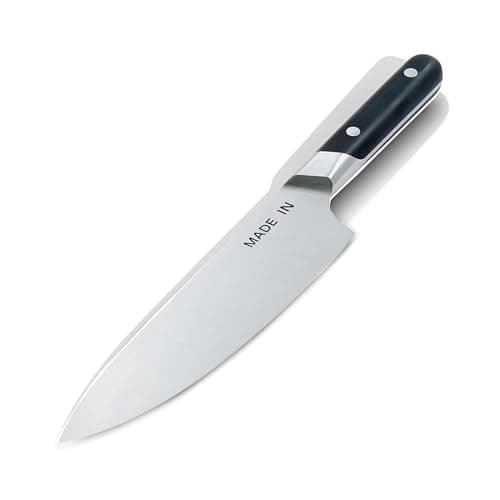
The Made In 8-inch is what happens when a direct-to-consumer brand does the expensive thing properly. It is fully forged in Thiers, France — the cutlery town that is to France what Solingen is to Germany — from X50CrMoV15 at around 58 HRC, with a full tang and a factory edge ground keener than the German norm. We have not cooked with this unit; the assessment below is compiled from published specifications and the value math on how we review.
It occupies a genuinely useful position: heavier and tougher than a Japanese blade, keener and cleaner-looking than most German ones, and priced below the Solingen names it competes with. That is why it appears in both our flagship roundup and the under-$200 list. What it is not is a value play — a Victorinox costs a third as much and does most of the same work.
What forging in Thiers actually gets you
Forging means the blade is hammered from a single billet of heated steel rather than cut from rolled sheet. In practice that produces a heavier knife with a thicker spine, better balance behind the handle, and a full tang running the length of the grip. It does not, by itself, make a knife sharper — that is grind and edge angle — and it does not make the steel harder. What it does is give the knife the planted, substantial feel that people mean when they say a knife feels expensive. Thiers has been the center of French cutlery for centuries, and a knife forged there is a real manufacturing claim rather than a marketing one, in the same way "made in Solingen" is — a distinction we spell out in our German roundup.
The steel is the same as a Wusthof. That matters.
X50CrMoV15 at around 58 HRC is exactly the specification you get from a Wusthof Classic, and it behaves the same way: tough, corrosion-resistant, easy to sharpen, and quicker to dull than harder Japanese steel. So the Made In does not offer better edge retention than the German knives — it offers the same retention with a keener factory grind and a lower price. That is a real advantage, and it is a narrower one than the marketing around direct-to-consumer knives usually implies. If retention is what you are shopping for, the Misenat 60–61 HRC costs less and holds longer.
Where it beats a Wusthof, and where it does not
It beats the Wusthof Classic on price and on factory sharpness, and it looks better on a magnetic strip if a clean modern aesthetic appeals to you. It loses on service: Wusthof has decades of repair, replacement and retail support behind it, and a knife you intend to keep for thirty years is partly a bet on the company still being there. It also loses on the reassuring familiarity of a shape millions of cooks already know. Neither of those is a performance argument, and both are legitimate reasons to pay more.
Living with it
Sharpen the front bevel at roughly 14 degrees and finish with a few light passes on the reverse, which is how Made In describes its own asymmetric grind — work both sides evenly at 15 degrees and you will slowly turn it into an ordinary symmetrical edge. Any competent stone will do; soft German-spec steel is forgiving, so nothing exotic is needed and our whetstone roundup covers the options. Hone regularly with a ridged steel rod; at 58 HRC the edge rolls rather than chips, so honing genuinely works. Hand wash and dry it, store it on a strip or in a block rather than loose in a drawer — see knife storage— and it will look and cut the same in fifteen years.
Who should buy it
The cook who wants one forged knife for life, likes the idea of French manufacturing, and does not want to pay the legacy premium. It is also a good gift for someone whose kitchen you already know — it is more interesting than a Wusthof and less risky than a hard Japanese blade, which is why it sits comfortably alongside the picks in our knife gift guide. If you are shopping purely on value, buy the Victorinox and put the difference into sharpening gear.
How we picked
We did not lab-test these knives
Everyone in this category says they tested twenty knives in a professional kitchen. We have not hands-on tested any of these, and we say so. What we did instead: compiled the published specifications — steel type and hardness (HRC), edge angle, blade geometry, weight and build — applied established sharpening standards, ran the value math (spec quality ÷ live price), and scored each product against a published rubric. The scores are judgments from documented research — not measurements we took, because we do not have a test lab and we will not pretend we do. Where a number came from someone else's work, we name them in Sources.