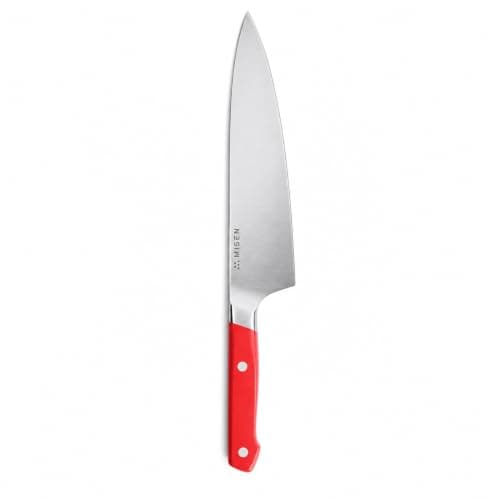
The Misen 8-inch is the clearest example on our site of what direct-to-consumer pricing actually buys you. It uses AUS-10 stainless hardened to roughly 60–61 HRC — harder than any German knife we recommend — ground to about 15 degrees, with a full tang and a sloped bolster, and it typically sells for less than a stamped Wusthof Gourmet. We have not cooked with this unit; what follows is compiled from published specifications and the value math described on how we review.
The short version: on paper this is the best steel-per-dollar in the mainstream chef's knife market, and it is genuinely why the knife appears in our flagship ranking and near the top of the under-$200 list. The catch is the same as with every hard blade: harder steel is more brittle, and 60–61 HRC is firmly in chip-if-you-abuse-it territory. If you cut around bone or you are heavy-handed, a softer forged knife from our German roundup will serve you better and cost you less grief.
One thing to know before you buy: this is the outgoing generation. Misen has moved its own range to a different steel — AICHI ACUTO440, a higher-chromium Japanese stainless chosen for corrosion resistance — on a blade with a rounded spine and bolster, and the ACUTO440 knife is the only 8-inch chef's knife Misen now sells direct. The AUS-10 blade reviewed here is still listed on Amazon, which is where our link and price point, but it is a run-out of the previous design. We have scored the AUS-10 knife because that is the one whose steel and hardness Misen published; Misen publishes far less about ACUTO440, so we are not going to score it from marketing copy.
What AUS-10 at 60-61 HRC actually means for you
AUS-10 is a Japanese stainless that typically lands around 58–60 HRC, and Misen publishes a figure at the top of that band. Practically, that is a meaningful step above the X50CrMoV15 in a Wusthof or Zwilling, which sits nearer 56–58. Harder steel resists deformation, so the apex stays where you put it for longer — you will hone less often and sharpen less often. The tradeoff is the one every hard blade makes: when it does fail, it fails by chipping rather than by rolling, and a chip cannot be honed out. Our knife steel guide works through why hardness and toughness pull against each other, and Japanese vs German frames it as a buying decision.
The sloped bolster is the underrated feature
Most people notice the steel; the bolster is arguably the better design decision. A traditional full bolster — the collar of steel that runs to the heel on a Wusthof Classic or a Zwilling Professional S — keeps the last inch of edge off a sharpening stone forever. Over a decade of maintenance the rest of the blade recedes and the heel stands proud as a hook, and the only real fix is grinding the bolster back. Misen's sloped bolster gives you the finger protection and the balance without that problem: the whole edge reaches the stone. If you intend to maintain your own knives, this matters more than most spec-sheet features, and we cover why in easiest knives to sharpen.
What you give up against a Shun or a MAC
Fit and finish, mostly. The premium Japanese names put more work into the spine and choil rounding, the handle transition, and the overall hand feel, and it is noticeable when you hold them side by side. A Shun Classic also brings Damascus cladding and a D-shaped handle that some hands genuinely prefer, and a MAC Chef Series is thinner behind the edge, which is why it out-slices the Misen despite similar hardness. None of that changes how long the edge lasts. If you are buying steel, the Misen is the value answer; if you are buying an object, it is not.
Sharpening a Misen
Treat it as a Japanese knife, because it is one. Sharpen at roughly 15 degrees per side rather than the Western 20 — the angle guidecovers how to find and hold it — and use a diamond plate or a hard ceramic stone rather than a soft waterstone, which can glaze against hard steel and stop cutting. If freehand is not your thing, a guided system from our systems roundup that reaches 15 degrees will do the job repeatably. And use a smooth ceramic honing rod rather than a ridged steel one; ridges chip hard edges.
Who should buy it
The cook who wants a keener edge that lasts, is willing to use a wooden board and keep the blade off bone, and would rather spend the difference on a decent stone than on a brand name. That is a large fraction of engaged home cooks. Everyone else — anyone buying their first real knife, anyone who cooks a lot of bone-in food, anyone who wants a knife they can genuinely stop thinking about — should look at our beginner ranking instead, where forgiveness is the criterion rather than hardness.
How we picked
We did not lab-test these knives
Everyone in this category says they tested twenty knives in a professional kitchen. We have not hands-on tested any of these, and we say so. What we did instead: compiled the published specifications — steel type and hardness (HRC), edge angle, blade geometry, weight and build — applied established sharpening standards, ran the value math (spec quality ÷ live price), and scored each product against a published rubric. The scores are judgments from documented research — not measurements we took, because we do not have a test lab and we will not pretend we do. Where a number came from someone else's work, we name them in Sources.