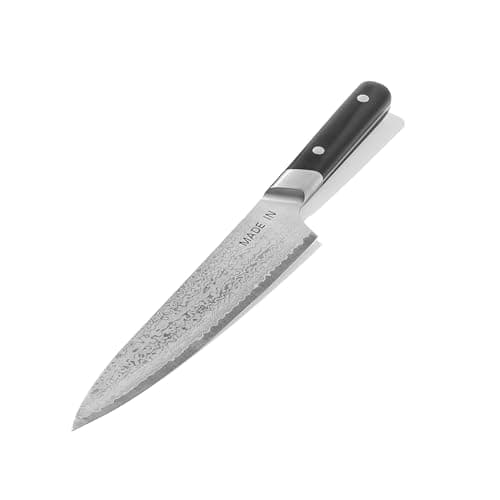
Made In is a direct-to-consumer brand that has done something unusual: rather than putting its name on a generic factory blade, it commissioned knives from established makers in Seki, Japan and Thiers, France. The 8-inch Damascus gyuto is the Japanese half of that story — a VG-10 core clad in 66 Damascus layers, run around 60–61 HRC, in a gyuto profile rather than a Western chef's knife shape.
We have not cooked with this unit and we do not have a test lab; what follows is compiled from published specifications and the value math we apply to every pick, as described in how we review. It ranks in our best Japanese chef knives roundup as the Damascus pick, and this page is the longer version of that entry. For the shape itself, read chef's knife vs gyuto.
What Damascus cladding actually does
This is the part worth understanding before you pay for it, because the marketing across the whole category is misleading. In a clad blade like this one, a hard cutting core — here VG-10 — is sandwiched between many layers of softer stainless, which are then etched to reveal the pattern. Only the core reaches the apex, so the Damascus layers contribute nothing to sharpness or edge retention. What they do contribute is real but modest: lateral support that makes a hard, brittle core less prone to cracking, some release as food passes the blade face, and the appearance you are largely paying for.
Two things to watch for elsewhere in the market, though not here. A surface pattern printed or acid-etched onto a monosteel bladeis not cladding at all — it is decoration, and it wears off. And a high layer count is not a quality metric; 66 layers is not inherently better than 33. Made In publishes the construction honestly, which is more than a lot of Damascus listings do.
VG-10 at 60–61 HRC
VG-10 is a well-understood Japanese stainless: high carbon with chromium, molybdenum, vanadium and cobalt, run hard. At 60–61 HRC it takes a keen edge, holds it considerably longer than any Western steel here, and fails by chipping rather than rolling. That last point drives everything about owning it. A honing rod does relatively little for a chipped edge, so this knife needs a stone rather than a steel — and if you are not prepared to learn stone work, the hard steel you paid for becomes a liability the first time the edge goes. Start with a beginner whetstone if that is you.
Best Damascus
Made In 8" Damascus Gyuto
VG-10 core66-layer Damascus~60-61 HRCCrafted in Japan
The Damascus showpiece. A VG-10 core in 66-layer Damascus, crafted in Japan - a keen, hard gyuto with the looks to match, from a modern direct-to-consumer brand.
- Edge & steel
- 9
- Sharpness
- 9
- Handling
- 8
- Build
- 9
- Value
- 7
Pros
- +VG-10 core takes and holds a keen edge
- +66-layer Damascus is genuinely striking
- +Gyuto profile suits push-cutting and slicing
- +Japan-crafted at a modern-brand price
Cons
- −Hard, thin edge is chip-prone against bone
- −Premium price near the top of this list
Don't buy this if…
…you want a tough do-anything knife - a gyuto this hard is for careful slicing, not heavy chopping.
The gyuto profile is not a detail
A gyuto is the Japanese interpretation of a Western chef's knife, and it behaves differently from one. It is thinner, lighter, flatter along the edge and more acutely pointed than a German knife of the same length. That flatter profile rewards a push cut or a shallow forward glide and rocks less willingly, so if you chop by rocking the tip on the board through a pile of herbs, expect an adjustment period. It replaces a chef's knife completely — unlike a santoku, it loses nothing on reach or piercing — but it asks you to cut slightly differently. See santoku vs gyuto for the shape comparison.
Who should not buy this knife
Three groups, and we would rather be direct about it. Anyone who will not sharpen on a stone, for the reasons above. Anyone whose cooking involves bone, joints, frozen food or hard squash on a regular basis — a 60+ HRC thin edge chips where a German knife would roll, and a chip needs a coarse stone and real time to remove. And anyone buying their first good knife: a hard, thin, expensive blade is an unforgiving place to learn knife handling, and a softer Western knife will teach you more cheaply. Our beginner roundup covers that case.
Direct-to-consumer, and what that changes
Made In sells directly rather than through the traditional distribution chain, which is how the price lands where it does for Japanese manufacture. The trade is the one every DTC brand carries: a shorter track record than a house that has been forging since the 1800s, and a service relationship that depends on the company continuing to exist in the same form. That is not a criticism so much as a different risk profile. If a hundred-year warranty network matters to you, the established German and Japanese names still hold that card.
Living with a hard Japanese blade
Hand-wash and dry immediately — VG-10 is stainless but the cladding and the etched pattern do not enjoy prolonged moisture, and the dishwasher is out entirely. Cut on wood or soft plastic; a glass or stone board will chip this edge quickly. Store it where nothing contacts the blade, which for a knife at this price means a magnetic strip, a saya or an edge guard rather than a drawer — see best knife storage. And sharpen at the angle it was ground at, around 15 degrees per side; a 20-degree pull-through sharpener will thicken the edge and undo the geometry that justifies the price. Knife sharpening angles has the detail.
Where it sits in our rankings
It scores 8.4 overall, held back only by a value score of 7 — which is the honest position for a genuinely excellent knife at a premium price. On specification it is one of the strongest blades we cover: hard, keen, well-built and honestly described. On value it is beaten by knives that cut nearly as well for far less. Which of those matters more is the question this whole site exists to help you answer, and are expensive chef knives worth it is where we take it on directly.
How we picked
We did not lab-test these knives
Everyone in this category says they tested twenty knives in a professional kitchen. We have not hands-on tested any of these, and we say so. What we did instead: compiled the published specifications — steel type and hardness (HRC), edge angle, blade geometry, weight and build — applied established sharpening standards, ran the value math (spec quality ÷ live price), and scored each product against a published rubric. The scores are judgments from documented research — not measurements we took, because we do not have a test lab and we will not pretend we do. Where a number came from someone else's work, we name them in Sources.
Questions
Frequently asked
Does Damascus cladding make a knife sharper?+
No. Only the hard core reaches the cutting edge. The cladding adds lateral support, some food release, and the pattern — but nothing to sharpness or edge retention.
Is a higher Damascus layer count better?+
No. Layer count is an aesthetic and manufacturing choice, not a quality metric. Sixty-six layers is not inherently better than thirty-three.
Is VG-10 a good steel?+
Yes — a well-understood Japanese stainless that runs hard, takes a keen edge and holds it well. The trade is that it chips rather than rolls, so it needs a stone rather than a honing rod.
Can I use this knife on bone?+
No. A thin edge at 60+ HRC chips against bone, joints and frozen food. Keep a tougher Western knife for that work.
Is a gyuto different from a chef's knife?+
Same job, different execution — thinner stock, harder steel, a flatter profile and a more acute point. It replaces a chef's knife entirely but rewards a push cut over a rock chop.
Receipts
Sources
We do not run a testing lab, and we do not pretend to. Where a spec or a measured number came from someone else's work — a manufacturer's page, a published standard — we name them and link them. Where we could not verify something, we say so on the page rather than quietly leaving it out. Read our full method.