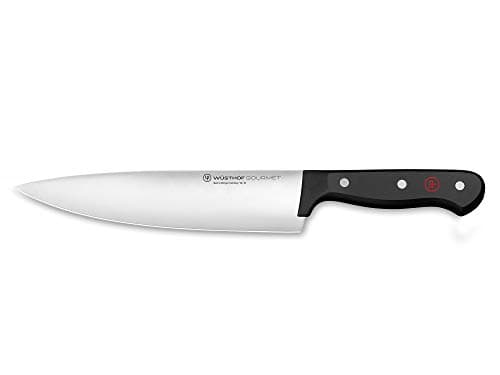
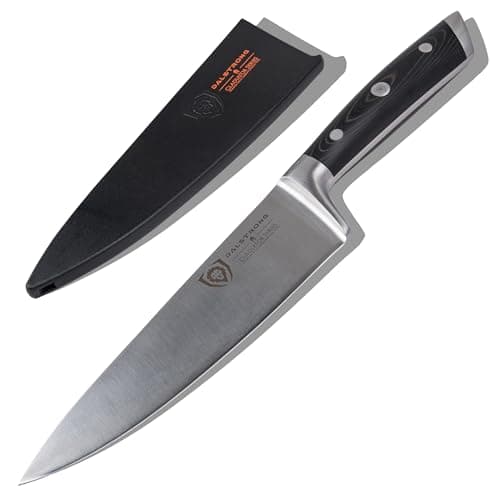
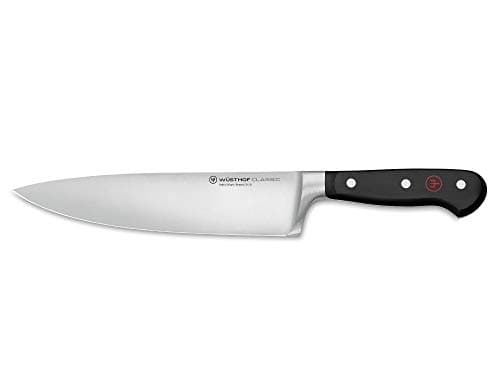
The Wusthof Classic 8-inch wins this comparison, and it is not the knife most people asking the question are choosing between. Dalstrong's Gladiator Series 8-inch sits roughly two-thirds of the Classic's price. At that money the knife it actually competes with is Wusthof's own stamped line, the Gourmet — and on our five-metric rubric those two finish level at 7.8, with the Gourmet cheaper and the Gladiator better built. If you want one knife for the next thirty years and you will keep it honed, buy the Classic. If you want the look and feel of a premium knife at a mid-budget price, the Gladiator is a legitimate purchase, and the honest comparison is a tie.
Two notes on method before the table. First, the scores on this page are reproduced, not re-rated.Each knife's five metrics come verbatim from its natural parent page on this site — Victorinox vs Wusthof for the two Wusthofs, our Gladiator reviewfor the Dalstrong — and all three use the same rubric, which is what makes the three averages directly comparable rather than three separate opinions.
Second, the Gladiator and the Gourmet genuinely tie at 7.8.We have not broken the tie by judgment; the house rule is cheaper-first, so the Gourmet takes second place on price. If presence and build matter more to you than ten dollars, read them as joint second. Everything here is judged from published specifications and the value math — see how we review. We have not cooked with these knives and we do not have a test lab.
The actual difference, in one paragraph
Wusthof is a 200-year-old Solingen house that forges from a single billet, grinds a full bolster and a full tang, and publishes its hardness and edge angle. Dalstrong is a marketing-led brand that specifies and sources its knives — forged ThyssenKrupp steel, a G-10 handle, NSF certification — and sells them at prices that undercut Solingen heavily. Neither of those descriptions is an insult. The Gladiator is a properly specified forged full-tang knife with a grippy composite handle; what it does not have is Wusthof's keener published grind, Wusthof's service and spares network, or Wusthof's century of continuity. What Wusthof does not have is Dalstrong's price.
Forged versus stamped, which is the real axis here
Two of the three knives on this page are forged and one is stamped, and that single distinction explains most of the score differences. A forged blade is hammered from a heated billet, which allows a bolster, a thicker spine and a full tang running the length of the handle — mass, balance and rigidity. A stamped blade is cut from rolled sheet: lighter, thinner, cheaper, and with nothing wrong with it except that it cannot be heavy or balanced in the way a forged knife is. Stamped vs forged knives has the full argument, including why stamped is sometimes the better buy.
The useful consequence for this comparison: at the Gladiator's price, Wusthof only sells you a stamped knife. If forged construction is the thing you want, Dalstrong is offering it two price tiers lower than Solingen does, and that is a real argument rather than a marketing one.
What the Wusthof premium actually buys
A keener published grind. Roughly 14 degrees per side on the Classic against a stated 16-18 on the Gladiator. That is a measurable difference in how the knife arrives and how it cuts, and honing angle explains why it also changes how you maintain it.
Continuity. Spares, matching pieces, a resharpening service and a company that has been in the same city doing the same thing for two centuries. If you expect to own the knife for thirty years and have it reground twice, that is worth real money.
Precision in what is published. Wusthof states an alloy designation, a hardness and an angle. Dalstrong states a steel supplier and a hardness range. Neither is dishonest; one is more verifiable, and this site scores on what is published, which is why edge-and-steel splits 8 to 7.
Which to buy, in three lines
One knife, for decades, and you will hone it: the Wusthof Classic. The build score is not a rounding difference.
A knife that feels expensive, on a mid budget: the Gladiator. It is the best-feeling object per dollar here, and that is a legitimate thing to buy.
The lightest knife, or the Solingen name on a budget:the Gourmet. And if value is what you are really optimising for, neither brand wins that argument on this site — Victorinox vs Wusthof and best chef knives under $100 both end somewhere else.
If you arrived here from the other direction — weighing the Gladiator against a Japanese knife rather than a German one — Shun vs Dalstrong is the companion to this page. It reaches a different conclusion for a specific reason: against Wusthof the Gladiator is a fair fight on the same steel family, and against a 60-61 HRC Shun it is not the same category of knife at all.