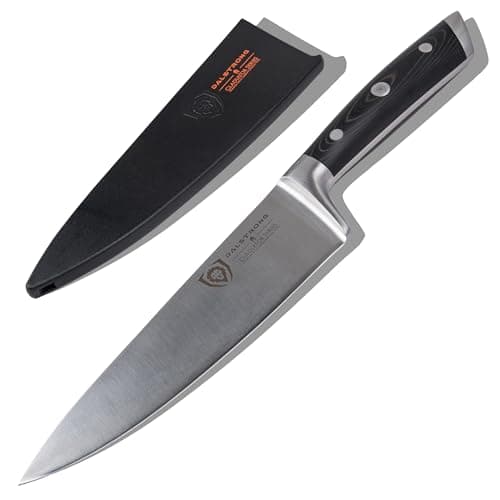
Dalstrong is the most polarizing brand in this category, and most of the argument is about tone rather than steel. The marketing is loud — series names borrowed from gladiator films, hyperbolic copy, dramatic photography — and that leads a lot of people to assume the knife underneath is all show. The published specifications say otherwise. The Gladiator Series 8-inch is a genuinely forged, full-tang blade in ThyssenKrupp German steel at around 56+ HRC, ground at roughly 16–18 degrees per side, with a G-10 handle and NSF certification. That is a real specification at a mid-budget price.
We have not cooked with this unit and we do not run a test lab. What follows is compiled from published specs and the value math we apply to every pick, exactly as set out in how we review. It ranks in our best chef knives and best chef knives for the money roundups, and this page is the longer version of that entry.
What you are actually buying
Three things distinguish this from the stamped budget knives it competes with on price. First, it is forged, with a full tang running the length of the handle — that gives it the mass and the rear-biased balance a stamped knife cannot have. See stamped vs forged for what that does and does not buy you. Second, the G-10 handleis a laminated composite that is genuinely grippy, dimensionally stable and impervious to moisture — it is the material used on serious outdoor knives, and it is unusual at this price. Third, the edge angleis ground keener than a traditional German knife at around 16–18 degrees per side, which sits between Western and Japanese practice.
The steel, in plain terms
ThyssenKrupp German steel at around 56+ HRC is squarely in the Western tradition: tough, forgiving, easy to sharpen, and it rolls rather than chips when it fails. That last point matters more than the hardness number, because a rolled edge is trivially fixed with a honing rod and a chip is not. It also means edge retention is good rather than exceptional — a hard Japanese blade at 60+ HRC will hold longer, and will punish you harder when you finally have to bring it back. If the alloy vocabulary is unfamiliar, knife steel types explained covers it.
Who this knife is for
Someone who wants a forged knife that feels substantial and looks expensive, without paying Solingen or Seki prices. If you have handled a stamped Victorinox and found it insubstantial — a genuinely common reaction, and not an unreasonable one — the Gladiator is the obvious next step. It delivers the heft, the bolstered feel and the visual weight that make some cooks enjoy using a knife, and enjoying a knife is a real factor in whether you keep it sharp and keep using it.
Who should buy something else
If you want the keenest possible edge, a harder Japanese blade at 60+ HRC ground at 15 degrees will out-cut this and hold it longer — see best Japanese chef knives. If you want maximum performance per pound, the stamped budget knives in best chef knives under $100 give you very nearly the same cutting for meaningfully less. And if you prep for long stretches or have smaller hands, a forged knife's weight works against you — chef knives for small hands explains why light usually wins there.
The Phantom problem
This is the part of the Dalstrong story worth knowing before you shop the wider range. Reviewers repeatedly single out the pricier Phantom line for build issues, and it is the series we would steer people away from. That is not a comment on Dalstrong as a whole — the Gladiator earns its place in our roundups on specification and value — but the brand's catalog is wide and inconsistent in a way that Wusthof's or Victorinox's is not. Buy the specific line, not the badge.
On the marketing
We would rather say this plainly than pretend it does not matter. The copy around these knives is far hotter than the product requires, and it costs Dalstrong credibility with exactly the buyers who read specifications. Ignore the series names and the adjectives and read the three numbers that matter — forged construction, roughly 56+ HRC, 16–18 degrees per side — and what remains is a solid mid-budget forged knife. The knife is better than its advertising, which is an unusual complaint to have.
Living with it
At around 56+ HRC this is soft enough that a honing rod does real work — hone it weekly and you will rarely need a stone. Full method in how to use a honing steel and how often to sharpen knives. When it does need sharpening, the 16–18 degree factory grind means a 20-degree pull-through sharpener will thicken the edge over time; a stone or an adjustable guided system respects the geometry. G-10 is impervious to water and needs no care beyond hand-washing and drying the blade, which you should be doing anyway — see knife care and maintenance.
One comparison this knife gets pulled into that it does not really belong in: people shop it against Shun. The steel says otherwise — the Gladiator is forged Western stainless in the mid-50s HRC and a Shun Classic is a VG-MAX core at 60-61 — and we have set out why that matters, and what the cheaper route to a Shun edge actually is, in Shun vs Dalstrong.
How we picked
We did not lab-test these knives
Everyone in this category says they tested twenty knives in a professional kitchen. We have not hands-on tested any of these, and we say so. What we did instead: compiled the published specifications — steel type and hardness (HRC), edge angle, blade geometry, weight and build — applied established sharpening standards, ran the value math (spec quality ÷ live price), and scored each product against a published rubric. The scores are judgments from documented research — not measurements we took, because we do not have a test lab and we will not pretend we do. Where a number came from someone else's work, we name them in Sources.