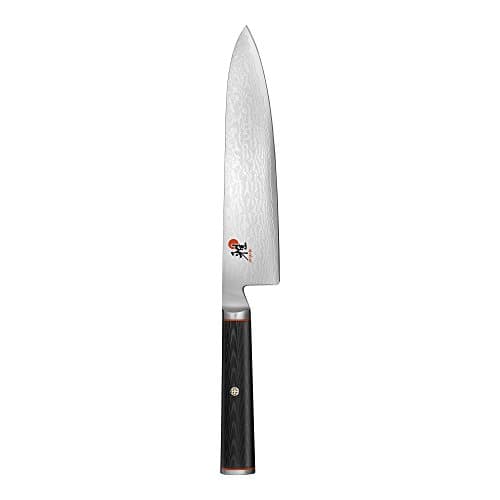
Buy it if you already sharpen on a stone. The Miyabi Kaizen arrives with a finer factory edge than anything else we rank — Zwilling publishes 9.5 to 12 degrees against the roughly 16 of a Shun Classic and the roughly 20 of a German knife — and that is a difference you feel on the first cut rather than infer from a table. If you do not sharpen, this is the most expensive dull knife you can buy.
That is an unusually conditional recommendation for a flagship, and it is the honest one. Most premium knives punish neglect gently: the edge rolls, you notice it is tired, a rod brings it back. A bevel this fine does not have that safety margin. The same geometry that makes it exceptional makes it unforgiving, and the published numbers say so plainly if you read them as a package rather than as a scorecard.
Everything here comes from Zwilling's own published specification for this knife, read while writing this review — steel and hardness, edge angle, cladding, handle material, blade length and weight. See how we review: we do not have a test lab, we have not handled this knife, and we are not going to imply otherwise. Where the maker's own page contradicts itself, which it does twice, this review reports both figures instead of picking the flattering one.
What Zwilling publishes
A CRYODUR ice-hardened blade at 60-62 HRCper the specification table — the same page says “ice-hardened to Rockwell 60” in its prose, so treat the figure as a band rather than a point. The edge is finished through a three-step Honbazuke process, hand-honed, to a published 9.5 to 12 degrees. The core is clad in 64-layer flower Damascus— the same page says 65 layers elsewhere. The handle is black linen Micarta, D-shaped. The blade is 7.87 inches and the knife weighs 0.44 lb, roughly seven ounces. It is handcrafted in Seki, Japan.
The one figure we cannot report cleanly is the steel. Zwilling's feature list describes a “resilient core of VG10 super steel”; the specification table immediately below names the substance as CMV60. Those are not the same designation. We are not going to resolve a manufacturer's inconsistency on its behalf, and we are not going to quietly print whichever one sounds better — so both are above, and the practical conclusion is unaffected: whatever the exact alloy, it is a hard Japanese stainless core in the low 60s, which is a well-understood category of behavior.
That matters more than it looks. This site weights published specifications heavily — it is the basis of every score we give — and Kai publishes Shun's figures consistently where Zwilling does not publish Miyabi's. On cutting performance that counts for nothing. On trust it counts for something, and it is the main reason this knife does not sweep every metric.
What the 9.5-12 degree edge actually buys
Edge angle is the most under-published and most consequential number in cutlery, and this is the lowest one we have on file. The practical effect is force: a finer bevel needs less downward pressure to start a cut, so the knife enters a tomato skin or an onion membrane without the small push that a 20-degree edge requires. On soft, slippery and layered food that is the difference between slicing and sliding.
The second effect is cut quality. Less force means less crushing, which on produce means cleaner cut faces that keep better — the same mechanism that makes a thin keen blade the right answer in the best knife for onions, where rupturing fewer cells also means fewer tears. On protein it means you can take a thin slice off a cooked piece without tearing it.
The Honbazuke process is the reason the angle is achievable at all. It is a named, published three-step hand-honing operation rather than a marketing word, and a hand-finished edge is how you get a bevel that fine to be even along the whole blade. A machine-ground 10-degree edge would be inconsistent; that is why almost nobody publishes one.
And what it costs you
Fragility, in a specific way.Steel in the low 60s chips rather than rolls — that is true of every knife in this band, including the Shun. What a 10-degree bevel adds is less steel behind the apex to absorb a shock, so the same knock that would dent a 16-degree edge can take a piece out of this one. Keep it off bone, off frozen food, off hard squash, and off hard boards. Glass, stone and ceramic are not an option; best cutting boards for knives covers why board hardness is the largest single determinant of edge life.
A maintenance requirement, not a maintenance option.A honing rod does very little at this hardness and a ridged steel rod can chip the edge outright. There is no rod-only path with this knife. You need a stone, you need to know the angle, and you need to hold it — because every degree you accidentally add is a large proportion of a ten-degree bevel. Put this edge through a pull-through sharpener cut for a 20-degree Western knife and you have not dulled it, you have reprofiled it, and recovering a factory-fine bevel from that is a long session on a stone. Start with knife sharpening angles and then sharpeners cut for Japanese edges.
No cheap way to try it first.This is the structural criticism rather than a criticism of the knife. Shun will sell you its cutting philosophy in a composite-blade entry knife for a small fraction of its flagship, so you can learn whether hard thin steel suits you before committing. Miyabi's entry 8-inch chef knife is still listed at retail, but Zwilling's own product page for it is retired, which leaves no maker-published specification to judge it on. The full version of that argument is at Shun vs Miyabi, and it is the reason that page recommends Shun to first-time buyers and this knife to everyone else.
This review is not about the Kaizen II
Worth stating early, because the two get conflated constantly and “miyabi kaizen ii review” is its own search. The Kaizen is the 5000DP line and the knife reviewed here. The Kaizen IIis the 5000FCD line, and per Zwilling's own separate listing it is built on FC61 steel rather than the core published for this knife. Same family name, different blade.
We have not reviewed the Kaizen II and we are not going to extrapolate a score to it from this one — a different steel is a different knife, and the whole method on this site is to judge what the maker publishes about the specific model in front of us. If the listing you are looking at says 5000FCD or FC61, the figures on this page do not describe it.
Who this knife is actually for
The cook who already owns a stone and uses it. This is the whole target market. If sharpening is already a habit, the finer bevel is a straightforward upgrade: you get a keener starting point and you already have the skill to put it back. For that person this is the best-specified knife we rank.
The cook adding a second serious knife.If you own a German workhorse for bone, squash and rough jobs, this is an excellent precision partner. The division of labor solves the fragility problem completely — the Kaizen never meets the things that would chip it. That two-knife setup is argued out in what knives a kitchen actually needs.
Not the cook buying their first good knife. We would send that person to best chef knives for beginners or, if they specifically want Japanese, to best Japanese chef knives for beginners. Not because the Kaizen is too good for a beginner — that is a snobbery we have no interest in — but because the failure mode is expensive and silent. A beginner does not chip this knife on day one. They put it in a drawer, hone it on the rod from the block, wonder why it got worse, and conclude that Japanese knives are overrated.
Not the cook who cooks bone-in. If you spatchcock chickens, portion ribs or work through squash regularly, the right tool is tougher steel at a wider angle. That is best German chef knives, and nothing about this review should talk you out of it.
Owning one: the four rules
1. A soft board, always. End-grain wood or a soft composite. The edge is the thing you paid for and the board is what removes it.
2. Hand wash, dry immediately.Not the dishwasher — caustic detergent and blade-on-blade contact are both bad for a Damascus-clad edge, and the reasoning is in can you put knives in the dishwasher.
3. A stone, not a rod. A 1000/6000 combination is enough to maintain this edge indefinitely once you know the angle; the beginner options are in best sharpening stones for beginners. Practice the angle on a cheap knife first, not on this one.
4. Stored on a strip or in a guard, never loose in a drawer. Blade-on-blade contact in a drawer is the commonest way a fine edge chips, and it happens without anyone noticing. Best knife storage ranks the options, and if the knife travels, best knife rolls and chef knife bags covers the full-depth pockets a hard blade needs.
How it sits against the rest of what we rank
Against the Shun Classic 8" (8.4), it wins on published edge angle and loses on documentation and on the absence of a cheap entry rung. The head-to-head is Shun vs Miyabi.
Against the MAC Chef Series 8", the comparison is more interesting than the scores suggest. The MAC is thinner behind the edge at a softer ~59 HRC and a wider ~15 degrees, and it is the knife that keeps winning our task pages on cut quality. The Kaizen has the finer bevel; the MAC has the thinner blade. For most home cooking the MAC is the better-value answer, which is why it holds the top slot on best chef knives.
Against a Wusthof Classic 8", it is not really a comparison — it is the Japanese-versus-German decision, and if you have not made that one yet, make it first at Japanese vs German chef knives. Every criticism on this page dissolves if the answer turns out to be German, and nothing here is an argument that it should not be.