Skip to content
The Edge Bench

Roundups & reviews · Chef Knives

Alternatives to Shun

Shun Classic is a VG-MAX core at 60-61 HRC, Damascus-clad, ground to about 16 degrees per side on a D-shaped handle. Five knives that match the steel, the grind or the price - ranked, with the handle question answered.

Miyabi Miyabi Kaizen 8"

Our top pick · Closest match overall

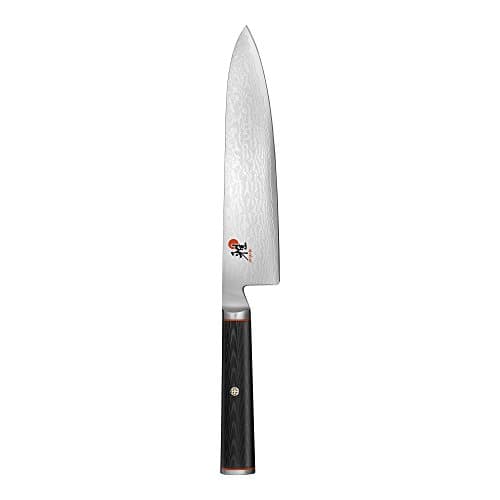
Miyabi Kaizen 8"

8.4

The closest alternative, and the only knife here that beats Shun on its own terms. CRYODUR ice-hardened to a published 60-62 HRC with a Honbazuke edge at 9.5-12 degrees per side and 64-layer flower Damascus, on a black linen Micarta D-handle. Harder band, narrower grind, same category of knife, same D-shaped handle problem.

$169.95Amazon

#ad · Full ranking below

By Stephen V.Updated How we review
#ad

We earn a commission when you buy through our Amazon links, at no extra cost to you. It never changes a verdict, and we say so when the cheaper knife is the better buy. How this works.

Buy the Miyabi Kaizen 8" — it is the closest alternative to a Shun Classic, and it is for someone who wants the same hard Damascus-clad Japanese knife from a different house. CRYODUR ice-hardened to a published 60–62 HRC, a Honbazuke edge at 9.5–12 degrees per side, 64-layer flower Damascus, and a black linen Micarta D-handle. On hardness it matches Shun; on grind it is narrower. The budget pick is the Kai Seki Magoroku nakiri— a thin Seki-made Japanese blade from Shun's own parent company, for a tiny fraction of Classic money, in a different shape.

Every knife here was in stock and priced at our last price check. We do not print a number in the prose: the Quick Picks table carries the live price and the date we pulled it, with a Check price button on every row.

What Shun is actually known for

From Kai's own published specification for the Classic line: a VG-MAX core at roughly 60–61 HRC, clad in 68 layers of Damascus, ground to about 16 degrees per side, on a D-shaped pakkawood handle, made in Seki, Japan. Kai also runs a sharpening and service programme for the line, which almost no knife brand does.

Three of those are the product. The hardness is what lets a thin edge stay keen for weeks of prep. The 16-degree grind on thin stock is what makes a cut through dense produce feel different rather than merely sharper. The Damascus claddingis a soft jacket around the hard core: protective, decorative, and not where the performance comes from — Damascus steel knives explained is honest about that.

The fourth, the D-shaped handle, is the most common reason people go looking for an alternative in the first place. It is contoured asymmetrically for a right hand, and in a left hand it is noticeable. Two knives on this page have symmetrical Western handles, and that is a genuine functional difference rather than a styling one.

Nothing here matches all four. If you want all four, buy the Shun — best Shun knives is where the line is ranked properly. What follows is which property each alternative keeps.

The method is on how we review: we have not hands-on tested these knives and we do not claim to have. The scores come from published specifications and from value arithmetic against the live price. Everything sits under the chef knives hub.

The short answer

Quick picks

#KnifeBest forScorePrice
01
Miyabi Miyabi Kaizen 8"
Miyabi Kaizen 8"

The closest alternative, and the only knife here that beats Shun on its own terms. CRYODUR ice-hardened to a published 60-62 HRC with a Honbazuke edge at 9.5-12 degrees per side and 64-layer flower Damascus, on a black linen Micarta D-handle. Harder band, narrower grind, same category of knife, same D-shaped handle problem.

Closest match overall
8.4
$169.95Amazon
02
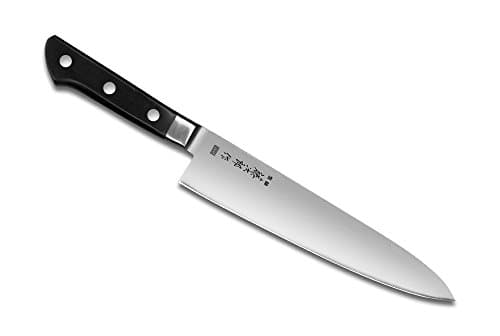
Tojiro Tojiro Professional VG10 Chef Knife 8.2" (210mm)
Tojiro Professional VG10 Chef Knife 8.2" (210mm)

The value answer, and the knife to buy if the core steel is what you came for. A VG-10 core clad in stainless, in a 210mm gyuto profile with a Western-style bolstered handle, made in Japan - the same steel family as Shun's cutting core, with a symmetrical handle and no Damascus, for well under Classic money.

Best value Japanese core
8.4
Check price →
03
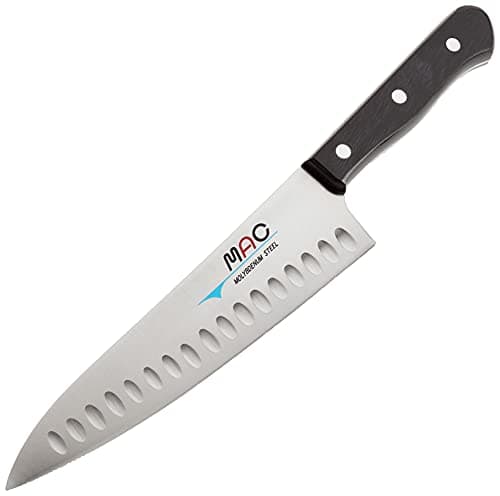
MAC MAC Chef Series 8" (Hollow Edge)
MAC Chef Series 8" (Hollow Edge)

The alternative for someone who wants thin and hard without Damascus or a handed handle. Japanese high-carbon steel at ~59 HRC with a ~15 degree edge, a thin blade and hollow-edge dimples, on a conventional symmetrical handle - a slightly softer core than Shun, a narrower grind, and no gamble on the grip.

Best thin-and-hard, no handedness issue
8.6
$110.87Amazon
04
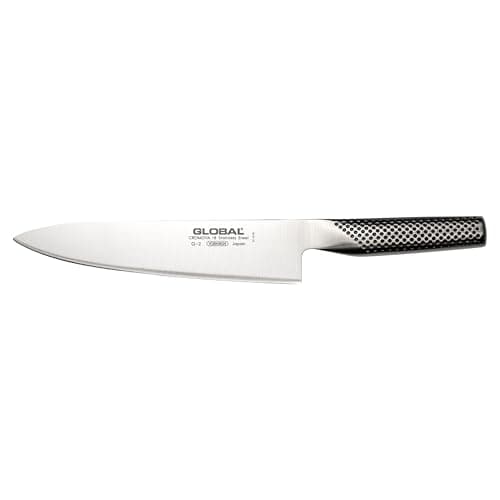
Global Global G-2 8"
Global G-2 8"

The alternative for someone whose objection to Shun is the handle, full stop. CROMOVA 18 at 56-58 HRC with a 10-15 degree factory edge on a one-piece steel body with a sand-filled, dimpled, completely symmetrical handle - at 6 ounces it is the lightest knife here, and there is no wood, no rivet and no handedness.

Best for a symmetrical grip
8.1
$119.99Amazon
05
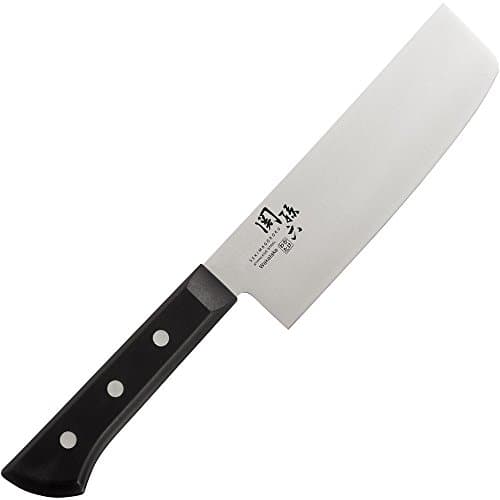
Kai Kai Seki Magoroku Nakiri 165mm
Kai Seki Magoroku Nakiri 165mm

The budget pick, and an unusual one: it is made by Kai, the company that makes Shun, in the same city. A thin 165mm Japanese stainless nakiri from the Seki Magoroku line on a light handle, for a tiny fraction of Classic money - a different shape and a plainer knife, from the same house.

Budget pick
7.7
$18.55Amazon

#ad · Live prices from the Amazon Product API, as of November 12, 2026. Where we have no verified live price, we show none — a gap beats a number that has rotted.

In detail

The picks, in full

01
Miyabi Miyabi Kaizen 8"

Closest match overall

Miyabi Kaizen 8"

CRYODUR ice-hardened, 60-62 HRC9.5-12 deg Honbazuke edge64-layer flower DamascusBlack linen Micarta D-handle
8.4/10

The closest alternative, and the only knife here that beats Shun on its own terms. CRYODUR ice-hardened to a published 60-62 HRC with a Honbazuke edge at 9.5-12 degrees per side and 64-layer flower Damascus, on a black linen Micarta D-handle. Harder band, narrower grind, same category of knife, same D-shaped handle problem.

Match on steel & hardness
9.5
Match on grind
9.5
Build & finish
9
Handle & handedness
7.5
Value per dollar
6.5

Pros

  • Published 60-62 HRC overlaps and slightly exceeds Shun's 60-61
  • A stated 9.5-12 degree edge is substantially narrower than Shun's ~16, which is a real difference in cut feel
  • Linen Micarta is more stable and more durable than pakkawood, and it does not mind water
  • 64-layer Damascus cladding, so the look is in the same register
  • Backed by Zwilling's service and distribution network

Cons

  • Costs more than a Shun Classic at our last price check, so this is a sideways move rather than a saving
  • A 9.5-12 degree edge at 60+ HRC is the most chip-prone combination on this page
  • Zwilling's own product page for the line contradicts itself on core steel and layer count, and we report both figures rather than choosing
  • Same asymmetric D-handle issue as Shun, so it does not solve that complaint

Don't buy this if…

…price or the D-shaped handle is why you are looking past Shun - this is dearer and handed the same way, and it answers neither objection.

Re-scored on this page's rubric rather than carried over; it is reviewed in full at our Miyabi Kaizen review, and the head-to-head is Shun vs Miyabi.

It wins this page by matching Shun on the specification that matters and exceeding it on the second. A published 60–62 HRC band sits at or above Shun's 60–61, and a Honbazuke edge at 9.5–12 degrees per side is far narrower than Shun's ~16 — which is the one specification difference on this page you would feel immediately. It is also the one you would feel when it chips: a very narrow edge on very hard steel has the least margin of anything here, and how to fix a chipped knife is worth reading before you buy it rather than after.

One honesty note we carry on every page that mentions this knife: Zwilling's own product page for the Kaizen contradicts itself on the core steel and on the Damascus layer count. We report both figures rather than choosing the flattering one, and the hardness is given as the published band rather than a single number.

$169.95View on Amazon

Price as of November 12, 2026. Prices change — Amazon's at checkout is the one that counts.

#ad · we may earn a commission from this link to Miyabi Kaizen 8"

02
Tojiro Tojiro Professional VG10 Chef Knife 8.2" (210mm)

Best value Japanese core

Tojiro Professional VG10 Chef Knife 8.2" (210mm)

VG-10 core, clad stainless210mm gyuto profileWestern-style handle with bolsterMade in Japan
8.4/10

The value answer, and the knife to buy if the core steel is what you came for. A VG-10 core clad in stainless, in a 210mm gyuto profile with a Western-style bolstered handle, made in Japan - the same steel family as Shun's cutting core, with a symmetrical handle and no Damascus, for well under Classic money.

Match on steel & hardness
8
Match on grind
8.5
Build & finish
7.5
Handle & handedness
9
Value per dollar
9

Pros

  • A VG-10 core is the same steel family Shun's VG-MAX belongs to, at a fraction of the price
  • A symmetrical Western handle, which solves the D-handle handedness problem outright
  • 210mm gyuto is the Japanese equivalent of an 8-inch chef's knife, so no re-learning
  • Made in Japan, with the thin grind that implies
  • The bolstered Western handle suits cooks coming from a German knife

Cons

  • Tojiro does not publish a hardness figure for this listing, so we score that as unpublished
  • No Damascus cladding and a plain finish - this is a working knife
  • Nothing like Kai's sharpening service or Zwilling's distribution behind it
  • Western handle means more weight in the hand than a Japanese wa-handle

Don't buy this if…

…you want a published hardness to compare against Shun's 60-61 - the steel family is right and the figure is not stated, and we will not invent one.

Re-scored here; it is ranked on our Japanese chef knives page.

This is the pick for the most common version of the question, which is “I want what Shun's steel does, not what Shun's knife looks like”. VG-10 is the stainless Japanese core steel the whole category is built on, and VG-MAX is Kai's own development of that family. You get the thin grind and the hard cutting core; you give up the Damascus, the finish and a published hardness number. The Western bolstered handle is the other reason to choose it: it is symmetrical, so there is no handedness question, and it feels more familiar if you are coming from a German knife.

Check price on Amazon →

No buyable offer at the last price check (November 12, 2026). We show nothing rather than a stale number.

#ad · we may earn a commission from this link to Tojiro Professional VG10 Chef Knife 8.2" (210mm)

03
MAC MAC Chef Series 8" (Hollow Edge)

Best thin-and-hard, no handedness issue

MAC Chef Series 8" (Hollow Edge)

Japanese high-carbon~59 HRC~15 deg edgeHollow-edge, thin blade
8.6/10

The alternative for someone who wants thin and hard without Damascus or a handed handle. Japanese high-carbon steel at ~59 HRC with a ~15 degree edge, a thin blade and hollow-edge dimples, on a conventional symmetrical handle - a slightly softer core than Shun, a narrower grind, and no gamble on the grip.

Match on steel & hardness
8.5
Match on grind
9
Build & finish
8
Handle & handedness
9
Value per dollar
8.5

Pros

  • A thin ~59 HRC blade takes a keener edge than any Western knife and holds it well
  • A published ~15 degree edge is slightly narrower than Shun's ~16
  • A conventional symmetrical handle, so no hold-it-first gamble and no handedness problem
  • Hollow-edge dimples genuinely help release sticky slices like potato and cucumber
  • Light and agile, so easier on the hand over long prep

Cons

  • ~59 HRC is a point or two below Shun's published 60-61, which shows in edge retention
  • No Damascus cladding and a plain finish, so it does not look like a Shun on a rail
  • Thin stock plus hard steel is still chip-prone - the care rules do not relax
  • Hollow-edge dimples do nothing at all for sharpness, whatever the listing implies

Don't buy this if…

…maximum edge retention is the point - Shun and Miyabi both publish higher hardness, and that is the specification you notice across a week.

Re-scored here; it is reviewed in full at our MAC Chef Series review and ranked on best professional chef knives.

It posts the highest overall on this page and sits third, which needs saying out loud. The rubric weights matching Shun's steel and grind heavily, and MAC is close on both while beating the field on the handle. We have still led with Miyabi and Tojiro, because this page is specifically about alternatives to Shun: Miyabi is the direct substitute and Tojiro is the direct value substitute, while MAC is a genuinely different and slightly softer proposition that happens to score well. If handedness is your objection to Shun and you do not care about Damascus, promote it to first without hesitation.

$110.87View on Amazon

Price as of November 12, 2026. Prices change — Amazon's at checkout is the one that counts.

#ad · we may earn a commission from this link to MAC Chef Series 8" (Hollow Edge)

04
Global Global G-2 8"

Best for a symmetrical grip

Global G-2 8"

CROMOVA 18, 56-58 HRC10-15 deg factory edge6 oz / 170 gOne-piece steel, sand-filled handle
8.1/10

The alternative for someone whose objection to Shun is the handle, full stop. CROMOVA 18 at 56-58 HRC with a 10-15 degree factory edge on a one-piece steel body with a sand-filled, dimpled, completely symmetrical handle - at 6 ounces it is the lightest knife here, and there is no wood, no rivet and no handedness.

Match on steel & hardness
6.5
Match on grind
9
Build & finish
8.5
Handle & handedness
8.5
Value per dollar
8

Pros

  • A one-piece steel body with no handle join at all - nothing to loosen, nothing to absorb water
  • Completely symmetrical, so handedness and D-handle contouring are non-issues
  • At 6 ounces it is the lightest knife on this page by a clear margin
  • A published 10-15 degree factory edge is narrower than Shun's ~16
  • Instantly recognisable design with a long professional track record

Cons

  • 56-58 HRC is the softest published figure here, well below Shun's 60-61
  • The dimpled steel handle is genuinely divisive - some hands find it slippery when wet
  • Very light, which reads as insubstantial to anyone coming from a forged knife
  • A 56-58 HRC band is a wide specification rather than a figure

Don't buy this if…

…you want hard steel - this is the lightest and most ergonomically distinctive knife here and the least like a Shun in the one place that matters, which is the heat treatment.

Re-scored here; it is reviewed in full at our Global G-2 review and the head-to-head is Shun vs Global, which is the page to read if this is the trade you are weighing.

Its argument is construction rather than steel. A one-piece knife has no handle join, nothing to loosen and nothing to swell, and a sand-filled hollow handle lets Global put the balance exactly where it wants it at a total of six ounces. For some hands that is the best-feeling knife in the kitchen; for others the dimpled steel is slippery. It is the knife on this page you most want to hold before buying.

The honest cost is the heat treatment. A published 56–58 HRC is Western territory, not Shun territory, and that is the specification that decides how long a thin edge stays keen — knife hardness HRC explained covers why a few points matter more than they look.

$119.99View on Amazon

Price as of November 12, 2026. Prices change — Amazon's at checkout is the one that counts.

#ad · we may earn a commission from this link to Global G-2 8"

05
Kai Kai Seki Magoroku Nakiri 165mm

Budget pick

Kai Seki Magoroku Nakiri 165mm

Japanese stainless, Seki manufacture165mm nakiri profileThin blade stockLightweight handle
7.7/10

The budget pick, and an unusual one: it is made by Kai, the company that makes Shun, in the same city. A thin 165mm Japanese stainless nakiri from the Seki Magoroku line on a light handle, for a tiny fraction of Classic money - a different shape and a plainer knife, from the same house.

Match on steel & hardness
6.5
Match on grind
8
Build & finish
6.5
Handle & handedness
8
Value per dollar
9.5

Pros

  • Made by Kai in Seki - the same company and the same city as Shun, which nothing else here can say
  • Thin Japanese blade stock, so the cutting feel is recognisably Japanese rather than Western
  • By far the cheapest knife on this page, and the lowest-risk way to find out whether you like the format
  • A flat nakiri edge gives full board contact, which is the best thing in a kitchen for vegetables
  • Light handle with no handedness contouring

Cons

  • It is a nakiri, not a chef's knife - it cannot rock-chop and it cannot pierce
  • Kai does not publish a hardness figure for this listing, and we will not invent one
  • The Seki Magoroku line is a working range, not a premium one - no Damascus, no finish
  • Not a substitute for a Shun Classic chef's knife in any functional sense

Don't buy this if…

…you need one knife that does everything - a nakiri is a brilliant second knife and a frustrating only knife, and this is on the page as the cheap way into Kai steel rather than as a chef's knife replacement.

Re-scored here; it is ranked on best nakiri knives.

We have been careful about what this pick claims. It is not a Shun Classic alternative in shape — a nakiri does a different job from a gyuto, and santoku vs nakiri and chef knife vs nakiri both lay out why. It is on the page because it answers a real version of the question: what is the cheapest way to find out whether a thin, hard Japanese blade suits how I cook, from a maker whose premium line is the one I am considering. The answer is a Seki-made Kai blade for pocket money, and if the answer comes back yes, the Classic is waiting.

$18.55View on Amazon

Price as of November 12, 2026. Prices change — Amazon's at checkout is the one that counts.

#ad · we may earn a commission from this link to Kai Seki Magoroku Nakiri 165mm

Which Shun property are you replacing?

The whole thing — hard, thin, Damascus-clad, Japanese.Buy the Miyabi Kaizen. Same category, published hardness at or above Shun's, a narrower grind, and it costs more rather than less. Shun vs Miyabi is the comparison.

The core steel, at a lower price.Buy the Tojiro. A VG-10 core is the family Shun's VG-MAX belongs to, and you are giving up the cladding and the finish rather than the cutting.

The handle.Buy the MAC or the Global. Both are symmetrical, neither has a D-shaped contour, and the Global has no handle join at all. This is the most common real objection to Shun and these are the two honest answers to it — left-handed chef knives goes further.

Just to find out whether you like Japanese knives. Buy the Kai Seki Magoroku nakiri. Same company, same city, a fraction of the money, different shape.

When to just buy the Shun

You want the service programme. Kai will sharpen Shun knives, which over ten years of ownership is a genuine part of the value and something only Zwilling, via Miyabi, matches here.

You want one specification across a whole kitchen.The Classic line applies the same VG-MAX core, the same 60–61 HRC and the same ~16 degree grind to every shape, so a drawer full of them needs one honing routine and one sharpening angle. Nothing else on this page offers that breadth.

You want the knife to look like that. Sixty-eight layers of Damascus and a pakkawood D-handle are what people picture. Only the Miyabi is in the same register, and it costs more.

The care rules do not change

Every alternative here except the Global is hard Japanese steel, and the rules follow the hardness rather than the badge. Hone on ceramic, never on a ridged steel rod — see best ceramic honing rods. Sharpen at the knife's own published angle, which for the Miyabi is under 12 degrees and for the MAC is about 15 — best knife sharpeners for Japanese knives. Use a wood or soft-plastic board, never glass or stone — best cutting boards for knives. And keep all of them away from bones, frozen food and levering cuts.

Hardness is the specification, not the Damascus

The pattern on a Damascus-clad blade is a soft stainless jacket folded around a hard core. It protects the core and it looks like that; it does not sharpen the knife. Two of the knives on this page have no cladding at all and one has none and no handle join either, and all three cut like Japanese knives because the core steel and the grind are what cut. Damascus steel knives explained is the full version, and knife hardness HRC explained is why a two-point difference in HRC matters more than sixty-eight layers.

How we ranked these

Five metrics, built for the question this page asks. Match on steel & hardnessscores the published core steel and HRC against Shun's VG-MAX at 60–61, and penalises an unpublished figure rather than assuming one. Match on grindscores the published edge angle and blade stock against Shun's ~16 degrees per side. Build & finish covers cladding, construction and materials. Handle & handedness is scored explicitly, because the D-shaped handle is the single most common reason people look past Shun. Value per dollaris specification quality against the live price. The overall is the mean of the five to one decimal place — which is why the highest-scoring knife is not first, and the page says so plainly in its entry rather than quietly reweighting. None of these numbers came from a test lab, because we do not have one, and how we review says so in those words.

The Global on this page is itself the most-replaced knife in its own right, usually over the dimpled steel handle or the softness of CROMOVA 18 behind a very narrow grind. That question has its own page: alternatives to Global knives.
How we picked

We did not lab-test these knives

Everyone in this category says they tested twenty knives in a professional kitchen. We have not hands-on tested any of these, and we say so. What we did instead: compiled the published specifications — steel type and hardness (HRC), edge angle, blade geometry, weight and build — applied established sharpening standards, ran the value math (spec quality ÷ live price), and scored each product against a published rubric. The scores are judgments from documented research — not measurements we took, because we do not have a test lab and we will not pretend we do. Where a number came from someone else's work, we name them in Sources.

Questions

Frequently asked

What is the best alternative to Shun?
The Miyabi Kaizen 8". CRYODUR ice-hardened to a published 60–62 HRC with a Honbazuke edge at 9.5–12 degrees per side and 64-layer Damascus — it matches Shun's hardness band and grinds narrower. It also costs more, so it is a sideways move rather than a saving.
Is there a cheaper knife like a Shun?
The Tojiro Professional VG10 210mm. A VG-10 core is the steel family Shun's VG-MAX belongs to, in a Japanese-made gyuto with a symmetrical Western handle, for well under Classic money. What you give up is the Damascus cladding, the finish and a published hardness figure.
What knife is similar to Shun but not D-handled?
The MAC Chef Series or the Global G-2. Both have symmetrical handles with no asymmetric contour, and the Global is a one-piece steel body with no handle join at all. The MAC keeps more of Shun's hardness; the Global is lighter and softer.
Is Miyabi better than Shun?
On two published specifications, yes: a 60–62 HRC band and a 9.5–12 degree edge against Shun's 60–61 and ~16 degrees. It also costs more and has no entry line with a published edge steel, which is why Shun vs Miyabi does not come out as a clean win.
Who makes Shun knives, and do they make anything cheaper?
Kai, in Seki, Japan. Kai's own cheaper ranges — including the Seki Magoroku line on this page — are made by the same company in the same city, without the Damascus cladding or the pakkawood. Shun's own entry line is the Sora, which welds a VG10 edge to a stainless upper.
Do Shun alternatives need the same care?
Yes, if they are hard. Ceramic honing rods rather than ridged steel ones, wood or soft-plastic boards rather than glass, no bones and no frozen food, and sharpening at the knife's own published angle. The Global at 56–58 HRC is the most forgiving knife on the page.
Is Damascus cladding worth paying for?
Not for performance. The layers are a soft stainless jacket around the hard cutting core: they protect it and they look like that. The core steel, the hardness and the grind do the cutting — see Damascus steel knives explained.

Keep reading

Receipts

Sources

We do not run a testing lab, and we do not pretend to. Where a spec or a measured number came from someone else's work — a manufacturer's page, a published standard — we name them and link them. Where we could not verify something, we say so on the page rather than quietly leaving it out. Read our full method.