Skip to content
The Edge Bench

Stones, sharpeners & how-to · Sharpening

The best knife sharpeners under $100

A hundred dollars is the first ceiling that buys a real guided-rod system and a real multi-stage diamond electric, so you stop choosing between formats and start choosing one. Six sharpeners ranked.

Work Sharp Work Sharp Precision Adjust

Our top pick · Best overall

Work Sharp Precision Adjust

8.9

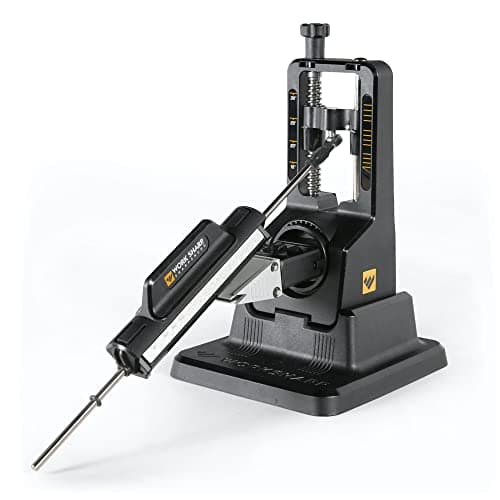
The best knife sharpener under a hundred dollars and the reason this band exists. A manual fixed-angle guided-rod system adjustable from 15 to 30 degrees, with diamond and ceramic rods, producing a whetstone-quality edge without whetstone technique. Buy it if you own both Japanese and Western knives, because it is the only pick here that can serve both without reprofiling one of them.

$69.95Amazon

#ad · Full ranking below

By Stephen V.Updated How we review
#ad

We earn a commission when you buy through our Amazon links, at no extra cost to you. It never changes a verdict, and we say so when the cheaper knife is the better buy. How this works.

Buy the Work Sharp Precision Adjust — it is the best knife sharpener under a hundred dollars, and it is for anyone who owns knives at more than one bevel angle. It is a genuine guided-rod system: the blade clamps, the rod sets a chosen angle anywhere from 15 to 30 degrees, and diamond and ceramic abrasives swap in as the edge progresses. A 15-degree setting means it can sharpen a Japanese knife without reprofiling it, which nothing in the band below can honestly claim. The budget pick is the Work Sharp Guided Field Sharpener— the cheapest thing here that still does the whole job, and the winner of our under-$50 band.

Every sharpener here was in stock and inside the band at our last price check. We do not print a number in the prose, because prices move and a sentence cannot: the Quick Picks table carries the live price and the date we pulled it, with a Check price button on every row. If a pick has drifted over a hundred dollars by the time you read this, the table says so rather than the page pretending otherwise.

What changes between $50 and $100

Our best knife sharpeners under $50 page makes the case that under fifty dollars you are not choosing a quality tier, you are choosing a format— a clamp, a guided pocket kit, a stone, a two-stage electric or a pull-through — and each one fails differently. That is still true, and it is the honest reason that page exists.

A hundred dollars changes two specific things, and they are the whole argument for this page.

First, the guided-rod system arrives. Under fifty dollars the only way to fix the angle exactly is a Lansky-style clamp, which works and is slow. At seventy you get a Work Sharp Precision Adjust: an adjustable angle across the range real knives actually use, swappable abrasives, and a stroke that is quick rather than fiddly. That is the single biggest jump in this category and it happens inside this band.

Second, the electric stops being a blunt instrument.The under-$50 electric is two stages of unspecified abrasive at one fixed angle. Just under a hundred, the Chef'sChoice 312 is diamond in bothstages with a sharpening pass and a separate ultra-honing pass. It still imposes a 20-degree-class Western bevel on whatever you feed it — that limit does not go away — but within that limit it is a far better machine.

What this band still does not buy is covered at the end of the page, honestly: no motorised belt-and-platen bench system, no premium clamp like the KME, and no 3000-grit-and-up stone progression. Our best sharpening systems page ranks the tier above and is the page most readers of this one should check next.

The method is on how we review: we have not hands-on tested these and we do not claim to have. The scores come from published specifications — abrasive type and grit, guide angles and adjustment range, stage count, included accessories — and from value arithmetic against the live price. Everything sits under the sharpening hub.

The short answer

Quick picks

#KnifeBest forScorePrice
01
Work Sharp Work Sharp Precision Adjust
Work Sharp Precision Adjust

The best knife sharpener under a hundred dollars and the reason this band exists. A manual fixed-angle guided-rod system adjustable from 15 to 30 degrees, with diamond and ceramic rods, producing a whetstone-quality edge without whetstone technique. Buy it if you own both Japanese and Western knives, because it is the only pick here that can serve both without reprofiling one of them.

Best overall
8.9
$69.95Amazon
02
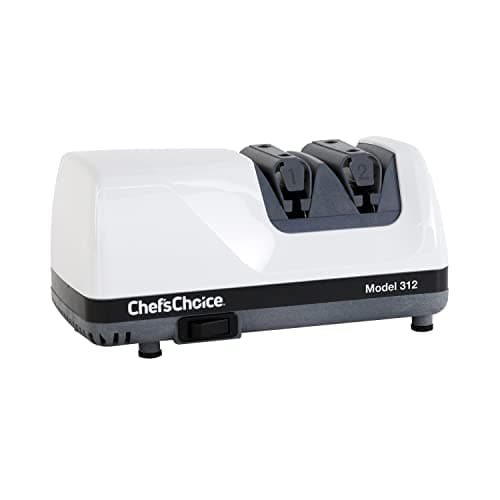
Chef'sChoice Chef'sChoice Diamond UltraHone (Model 312)
Chef'sChoice Diamond UltraHone (Model 312)

The best electric in the band, and a genuinely different machine from a cheap two-stage. One hundred per cent diamond abrasive in both stages - a sharpening pass then an ultra-honing pass - at 20-degree-class angles, and it handles serrated edges too. Buy it if your knives are Western and nobody will learn a stroke.

Best electric
8.1
$99.99Amazon
03
SHARPAL SHARPAL 162N Double-Sided Diamond Stone 8" x 3"
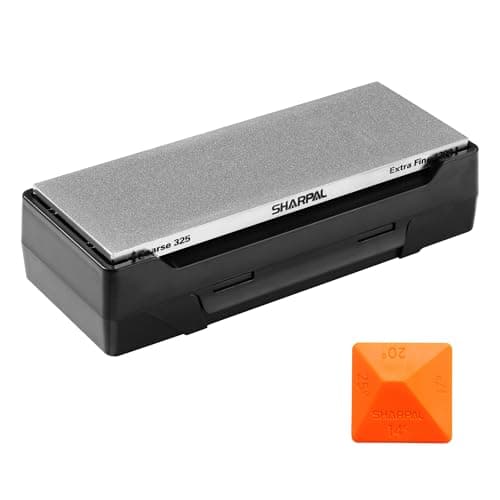
SHARPAL 162N Double-Sided Diamond Stone 8" x 3"

The best edge available in the band, and the one that asks the most. Coarse and fine monocrystalline diamond on one 8 x 3 inch flat plate with a non-slip base - no soaking, no flattening, and an abrasive that cuts anything from soft Swiss stainless to a high-vanadium folder. Buy it if you want to learn to sharpen properly rather than buy your way out of it.

Best for freehand and hard steels
8.0
$69.99Amazon
04
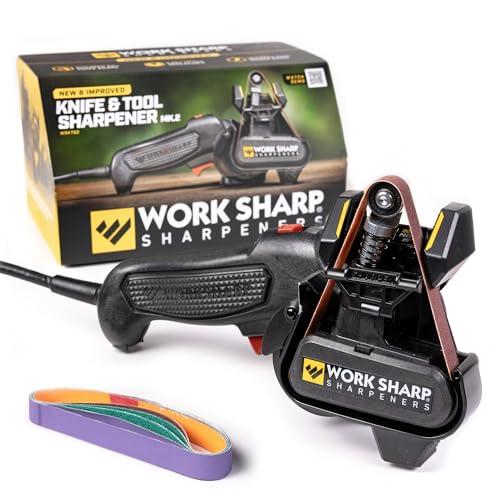
Work Sharp Work Sharp MK2 Electric Knife Sharpener
Work Sharp MK2 Electric Knife Sharpener

The pick for fast repair and for a household with more than kitchen knives in it. A flexible abrasive belt system with two speeds and a guided angle, rated for kitchen, pocket and outdoor blades, with replaceable belts. A belt reshapes a wrecked edge faster than anything here - and it will take a lot of steel doing it.

Best for fast repair and mixed blades
7.9
$89.95Amazon
05
Lansky Lansky Deluxe 5-Stone Sharpening System
Lansky Deluxe 5-Stone Sharpening System

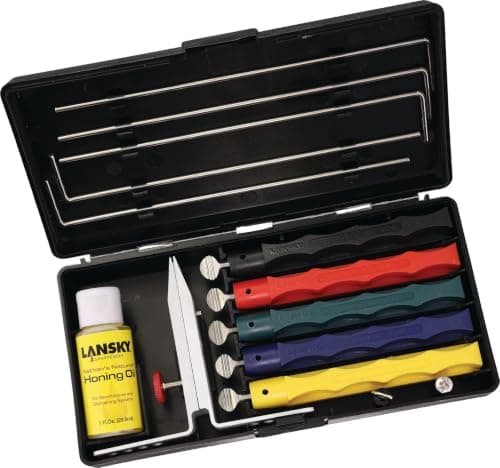
The most repeatable bevel in the band, for a fraction of the top pick. A clamp system with four preset angles and five hones from extra-coarse 70 through ultra-fine 1000, plus oil and a case. Crude next to the Precision Adjust and still the choice if exact, identical results on folders matter more than speed.

Best angle precision for folders
8.4
$47.31Amazon
06
Work Sharp Work Sharp Guided Field Sharpener
Work Sharp Guided Field Sharpener

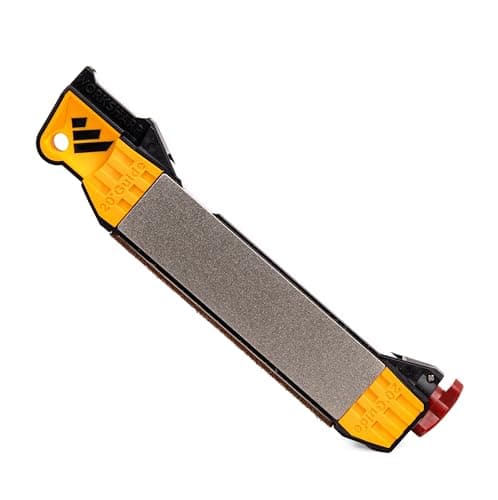
The budget pick, and the cheapest thing in the band that still does the whole job. Coarse and fine diamond plates, two ceramic rods, a leather strop and molded 20- and 25-degree guides, at 4.6 ounces. It wins our under-$50 band outright, and it is here because spending more than this only makes sense if you know which upgrade you want.

Budget pick
8.6
$39.95Amazon

#ad · Live prices from the Amazon Product API, as of November 12, 2026. Where we have no verified live price, we show none — a gap beats a number that has rotted.

In detail

The picks, in full

01
Work Sharp Work Sharp Precision Adjust

Best overall

Work Sharp Precision Adjust

Manual fixed-angle guide15-30 degree rangeDiamond + ceramic rodsWhetstone-quality edge
8.9/10

The best knife sharpener under a hundred dollars and the reason this band exists. A manual fixed-angle guided-rod system adjustable from 15 to 30 degrees, with diamond and ceramic rods, producing a whetstone-quality edge without whetstone technique. Buy it if you own both Japanese and Western knives, because it is the only pick here that can serve both without reprofiling one of them.

Angle control
9.5
Abrasive range
9
Edge quality
9
Ease of use
8
Value
9

Pros

  • A 15 to 30 degree adjustable range covers Japanese, Western and outdoor bevels on one tool
  • Diamond for setting the bevel and ceramic for refining it - a real abrasive progression, not one grit
  • The angle is fixed by the tool, so the result is repeatable rather than dependent on your wrist
  • Far quicker than a clamp system: no oil, no hone swapping, no re-clamping per side
  • Abrasives are replaceable and upgradeable, so the body is a long-term purchase

Cons

  • You still move the blade, so pressure and stroke count are on you
  • Narrow rods mean more passes on a long blade than a bench stone needs
  • Assembly and first setup take longer than plugging in an electric
  • A guided rod cannot thin a blade behind the edge the way a wide bench stone can

Don't buy this if…

…nobody in the house will learn a short routine - this rewards ten minutes of reading and an electric does not ask for any.

Re-scored on this page's rubric rather than carried over; it is ranked on best sharpening systems against the KME and the SHARPAL 202H, both of which cost multiples of it, and it is the sharpening pick on best knife gifts under $150.

The specification that wins this band is the adjustment range. Almost every sharpener under fifty dollars is set to a Western bevel, usually 20 degrees per side, and running a 15- or 16-degree Japanese edge through one widens it permanently — knife sharpening angles explains why that is expensive rather than merely untidy. A tool that will sit at 15 degrees for a Shun and 20 for a Victorinox and 25 for a folder solves a problem the cheaper band simply cannot.

Its honest limit is that it is a rod rather than a plate. Narrow abrasives remove metal in a line, so a badly damaged edge takes a while and a blade that needs thinning behind the edge needs a bench stone instead — which is what best sharpening stones is for.

$69.95View on Amazon

Price as of November 12, 2026. Prices change — Amazon's at checkout is the one that counts.

#ad · we may earn a commission from this link to Work Sharp Precision Adjust

02
Chef'sChoice Chef'sChoice Diamond UltraHone (Model 312)

Best electric

Chef'sChoice Diamond UltraHone (Model 312)

100% diamond, both stages20-degree class edges2-stage bevel then ultra-honeStraight and serrated
8.1/10

The best electric in the band, and a genuinely different machine from a cheap two-stage. One hundred per cent diamond abrasive in both stages - a sharpening pass then an ultra-honing pass - at 20-degree-class angles, and it handles serrated edges too. Buy it if your knives are Western and nobody will learn a stroke.

Angle control
7
Abrasive range
8.5
Edge quality
7.5
Ease of use
9.5
Value
8

Pros

  • Diamond in both stages, so it cuts hard stainless rather than burnishing it
  • Two genuinely different passes - one sets the bevel, one refines it
  • Rated for serrated edges, which most electrics and most rods are not
  • Completely effortless: no angle to hold, no technique, no setup
  • Chef'sChoice has sold this platform long enough that spares and pads are easy to find

Cons

  • A 20-degree-class fixed angle, imposed on whatever you feed it - this is not a Japanese-knife machine
  • Removes more metal than any manual pick here; a knife has a finite number of these
  • Motorised wheels are loud and the housing is plastic
  • No way to thin a blade or change a bevel deliberately

Don't buy this if…

…you own a Shun, a Global, a Miyabi or any thin Japanese knife - a fixed 20-degree electric will regrind a 15-degree edge to its own geometry and keep going.

Re-scored here; it is ranked on best electric knife sharpeners, where it sits against the Trizor 15XV and the Work Sharp Culinary E5, both above this band.

The reason it is worth the step up from the under-$50 electric is the abrasive. The Presto in that band uses sapphirite wheels and does not publish a grit; this publishes diamond in both stages, which matters because diamond cuts every carbide in every kitchen steel rather than polishing the hard ones. The two stages are also real: a bevel-setting pass and a separate ultra-honing pass is the same sequence a stone progression follows.

The fixed angle is the thing to be clear-eyed about. It is the most forgiving tool on this page to use and the least forgiving of the knife, and do electric knife sharpeners ruin knives is the honest answer to the obvious question. For a drawer of German and foodservice knives it is an excellent purchase.

$99.99View on Amazon

Price as of November 12, 2026. Prices change — Amazon's at checkout is the one that counts.

#ad · we may earn a commission from this link to Chef'sChoice Diamond UltraHone (Model 312)

03
SHARPAL SHARPAL 162N Double-Sided Diamond Stone 8" x 3"

Best for freehand and hard steels

SHARPAL 162N Double-Sided Diamond Stone 8" x 3"

Double-sided, coarse + fine diamond8 x 3 in. working surfaceMonocrystalline diamond on a flat substrateNon-slip base included
8.0/10

The best edge available in the band, and the one that asks the most. Coarse and fine monocrystalline diamond on one 8 x 3 inch flat plate with a non-slip base - no soaking, no flattening, and an abrasive that cuts anything from soft Swiss stainless to a high-vanadium folder. Buy it if you want to learn to sharpen properly rather than buy your way out of it.

Angle control
6
Abrasive range
9
Edge quality
9.5
Ease of use
6.5
Value
9

Pros

  • Freehand on a wide flat plate is the highest edge quality available at any price
  • Diamond cuts every carbide in every kitchen and pocket steel - nothing is too hard for it
  • Two grits on one plate covers repair and finishing without a second purchase
  • Needs no water, no soaking and no flattening, ever - unlike a water stone
  • The only pick here that can thin a blade behind the edge, which is what actually makes a knife cut

Cons

  • No angle guide at all - the whole result depends on holding a consistent bevel
  • Diamond cuts fast, so a heavy hand removes more metal than intended
  • The fine side is a working finish rather than a polish; a strop is the real last step
  • A beginner's first few knives will be worse before they are better

Don't buy this if…

…you want a sharp knife this evening with no learning curve - every other pick on this page is faster and this one is better.

Re-scored here; it is our top pick on best diamond sharpening stones and on best sharpening stones for pocket knives. On this page it takes edge quality outright and loses angle control, which is the honest trade a bare stone makes against a guided system.

It is on the list because the band contains it and because it does one thing nothing else here can: it can thin the blade behind the edge. Every guided rod and every electric sharpens the last fraction of a millimetre; a wide plate can take metal off the whole bevel face, which is what stops an old knife from feeling thick and wedgy no matter how sharp the apex gets. How to sharpen kitchen knives is the method, and whetstone grits explained covers what the two sides are actually for.

$69.99View on Amazon

Price as of November 12, 2026. Prices change — Amazon's at checkout is the one that counts.

#ad · we may earn a commission from this link to SHARPAL 162N Double-Sided Diamond Stone 8" x 3"

04
Work Sharp Work Sharp MK2 Electric Knife Sharpener

Best for fast repair and mixed blades

Work Sharp MK2 Electric Knife Sharpener

Flexible abrasive belt systemTwo speeds, guided angleHandles kitchen, pocket and outdoor bladesReplaceable belts
7.9/10

The pick for fast repair and for a household with more than kitchen knives in it. A flexible abrasive belt system with two speeds and a guided angle, rated for kitchen, pocket and outdoor blades, with replaceable belts. A belt reshapes a wrecked edge faster than anything here - and it will take a lot of steel doing it.

Angle control
7.5
Abrasive range
8
Edge quality
7
Ease of use
9
Value
8

Pros

  • A moving belt removes damage in seconds where a rod or a plate takes many minutes
  • Rated across kitchen, pocket and outdoor blades, so one machine covers the whole house
  • A flexible belt follows a curved or recurved edge better than a rigid wheel
  • Two speeds give a sharpening pass and a gentler finishing pass
  • Belts are consumable and cheap, so the machine stays useful

Cons

  • The most aggressive tool on this page - it is very easy to remove too much steel
  • A belt rounds the edge slightly if the stroke is slow or the speed is high
  • Guided rather than fixed, so the result varies more than an electric wheel
  • Not a finishing tool: the best edge it leaves is below the plate and the guided rod above

Don't buy this if…

…your knives are merely dull rather than damaged - this is a repair machine, and using a belt for routine upkeep eats a knife over a few years.

Re-scored here; it is ranked on best electric knife sharpeners and on best knife gifts under $150.

Its real job is the knife everyone has and nobody admits to: a chipped tip, a rolled heel, an edge someone used on a frozen loaf. A belt system fixes that in under a minute, and how to fix a chipped knife is the longer version of why that is a genuinely useful capability. The flexible belt also follows a curved belly better than a rigid wheel, which is why it handles outdoor and pocket blades the kitchen electrics struggle with.

Use it the way you would use a coarse stone: for damage, not for Tuesdays. Routine upkeep belongs on a rod — see best ceramic honing rods if any of your knives are hard, and best honing steels if they are not.

$89.95View on Amazon

Price as of November 12, 2026. Prices change — Amazon's at checkout is the one that counts.

#ad · we may earn a commission from this link to Work Sharp MK2 Electric Knife Sharpener

05
Lansky Lansky Deluxe 5-Stone Sharpening System

Best angle precision for folders

Lansky Deluxe 5-Stone Sharpening System

17 / 20 / 25 / 30 deg presetsFive hones: 70, 120, 280, 600, 1000Alumina oxide ceramicHoning oil + storage case
8.4/10

The most repeatable bevel in the band, for a fraction of the top pick. A clamp system with four preset angles and five hones from extra-coarse 70 through ultra-fine 1000, plus oil and a case. Crude next to the Precision Adjust and still the choice if exact, identical results on folders matter more than speed.

Angle control
9.5
Abrasive range
9
Edge quality
8.5
Ease of use
6
Value
9

Pros

  • A clamp removes the angle from the equation entirely - the same knife returns to the same bevel every time
  • Five grits from aggressive repair to a genuinely fine finish, which is more stages than any electric here
  • 17, 20, 25 and 30 degree presets cover kitchen and pocket bevels
  • Decades-old design with cheap, available replacement hones
  • Well under half the price of the top pick

Cons

  • Slow. Clamping, swapping hones, oiling and re-clamping per side takes real time
  • The clamp grips a limited blade width, so tall chef's knives are awkward
  • Small hones mean many strokes on a long blade
  • Alumina oxide rather than diamond, so high-vanadium powder steels will fight it

Don't buy this if…

…you want to sharpen the kitchen on a Sunday afternoon - this is a system for doing one knife exactly right, not six knives quickly.

Re-scored here; it is the budget clamp pick on best sharpening systems and the angle-precision pick on best knife sharpeners under $50, which is the band it also sits inside.

It posts a higher overall than two picks above it and sits fifth, which needs saying plainly. The rubric here weights ease of useas a scored metric, and a clamp system is genuinely slow — but it is the only pick on this page besides the top one that fixes the angle mechanically, and on a pocket knife, where the bevel is narrow and the blade is short, that mechanical certainty is worth more than speed. If folders are most of what you sharpen, promote it; see also best sharpening stones for pocket knives, which explains why its alumina-oxide hones are the one real limitation on modern powder steels.

$47.31View on Amazon

$76.2238% off

Price as of November 12, 2026. Prices change — Amazon's at checkout is the one that counts.

#ad · we may earn a commission from this link to Lansky Deluxe 5-Stone Sharpening System

06
Work Sharp Work Sharp Guided Field Sharpener

Budget pick

Work Sharp Guided Field Sharpener

20 and 25 deg molded guides220 + 600 grit diamond platesTwo ceramic rodsLeather strop, 4.6 oz
8.6/10

The budget pick, and the cheapest thing in the band that still does the whole job. Coarse and fine diamond plates, two ceramic rods, a leather strop and molded 20- and 25-degree guides, at 4.6 ounces. It wins our under-$50 band outright, and it is here because spending more than this only makes sense if you know which upgrade you want.

Angle control
8.5
Abrasive range
9
Edge quality
7.5
Ease of use
8.5
Value
9.5

Pros

  • A full progression - coarse diamond, fine diamond, ceramic, strop - in something the size of a phone
  • Moulded guides at 20 and 25 degrees, so the angle is held rather than guessed
  • Diamond abrasive, so hard stainless and high-vanadium steels are not a problem
  • The ceramic rods double as a honing rod between sharpenings
  • Travels, needs no bench, no power and no water

Cons

  • Small plates mean several careful passes on an 8-inch chef's knife
  • No 15-degree guide, which is the angle a Japanese knife wants - the top pick's whole advantage
  • 220 grit is coarse for a kitchen knife; it is there for field repair
  • A strop this small does less than a bench strop

Don't buy this if…

…all your knives are thin 15-degree Japanese blades - the guides are 20 and 25 degrees and you would widen every edge you own. Buy the Precision Adjust instead.

Re-scored here; it is the outright winner of best knife sharpeners under $50 and is ranked on best knife sharpeners.

Its presence here is the honest part of a price-band page. The cheapest pick in this band is not a compromise version of the expensive ones — it is a complete sharpening progression that costs less than half the ceiling, and for a drawer of Western knives it will do everything the Precision Adjust does except sit at 15 degrees. If you are not sure which upgrade you need, buy this, use it for a season, and the answer will become obvious. Our beginner sharpening kit guide is the longer version of that advice.

$39.95View on Amazon

Price as of November 12, 2026. Prices change — Amazon's at checkout is the one that counts.

#ad · we may earn a commission from this link to Work Sharp Guided Field Sharpener

Why three of six picks are Work Sharp

Worth stating plainly rather than letting the list imply something. Work Sharp is the only maker in our registry with a guided-rod system, a belt electric and a pocket field kitall priced under a hundred dollars, and those are three of the five formats a reader of this page might sensibly want. We have not excluded competitors to make a brand look good; the band simply does not contain a rival guided-rod system, and the rival electrics at this money are the Chef'sChoice 312 (ranked second) and the Presto, which belongs to the band below.

The angle question decides everything

One specification separates the picks on this page more than price does: what bevel angles the tool can hold.

15 to 30 degrees, adjustable. Only the Precision Adjust. This is what you need if any of your knives are Japanese, because a Shun Classic is ground to about 16 degrees per side and a Western sharpener set to 20 will widen it permanently every time you use it.

17, 20, 25 or 30 degrees, preset. The Lansky clamp. Seventeen is close enough to a Japanese bevel to be usable, and the clamp means the result is identical every time.

20 and 25 degrees, molded. The Guided Field Sharpener. Correct for Western kitchen knives and for folders, wrong for Japanese.

20-degree class, fixed, no choice.The Chef'sChoice electric. Excellent for German and foodservice steel, and it will reprofile anything thinner.

Whatever you hold. The diamond plate. Highest ceiling, no floor. Knife sharpening angles has the full table, and best knife sharpeners for Japanese knives is the page to read first if your drawer is mostly Japanese.

Abrasive matters more than the grit number

Three abrasives appear in this band and they are not interchangeable. Diamondis harder than every carbide found in knife steel, so it cuts everything — soft Swiss stainless, 61 HRC Japanese cladding, high-vanadium powder steel. Four picks here use it. Alumina-oxide ceramic is what the Lansky hones are: ample for kitchen stainless, slow on modern folder steels. A coated flexible beltis its own category — aggressive, forgiving of curvature, and the easiest way to remove more steel than you meant to. Knife steel types explained is why the steel in your knife decides this and not your preference.

How much metal each one takes

A knife has a finite number of sharpenings in it, and the picks on this page sit at very different points on that scale. Roughly, from most aggressive to least: the belt electric, then the diamond wheel electric, then the coarse diamond plate if you lean on it, then the guided rod, then the clamp with a fine hone. None of them is reckless when used for its purpose; all of them are destructive used weekly on a knife that only needed honing.

That is the single most useful thing on this page: most knives that feel blunt are rolled, not worn, and a rod fixes that in under a minute without touching the bevel. Sharpening vs honing is the test, how to tell if a knife needs sharpening is how to tell the two apart, and how often to sharpen knives gives the cadence. Budget for a rod alongside any pick here.

What a hundred dollars still cannot buy

A bench belt-and-platen system. Motorised bench grinders with variable speed and a platen start well above this band and are a different tool for a different user.

A premium clamp. The KME and the SHARPAL 202H bring machined hardware, diamond hones and finer angle increments than the Lansky, and both sit on best sharpening systems at multiples of this ceiling.

A full stone progression.The plate here finishes at a working fine grit. A 3000- or 6000-grit finishing stone is where an edge starts to feel keen rather than merely sharp, and that is a separate purchase — see best sharpening stones.

A premium kitchen electric.The Chef'sChoice Trizor 15XV and the Work Sharp Culinary E5 both convert Western knives to 15-degree edges and both sit above this band on best electric knife sharpeners.

How we ranked this band

Five metrics, weighted for what actually goes wrong at this money. Angle controlis how closely the tool fixes the bevel and which angles it offers — the metric that decides this page. Abrasive range reads the number and type of stages, and penalises a single coarse abrasive that cannot finish an edge. Edge quality is the best result the format can produce in competent hands. Ease of use is setup, speed and how likely the thing is to actually get used. Valueis specification quality against the live price. The overall is the mean of the five to one decimal place — which is why the clamp system scores above two picks ranked ahead of it, and the entry for it says so rather than the weights being quietly adjusted. None of these numbers came from a test lab, because we do not have one, and how we review says so in those words.
How we picked

We did not lab-test these knives

Everyone in this category says they tested twenty knives in a professional kitchen. We have not hands-on tested any of these, and we say so. What we did instead: compiled the published specifications — steel type and hardness (HRC), edge angle, blade geometry, weight and build — applied established sharpening standards, ran the value math (spec quality ÷ live price), and scored each product against a published rubric. The scores are judgments from documented research — not measurements we took, because we do not have a test lab and we will not pretend we do. Where a number came from someone else's work, we name them in Sources.

Questions

Frequently asked

What is the best knife sharpener under $100?
The Work Sharp Precision Adjust. It is a guided-rod system adjustable from 15 to 30 degrees with swappable diamond and ceramic abrasives, which means it can sharpen a Japanese knife at its own angle and a Western knife at its own angle without reprofiling either.
Is it worth spending $100 instead of $50 on a knife sharpener?
Only for two specific upgrades: an adjustable guided-rod system, and a multi-stage diamond electric. If neither of those is what you want, the winner of our under-$50 band is a complete sharpening progression and costs less than half this ceiling.
What is the best electric knife sharpener under $100?
The Chef'sChoice Diamond UltraHone 312. It uses diamond abrasive in both stages rather than unspecified wheels, runs a bevel-setting pass and a separate ultra-honing pass, and is rated for serrated edges. It is a 20-degree-class fixed-angle machine, so keep thin Japanese knives away from it.
Can a sharpener under $100 handle Japanese knives?
One can properly: the Precision Adjust, because it sits at 15 degrees. The Lansky clamp offers 17, which is usable. Everything else in the band is 20 degrees or wider and will widen a Japanese bevel permanently — see best knife sharpeners for Japanese knives.
Guided rod system or electric sharpener?
Guided rod if you own knives at more than one angle, or you mind how much steel comes off. Electric if nobody in the house will learn a short routine and all the knives are Western. The electric is easier to use; the guided rod is easier on the knife.
Do I still need a whetstone?
Not for sharpness. You need one for thinning— a wide flat plate is the only tool here that can take metal off the whole bevel face, which is what stops an old knife feeling thick behind a sharp apex. The diamond plate on this page does that job and needs no soaking or flattening.
How often should I use one of these?
Far less often than people think. Hone on a rod every few uses and most knives need a sharpener two or three times a year. Using a belt or a wheel electric monthly on a knife that only needed honing is how a chef's knife gets visibly narrower in five years.
Do these prices stay under $100?
Not guaranteed. Every pick was inside the band at our last price check, and the Quick Picks table shows the live price with the date we pulled it. Amazon's price at checkout is the only one that counts, so check the table rather than trusting the page title.

Keep reading

Receipts

Sources

We do not run a testing lab, and we do not pretend to. Where a spec or a measured number came from someone else's work — a manufacturer's page, a published standard — we name them and link them. Where we could not verify something, we say so on the page rather than quietly leaving it out. Read our full method.