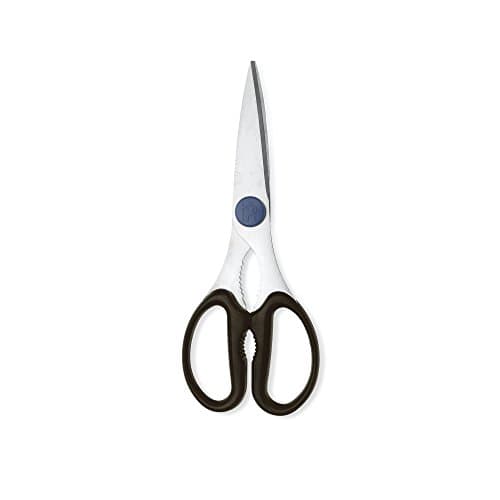
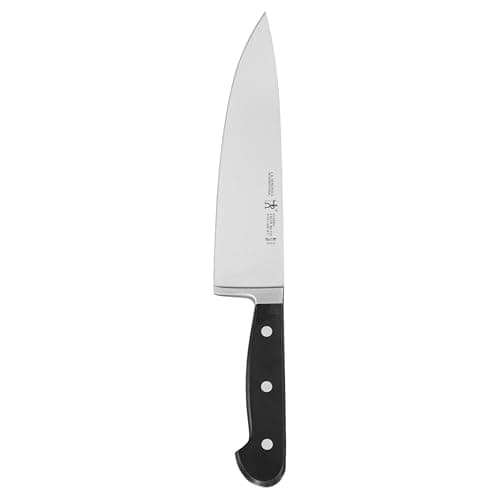
The HENCKELS Classic 8-inch chef's knife is the best Henckels knife, and it is for someone who wants a traditional forged German knife without paying Solingen prices. It is fully forged with a full bolster, German stainless at a published 55–58 HRC, triple-riveted and rated dishwasher safe — and critically, it is the only piece in this lineup you can buy forged, on its own, without buying a block. The budget pick is the micro-serrated Henckels kitchen scissors, which are take-apart, dishwasher safe and made in Japan, and which score higher on this page than two of the knives.
Before the rankings, the thing that makes this brand confusing in a listing search and the reason the autocomplete cluster for "best henckels knives" keeps returning Zwilling suggestions. HENCKELS, written in capitals, and Zwilling are two different brands under one parent company, and they are deliberately different tiers. Zwilling knives are forged in Solingen with FRIODUR ice-hardening. The HENCKELS Classic line ranked here is forged, and its published country of manufacture is Spain. That is not a criticism — it is why the Classic costs roughly half what a comparable Zwilling does — but it is the single fact most buyers of these knives do not know they are buying. Zwilling vs Henckels is the page that settles that comparison properly.
We do not print a price in the prose. The Quick Picks table carries the live price and the date we pulled it, with a Check price button on every row.
The shape of the Henckels lineup, and the one real decision
Spend ten minutes looking at what the brand actually sells in the US and a clear pattern appears: HENCKELS is a set brand. The volume is in blocks and multi-piece sets built from precision-stamped blades, and the open-stock forged pieces are a narrow range sold alongside them.
That gives you exactly one decision to make, and it is the same decision as on any German lineup: forged or stamped.
Forged— the Classic line here — means the blade is hot-worked from a billet, carries a bolster where the blade meets the handle, and is noticeably heavier in the hand. Weight does chopping work for you and a bolster adds stiffness behind the heel. It also makes the knife harder to sharpen on a guided system, because the bolster blocks the last inch of edge from reaching the abrasive.
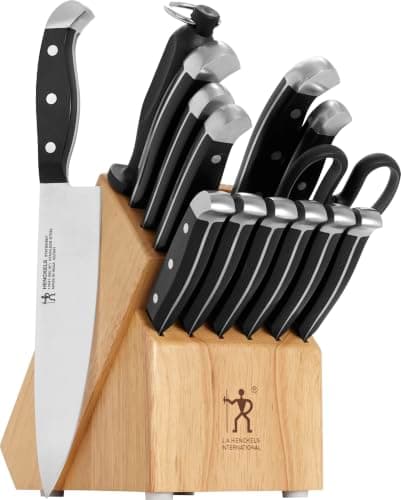
Stamped— the Statement set here — means the blade is cut from rolled sheet. Lighter, cheaper, no bolster, and genuinely easier to sharpen edge-to-heel. Our stamped vs forged knives page makes the case that stamped is underrated, and this lineup is a good example of why.
Everything else is shared across lines: the steel family, the published 55–58 HRC band, the riveted handle construction and the dishwasher-safe claim. Once you have chosen forged or stamped, you are choosing shapes, not quality tiers.
One specification Henckels does not publish
A per-side edge angle. Neither the Classic nor the Statement listings state the factory bevel, so we score that as unpublished rather than estimating it. The practical consequence is that if you put these on a guided sharpener, 20 degrees a side is the safe setting for a German knife in this hardness band — knife sharpening angles explains what that choice does, and knife hardness explainedcovers why a 55–58 HRC steel wants a slightly wider angle than a harder Japanese one.
How we ranked them
Five metrics, applied identically to a knife, a set, a carving pair, a steel and a pair of scissors — which is unusual and worth explaining. Steel & edge is what the cutting part is made of and how it is finished. Build is construction and durability. Handling is how it feels and behaves in use. Coverage is how much of a kitchen's work the item actually does. Value is what you get for the money. How we review sets out that these are judgments from published specifications rather than lab measurements.
A consequence of scoring honestly across categories: a twenty-dollar pair of Japanese-made take-apart scissors beats a hundred-dollar carving set on this rubric, because it does more work, more often, for far less money. We have left that result alone rather than reweighting the rubric to produce a tidier-looking list, and the entries say so.
Which Henckels should you actually buy?
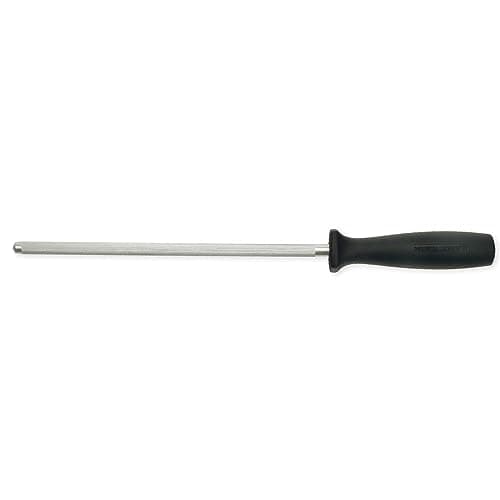
One knife, and you want forged.The Classic 8-inch chef's knife, plus the 9-inch steel. That pair is the whole answer for most kitchens.
You are furnishing an empty kitchen. The Statement 15-piece set. Accept that several pieces will not get used and enjoy the per-piece economics.
You want the best value item in the brand. The micro-serrated scissors, without hesitation.
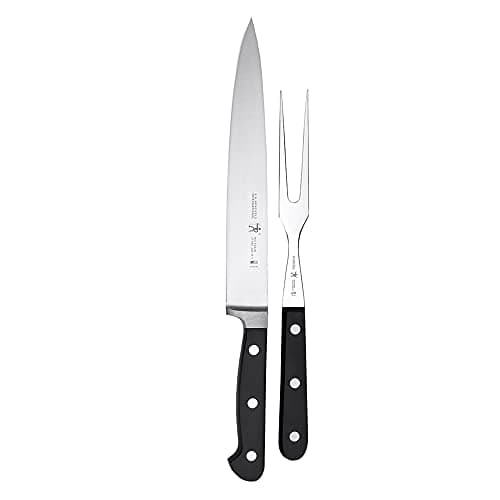
You roast for guests. Add the Classic carving set.
You sharpen on a guided system and want the whole edge reachable. The stamped Statement blades, not the forged Classic. This is the opposite of the usual advice and it is the right advice for anyone who maintains their own knives.
Henckels or Zwilling?
The short version: if the price difference is immaterial to you, Zwilling. Its knives are forged in Solingen with a specified ice-hardening process, and the manufacturing provenance is tighter. If the price difference matters, the HENCKELS Classic sits in the same published 55–58 HRC band, uses the same steel family, and is forged. You are not buying a softer or weaker knife; you are buying one with less specified about where and how it was made.
Both sides of that argument are set out properly on Zwilling vs Henckels, and best chef knife brands places both against the rest of the market.
What this lineup does not contain
There is no Henckels santoku, nakiri, cleaver or Japanese-style knife in this registry with a live price, and no open-stock Henckels paring or bread knife either — those shapes exist in the brand, but the way to get them here is the Statement set. If you specifically want a German-made santoku or a forged bread knife bought on its own, the Wusthof and Zwilling lineups cover that and the Henckels one does not: best Wusthof knives and best German chef knives are the two pages to read instead.