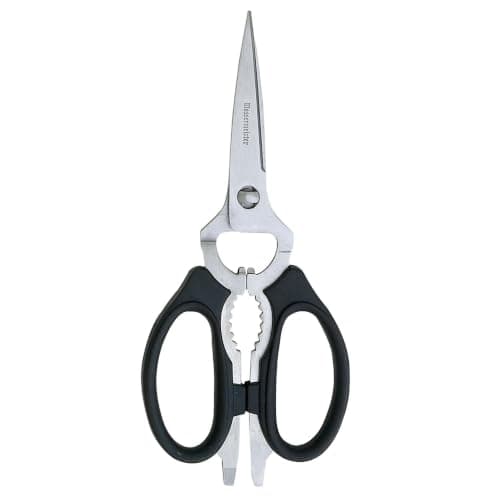
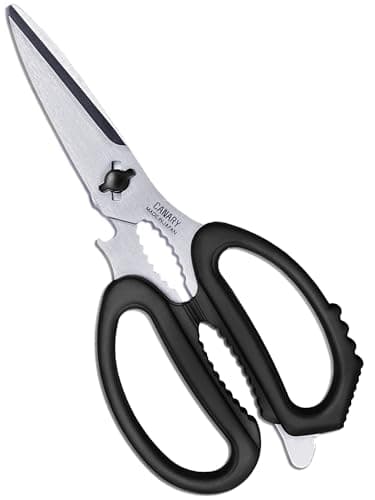
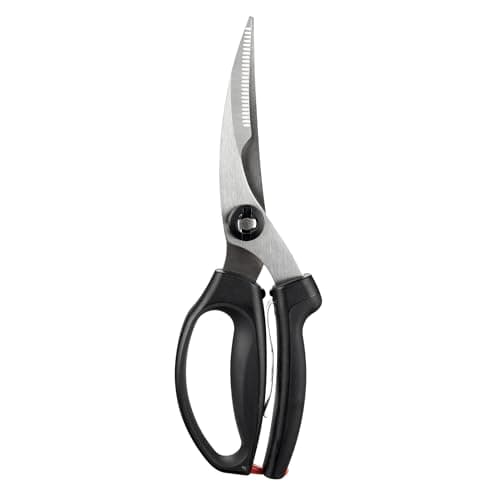
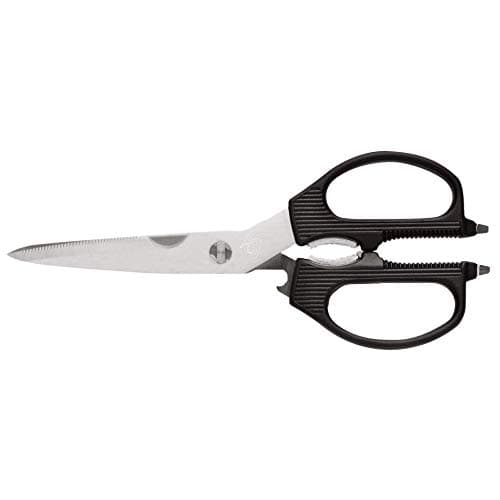
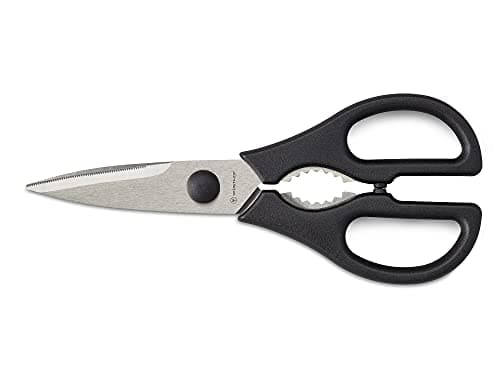
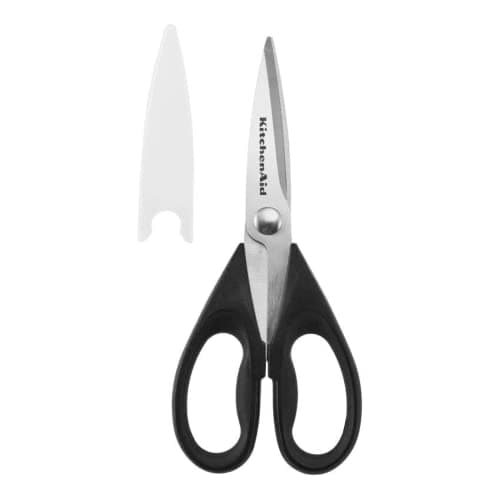
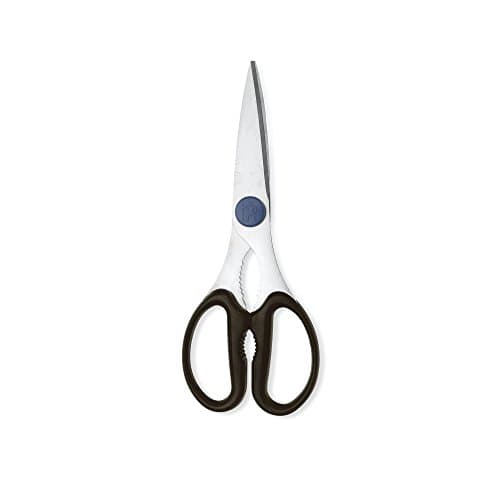
A pair of kitchen shears is the only tool in most kitchens that gets closed around raw poultry and then dropped in a drawer with the residue sealed inside a pivot you cannot reach. That is not a minor ergonomic footnote — it is the single specification that should decide which pair you buy, and it is the one the listings are quietest about. So this page ranks on it first.
We should be straight about something before the list, because the rest of this site has been saying it for a year: shears are not a knife, and they are the item that pads out a knife block. Our knife set guide counts them among the pieces your money gets spread across, and what knives a kitchen actually needs puts it plainly: genuinely useful, but you should not pay knife-set prices for a mediocre pair. Nothing here contradicts that. A good pair costs less than a mediocre paring knife, and the correct amount to spend is "not much" — which is precisely why getting the one spec right matters more than the badge on the handle.
What we ranked on
Five metrics, weighted toward the two that change what the tool can safely do rather than how it feels in the shop.
- Cleaning access. Do the blades separate at the pivot, and does the maker state a dishwasher rating? Separation alone is most of the answer; a published dishwasher rating is the rest, because a hand-wash-only pair still has to be scrubbed into the hinge by someone.
- Cutting power.What the blades will actually go through — herbs and clamshell packaging is the easy case, chicken joints is the hard one. Blade length, micro-serration and whether there is a bone notch decide this.
- Grip & control. Handle material when your hands are wet and greasy, plus spring loading, a safety lock, and whether the handles work in a left hand.
- Build. Steel, pivot construction, country of manufacture and the warranty the maker is prepared to put in writing.
- Value. Capability against the live price on the card, which is the number most likely to move without a word of this page changing.
One consequence of ranking this way is worth flagging up front, because it looks like an error until you see the reasoning: the cheapest pair on this page finishes last. It is a perfectly good pair of scissors and we still recommend it for a specific job. It just does not come apart, which is the thing this page is about.
Why cleaning access outranks sharpness here
On a knife, the edge is the product. On shears it very nearly is not. Every pair on this page cuts herbs, twine and clamshell packaging competently out of the box, and the differences between them on a tomato skin are not differences most people will ever notice. What does differ, enormously, is what happens after you use them on chicken.
A pair of scissors is two blades riding on a pivot, and the pivot is a closed seam that sits directly in the cutting path. Push it through raw poultry and protein works into that seam. A pair that separates lets you get a brush and hot soapy water onto both faces and into the pivot itself. A pair that does not separate leaves you rinsing the outside of a joint you cannot see into. That is the whole argument, and it is why the ranking above puts a $20 Japanese-made pair at the top and a perfectly competent cheaper pair at the bottom.
Two things are commonly confused here and they are not the same claim. Dishwasher safemeans the materials survive the cycle — the steel will not pit and the handle will not deform. Take-apart means the water can reach the part that matters. You want both, and only two picks on this page have both. If you can only have one, take the separation.
Micro-serration is the other spec worth reading
Almost every decent pair of kitchen shears has one micro-serrated blade, and it exists for exactly one problem: slick, loose material slides out of a smooth scissor action instead of being cut. Chicken skin is the case everyone meets. The fine teeth grip it so the blades can close on it rather than pushing it forward.
It is the same principle as the serrations on a bread knife, which we cover in serrated vs straight-edge knives, and it carries the same cost: you cannot practically re-sharpen it at home. That is not a defect in a $20 tool; it is a reason not to spend $60 on one expecting to maintain it for a decade the way you would a knife.
General shears vs poultry shears: they are different tools
The five general-purpose pairs on this page are straight-bladed, three to three-and-a-half inches of cutting edge, built to live in a drawer and do fifty small jobs. The OXO is a different object: curved four-inch blades, a notch that traps bone so it cannot skate, a spring that reopens the handles for you, and a lock so it can be stored safely.
That curve and that notch are what let you go through a chicken's joints and backbone. They are also what makes it awkward at snipping chives. If you break down whole birds regularly, own both — together they still cost less than one mid-range chef's knife. If you buy one whole chicken a year, buy a take-apart general pair and let the butcher do the rest, which is the same conclusion our chef's knife vs cleaver comparison reaches about cleavers.
What shears should never be asked to do
They are not a substitute for a knife and they are not a substitute for a boning knife. Shears cut across material by trapping it between two blades. A boning knife follows a contour, which a scissor action physically cannot do, so anything that involves tracing a bone or skinning a fillet is the wrong job for them.
Nor do they replace a cleaveron large bones. Poultry joints and a chicken backbone are within reach of a spring-loaded poultry shear; pork ribs, beef bones and anything requiring a chop are not, and forcing the issue springs the pivot. And do not use kitchen shears as a package opener for anything abrasive — staples, wire ties and cardboard with grit in it will dull a micro-serrated edge far faster than food ever will.
Sharpening them is mostly a myth
This is a sharpening site, so we will be blunt about it. You cannot meaningfully sharpen a micro-serrated shear blade at home, and the ones with smooth blades are ground at a scissor geometry that a whetstone is the wrong tool for. Our electric sharpener coverage says the same thing from the other direction: scissors and shears do not belong in a slot sharpener, alongside serrated blades and ceramic knives.
What actually keeps shears cutting is far duller than sharpening. Take them apart, clean the pivot, dry them properly, and on the Messermeister snug the tension rivet when the action gets sloppy. Most "blunt" shears are not blunt — they are loose, or gummed up at the joint. When a pair genuinely is worn out, it is a $20 tool and replacing it is the honest answer, which is not something we would say about a knife.
Left-handed cooks get one real option
Scissors are the most aggressively right-handed object in a kitchen. The problem is not the handle shape, it is the blade offset: a right-handed pair puts the upper blade on the side where a right thumb's natural pressure closes the blades together, and the same pressure from a left hand pushes them apart, so the material slides into the gap instead of being cut.
Of the seven pairs here, Messermeister is the only maker that states its handles suit left and right hands equally, which is why it takes the left-handed pick rather than the overall win. If you are left-handed, that is the pair, and our left-handed knife guide covers the same problem on the knife side.
What we would skip
Skip any pair that does not state whether it comes apart.That is a deliberate omission far more often than an oversight — a maker with a take-apart pivot puts it in the product title, because it is the feature that sells. Silence on the point is close to an answer.
Skip the shears in a block set as your only pair.Not because they are always bad, but because you did not choose them and they are almost never take-apart. If a set you already own came with a pair, keep them for packaging and twine and buy a proper take-apart pair for anything that touches food — are knife sets worth it goes through what else that box is charging you for.
And skip spending real money here.The best pair on this page costs less than a good honing rod. If you have $60 spare and you are choosing between premium shears and something else, the something else is almost always the better call — a sharper chef's knife, or the sharpening gear to keep the one you own keen, which is where we point people at the end of nearly every roundup on this site.