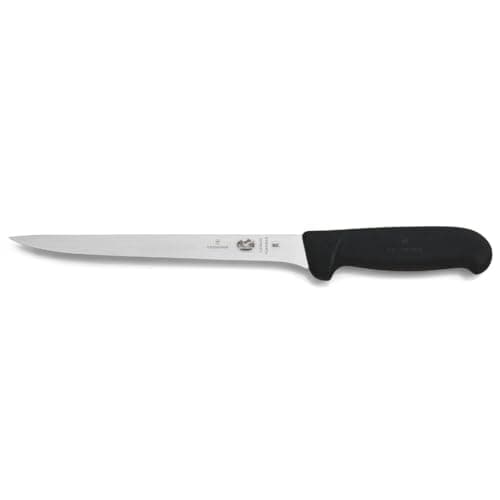
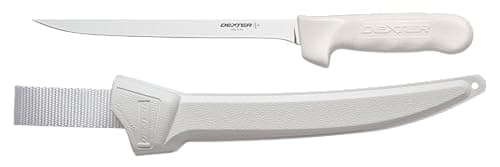
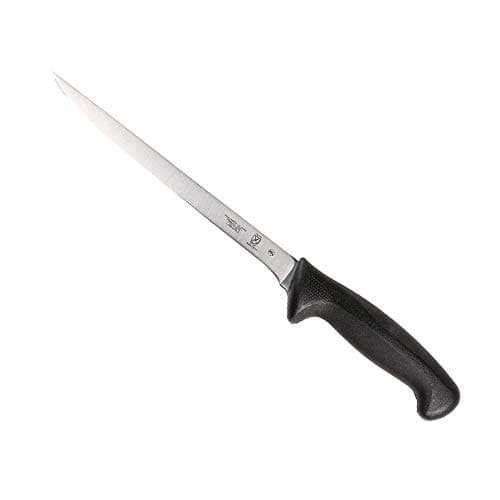
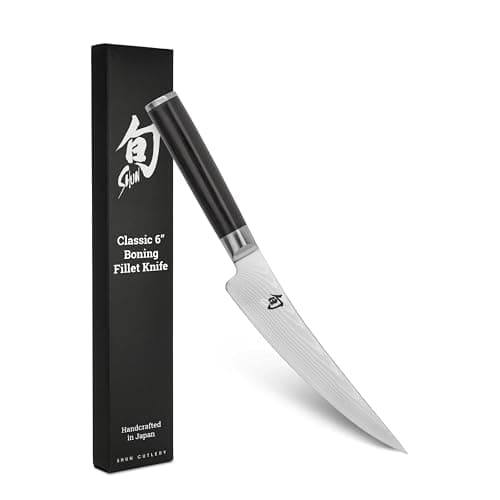
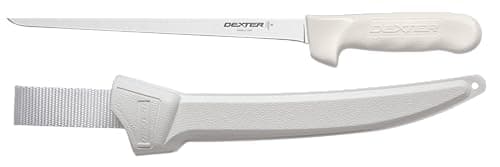
Buy the Dexter-Russell Sani-Safe 9" fillet knife. If you work with wet hands on a boat deck or a dock rather than a kitchen bench, buy the Victorinox Fibrox 8" instead — it loses by a tenth of a point on this rubric and wins the one metric that keeps your fingers attached. Those are the two knives that cover almost every home fish job between them, and they cost a fraction of what the specialist blades further down this page do.
The reason most “best knife for fish” advice is useless is that it treats fish as one task. It is three. Filletingmeans running a blade along a flexible rib cage and backbone, taking everything and leaving nothing — that wants a long, narrow, flexible blade that can bend into the frame. Skinning means working a blade almost flat between flesh and skin in one continuous pull — same flexibility, more length. Slicing means cutting a finished fillet into clean portions or sashimi, where any flex at all ruins the cut and you want a long, thin, perfectly stiff blade. A knife that is good at the first two is bad at the third, and vice versa. That is not a flaw in the knives; it is physics.
There is a fourth job people ask about, and the honest answer is that no knife on this page should do it: cutting through fish bone, which is what you are really asking when you search for a knife for fish steaks or for taking a head off. That gets its own section below, because the tool for it is not a fillet knife.
Everything below is judged from published specifications — blade length and profile, stated flex, steel and construction, handle material, certifications — and the value math against the live price. See how we review: we do not have a test lab and we do not claim one. The rubric is the same five metrics we use on best boning knives(blade geometry, flex suitability, edge maintenance, grip security, value), which means the averages on this page are directly comparable with that one — three of the six scores here are reproduced from it and from Victorinox vs Dexter rather than re-derived, and each product says where its number came from.
What actually matters in a fish knife
Flex, and specifically the right amount of it. A fillet knife needs to bend enough to ride the curve of a rib cage without you forcing it, and stay stiff enough that you can still steer the tip. Too stiff and you leave flesh on the frame. Too floppy and the blade wanders off the bone into the fillet. The narrow 8-to-9-inch patterns at the top of this page sit in that band, which is why commercial fish houses have used them for decades.
Length, matched to the fish. The blade should be able to travel the length of one side in a single stroke, because every time you stop and restart you leave a step in the fillet. Panfish and trout want 6 to 7 inches. Salmon, snapper, cod and most of what a home cook buys whole want 8 to 9. A 9-inch blade on a small trout is awkward rather than dangerous; a 6-inch blade on a salmon is a worse fillet.
Grip security, weighted higher here than anywhere else on this site.Fish are slime, water and scales, and a fish knife is held at shallow angles with real forward pressure. A handle that is merely “comfortable” dry is not good enough. Molded TPE and textured polypropylene — the Fibrox and Sani-Safe handles — are the two best wet grips in the category and the reason both brands dominate commercial fish work. Beautiful wood is a liability on this job, which is why the most expensive knives here score lowest on that metric.
Corrosion behavior.Fish work is wet, salty, and often acidic from a final squeeze of citrus. Everything on this page is stainless for that reason, and a carbon-steel Japanese blade — which many sites will recommend for fish — needs wiping dry every few minutes or it spots. If you already own one, read why does my knife rust before you take it near brine.
What does not matter much: hardness, Damascus cladding, bolsters, and single-bevel Japanese geometry unless you are slicing sashimi professionally. The single-bevel versus double-bevel argument is real but it belongs to the slicing job only, and a double-bevel sujihiki gets you most of the way there without the maintenance.
The best knife for cutting fish bones — and why it is not a fillet knife
This is the most-searched version of the question and it has the least satisfying answer: nothing on this page should be cutting through fish bone, and a fillet knife asked to do it will chip, bend or fold.
Split the problem. Pin bones— the fine Y-shaped bones in salmon and trout fillets — are not cut at all. You pull them, with fish tweezers or needle-nose pliers, against the grain in which they lie. Any knife you use will either leave them or take a strip of flesh out with them. Rib cage and backbone are not cut either; the whole point of filleting is that the blade goes around them, which is what the flex on the top three knives is for. Through-the-bone cuts— taking a head off, cutting a monkfish or a salmon into steaks, going through a spine — need a stiff, heavy blade or a different tool entirely. Heavy kitchen shears are usually the safest answer for a home cook; a cleaver is the other one. See best kitchen shears and best cleavers, both of which rank tools built for that load.
If you take one rule from this page: the moment your knife meets bone, you are using the wrong knife or cutting in the wrong place. That is also the single most common way a fillet knife dies.
The best knife for cutting fish fillets and fish skin
Same knife, same property: a long, narrow, flexible blade. Skinning is the clearest demonstration of why flex matters, because the blade has to stay almost flat against the skin for its entire travel — and a stiff blade cannot, so it rides up into the flesh and you lose the thin, dark, fatty layer that is the best-tasting part of a salmon fillet.
Technique, briefly, because the knife only matters once this is right. Work from the tail, with the skin side down and the fillet flat. Get the tip under a corner of skin, grip the loose flap with a paper towel so it does not slide, and then move the fish against the knife rather than sawing the knife through the fish. The blade stays nearly still and nearly flat. A long blade makes this one motion; a short blade makes it three.
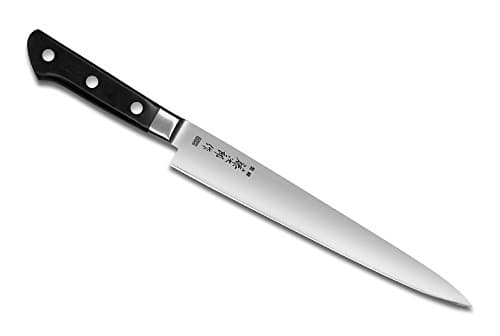
For fish steaks — cutting a fillet or a whole fish crosswise into portions — you want the opposite. Stiff and long. If the steaks are boneless portions off a loin, the sujihiki is the right tool and it is a single pull. If you are cutting across a spine, go back to the section above.
One knife for fish and meat?
Yes, with a caveat, and this is the pos-6 question in the autocomplete cluster so it is worth answering straight. A flexible fillet knife handles fish and does a decent job of boning poultry; it is poor on red meat because red meat work wants either a stiff boning knife or a long slicer. A long stiff slicer like the sujihiki handles cooked meat, barbecue and raw fish beautifully and cannot fillet anything.
So the honest two-knife kit for someone who does both: a flexible 8-to-9-inch fillet knife and a stiff slicer. The flexible one is cheap. If red meat is the bigger half of your cooking, start with best chef knives for cutting meat instead, and read best boning knives for the stiff-versus- flexible argument in full.
Fish butchery at home: what you actually need beyond the knife
The knife is a smaller part of this than the internet suggests. In rough order of how much difference they make:
A big board that does not move.A whole fish is long, wet and awkward, and a board that slides during a long flat stroke is genuinely dangerous. Big enough that the tail is not hanging off, and soft enough not to wreck the edge — see best cutting boards for knives.
Fish tweezers or pliers. Pin bones, as above. A few dollars, and the difference between a professional-feeling fillet and a mouthful of bone.
A sharpening setup you will actually use. Every knife at the top of this page is deliberately soft steel, which means sharpening is not optional, it is the operating model. A basic two-sided stone is enough: best sharpening stones for beginners and how to sharpen kitchen knives cover it.
Immediate washing and drying.Salt, blood and citrus are the three things that mark stainless, and all three are present in fish work. Wash and dry as you finish, not later — knife care and maintenance has the routine, and can you put knives in the dishwasher answers the shortcut you are considering.
Two related pages if you came here from a single-job search. On the produce side, onions are the job where a tip decides everything rather than flex — the same approach applied to the opposite problem, in the best knife for onions. And if your fish knives travel — to a dock, a cabin or someone else's kitchen — two of the knives above ship with a sheath for a reason, and the carry options are ranked in the best knife rolls and chef knife bags.