Skip to content
The Edge Bench

Decision guides · Buying Guides

Why does my knife rust?

Because "stainless" means stain-resistant, not rust-proof - and because of five specific things that happen in every kitchen. What the spots are, how to remove them, and what to change.

By Stephen V.Updated How we review
#ad

We earn a commission when you buy through our Amazon links, at no extra cost to you. It never changes a verdict, and we say so when the cheaper knife is the better buy. How this works.

Because “stainless” means stain-resistant, not rust-proof — and because something in your routine is leaving the blade wet. Stainless knife steel resists corrosion through a microscopically thin chromium oxide layer that re-forms when it is damaged, provided it has air and is dry. Keep a blade wet, salty or acidic for long enough and that layer cannot keep up, and you get rust. The fix is almost always behavioural and costs nothing: wash the knife when you have finished with it, dry it, and store it somewhere it stays dry. If it still rusts after that, the cause is probably one of the five below.

This page is the diagnosis first, then the two products that change the outcome — a storage method that lets a blade air-dry, and the one steel in our registry whose maker describes it as stain-resistant. Everything we quote is from published specifications and established corrosion mechanisms; we have not run corrosion tests and we do not have a lab. See how we review.

The five causes, in the order they are likely

1. Standing water. A blade left in a sink, under a tea towel, in a wet block slot or flat on a damp draining board has water sitting on it with no air getting underneath. That is the single most common cause, and it is why the drying step matters more than the washing step.

2. Salt. Chloride ions attack the passive layer directly, which is why brining, salted water, cured meat and anchovies leave marks that plain water does not. Salty residue left on a blade overnight is the fastest way to pit a stainless knife.

3. Acid. Lemon, tomato, vinegar and onion all lower the surface pH long enough to interfere with the oxide layer. On a carbon-steel knife this shows up within minutes as grey or blue-black discolouration. On stainless it takes longer and still happens if the residue is left on.

4. The dishwasher.Hot caustic detergent, a long wet cycle and steel knocking against steel is the worst environment a kitchen can offer a blade, and it attacks the passive layer chemically while the knocking damages it mechanically. Even knives their makers rate as dishwasher safe will age faster in one — can you put knives in the dishwasher sets out all four mechanisms.

5. The knife is not stainless.High-carbon non-stainless steel — traditional Japanese white and blue steels, old butcher knives, many carbon-clad Damascus blades — has little or no chromium and will rust. That is not a fault, it is the deal: those steels take a keener edge in exchange for needing to be dried immediately and oiled. High-carbon vs stainless steel knives is the full trade-off.

What the spots actually are

Orange-brown, slightly raised, grows if ignored:that is rust — iron oxide, actively eating metal. Remove it. A paste of bicarbonate of soda and water on a cork or a soft scouring pad, worked along the blade and rinsed and dried, lifts light rust without scratching. Heavier rust needs a fine abrasive and will leave the finish marked.

Grey, blue, or purple-black, flat and stable: that is patina, not rust, and it is what a carbon-steel blade does when it meets acidic food. It is a stable oxide layer and it genuinely protects the steel underneath. Leave it alone; forcing a carbon blade back to bright metal removes the protection.

Tiny dark pinpricks in a stainless blade:pitting, usually from chloride attack. Clean it off, keep the blade dry, and accept the cosmetic damage — pits do not regrow into smooth steel.

Orange specks that wipe straight off:not your knife. Transfer rust from another item in the sink or drawer — a tin, a trivet, a cast-iron pan — which is its own argument for not storing knives loose with other metal.

The short answer

Quick picks

#KnifeBest forScorePrice
01
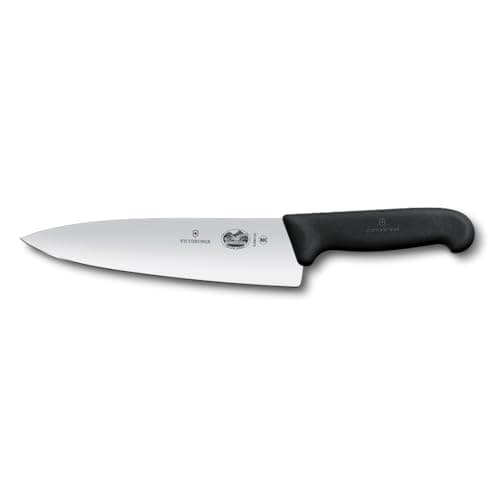
Victorinox Victorinox Fibrox Pro 8"
Victorinox Fibrox Pro 8"

The pick if your knife rusts because it is not really stainless. Victorinox's X50CrMoV15 is a high-chromium stain-resistant stainless at around 55-56 HRC, Swiss made, NSF certified and rated dishwasher safe by its maker - about as corrosion-tolerant as a kitchen knife gets, at a price that makes replacing a rusting knife a non-decision.

Best stain-resistant knife
8.8
$46.87Amazon
02
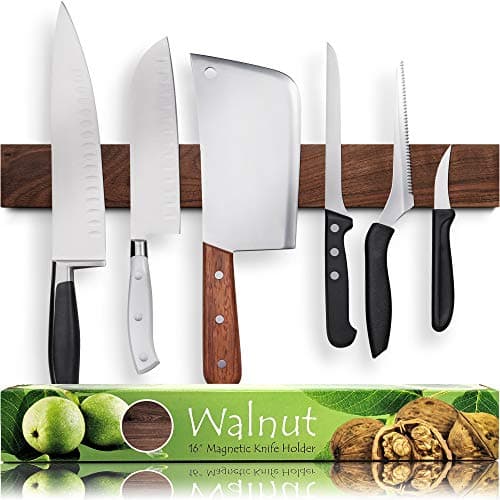
Magnetic Knife Holder Dark Walnut Magnetic Knife Holder (16 in)
Dark Walnut Magnetic Knife Holder (16 in)

The storage fix, and the one that addresses the actual cause. A knife hanging on a wall strip has air on every surface and nothing trapping moisture against the steel - unlike a block slot that stays damp, a drawer that holds humidity, or an edge guard that seals water in. It protects the edge at the same time.

Best storage fix
8.6
$44.95Amazon
03
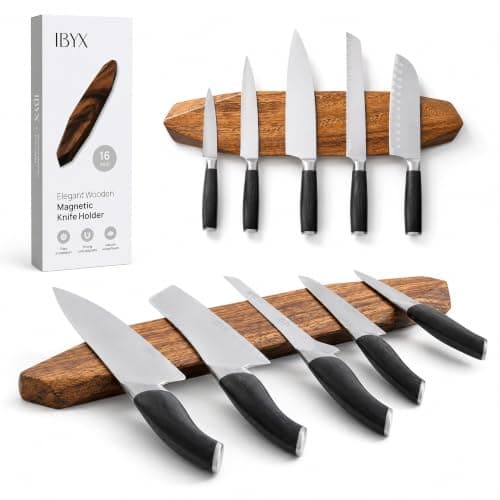
Ibyx Ibyx Acacia Magnetic Knife Holder (No-Drill)
Ibyx Acacia Magnetic Knife Holder (No-Drill)

The renter's version of the same fix. The same air-on-every-surface logic mounted with 3M adhesive, with screws included as a fallback - the obvious caveat being that adhesive on a tiled or textured splashback is a leap of faith with sharp objects on it.

Best for renters
8.2
$37.99Amazon

#ad · Live prices from the Amazon Product API, as of October 17, 2026. Where we have no verified live price, we show none — a gap beats a number that has rotted.

In detail

The picks, in full

01
Victorinox Victorinox Fibrox Pro 8"

Best stain-resistant knife

Victorinox Fibrox Pro 8"

Stamped X50CrMoV15~55-56 HRC~20 deg/side edgeLight ~7.4 oz
8.8/10

The pick if your knife rusts because it is not really stainless. Victorinox's X50CrMoV15 is a high-chromium stain-resistant stainless at around 55-56 HRC, Swiss made, NSF certified and rated dishwasher safe by its maker - about as corrosion-tolerant as a kitchen knife gets, at a price that makes replacing a rusting knife a non-decision.

Fit for the problem
8.5
Effectiveness
9
Ease of use
9.5
Build
7
Value
10

Pros

  • High-chromium stainless formulated for corrosion resistance, which is exactly the property in question here
  • Victorinox rates it dishwasher safe, so household handling will not destroy it even if we would still hand wash
  • Synthetic Fibrox handle cannot swell, crack or harbour water the way wood can
  • Soft forgiving steel that hones back in seconds, so sharpness never becomes a reason to neglect it
  • Cheap enough to be the obvious replacement for a knife that has already pitted

Cons

  • Stain-resistant is not stain-proof - leave it wet and salty and it will still mark
  • Softest steel in most comparisons, so honing is maintenance rather than an option
  • Widest stated edge angle of the knives we rank, so the factory edge is blunter than a Japanese grind
  • Utilitarian looks, no bolster, no heft

Don't buy this if…

…the rusting knife is a carbon-steel blade you chose deliberately - you do not have a problem, you have a maintenance routine to adopt.

Re-scored on this page's rubric; it wins best chef knives on its own and is reviewed at full length here. It is on this page as the corrosion answer rather than the cutting answer: a high-chromium stainless with a synthetic handle in a kitchen that is hard on knives is the combination least likely to come back to this question. If your current knife is a decent stainless that rusted, buying this changes nothing — change the drying habit instead.

$46.87View on Amazon

Price as of October 17, 2026. Prices change — Amazon's at checkout is the one that counts.

#ad · we may earn a commission from this link to Victorinox Fibrox Pro 8"

02
Magnetic Knife Holder Dark Walnut Magnetic Knife Holder (16 in)

Best storage fix

Dark Walnut Magnetic Knife Holder (16 in)

16-inch walnut stripWall-mountedBlade face contact onlyHolds heavy knives
8.6/10

The storage fix, and the one that addresses the actual cause. A knife hanging on a wall strip has air on every surface and nothing trapping moisture against the steel - unlike a block slot that stays damp, a drawer that holds humidity, or an edge guard that seals water in. It protects the edge at the same time.

Fit for the problem
9
Effectiveness
9
Ease of use
8
Build
9
Value
8

Pros

  • A hanging blade air-dries on every surface, which is the opposite of what a block slot or a sheath does
  • Only the flat of the blade touches anything, so the edge is never in contact - it is a sharpness fix too
  • Visible storage means a damp knife gets noticed and dried rather than forgotten
  • Frees counter space rather than taking it
  • Works with whatever knives you already own

Cons

  • Needs a wall and a drill, which rules it out in some kitchens and most rentals
  • A household with small children may not want blades at reachable height
  • Mounted over a hob or a kettle it collects grease and steam, which defeats the purpose
  • Does nothing at all if knives still go into the strip wet

Don't buy this if…

…you cannot drill - the no-drill version below does the same job with an adhesive mount, and an in-drawer organiser is the invisible alternative.

Re-scored here; it is also a top pick in best knife storage and in gifts for home cooks, where it is judged on different criteria. On a rust page it earns its place because of what it does not do: it does not hold water against steel. Knife blocks and edge guards both do, which is why a knife put away slightly damp rusts in a block and air-dries on a strip.

$44.95View on Amazon

Price as of October 17, 2026. Prices change — Amazon's at checkout is the one that counts.

#ad · we may earn a commission from this link to Dark Walnut Magnetic Knife Holder (16 in)

03
Ibyx Ibyx Acacia Magnetic Knife Holder (No-Drill)

Best for renters

Ibyx Acacia Magnetic Knife Holder (No-Drill)

Acacia wood strip3M adhesive or screw mountWall-mountedBlade face contact only
8.2/10

The renter's version of the same fix. The same air-on-every-surface logic mounted with 3M adhesive, with screws included as a fallback - the obvious caveat being that adhesive on a tiled or textured splashback is a leap of faith with sharp objects on it.

Fit for the problem
8.5
Effectiveness
8
Ease of use
9
Build
7
Value
8.5

Pros

  • No drilling, so it suits rentals and tiled splashbacks
  • Same air-drying and edge-protection benefit as a drilled strip
  • Includes screws as a fallback if the adhesive will not hold
  • Costs less than most drilled hardwood strips

Cons

  • Adhesive mounting is only as good as the surface under it, and the failure mode involves knives falling
  • Lower load ceiling than a screwed strip - be sensible about heavy cleavers
  • Acacia is a softer, less dense wood than walnut and will mark more
  • Still useless if the knife goes up wet

Don't buy this if…

…you own heavy forged knives and can drill - screw a proper hardwood strip to the wall instead and stop thinking about it.

Re-scored here; it is the renter's pick in best knife storage. It finishes last of three on this page on build and effectiveness, and it is the right purchase for anyone who cannot put a hole in a wall. If adhesive mounting makes you uneasy — and it reasonably might — an in-drawer organiser keeps blades apart and dry-ish without any mounting at all, and the storage guide ranks those too.

$37.99View on Amazon

Price as of October 17, 2026. Prices change — Amazon's at checkout is the one that counts.

#ad · we may earn a commission from this link to Ibyx Acacia Magnetic Knife Holder (No-Drill)

How to remove rust that is already there

Light orange surface rust: make a thick paste of bicarbonate of soda and water, apply it along the blade, and work it with a wine cork, a nylon pad or the soft side of a sponge — always along the length of the blade rather than across it, so any scratches follow the grind. Rinse, dry completely, and look again. Repeat rather than pressing harder.

Heavier rust or pitting: a fine abrasive — a rust eraser block, or very fine wet-and-dry paper used wet — will take it off and will visibly change the finish. That is an honest trade on a working knife and a bad one on a Damascus-clad blade, where the cladding pattern is a surface feature. Do not use steel wool on a stainless blade; the iron particles it leaves behind start the next rust spot.

Then deal with the edge. Rust removal is abrasive work near a cutting edge and you will usually need to re-sharpen afterwards — how to sharpen kitchen knives has the method, and a local service is a sensible route if the knife is worth it.

The routine that stops it coming back

Wash the knife when you put it down, not when you clear up. Dry it with a cloth, both sides, including the bolster and the heel where water collects. Never leave it in the sink, under anything wet, or in a drying rack with the blade sitting in a puddle. Store it where air reaches it. If you use a block, make sure knives go in dry — a damp slot stays damp for hours. If you use edge guards or a roll, the same applies with more force, because both are designed to seal.

For carbon steel specifically, add one step: wipe the blade during use, not only after it, and put a very thin film of food-safe mineral or camellia oil on it before long storage. Knife care and maintenance covers the full routine, and how long does a chef knife last is what this habit is actually buying you.

One thing that is not a fix

Buying a more expensive knife. Price is not corrosion resistance — some of the most expensive blades in any kitchen are carbon-clad or carbon-core and rust faster than a twenty-dollar Swiss knife. Chromium content and your drying habit are what decide this, and only one of the two is on the price tag. If you want the material explanation, knife steel types explained has it, and damascus steel knives explained covers why patterned cladding is often the part that stains.
How we picked

We did not lab-test these knives

Everyone in this category says they tested twenty knives in a professional kitchen. We have not hands-on tested any of these, and we say so. What we did instead: compiled the published specifications — steel type and hardness (HRC), edge angle, blade geometry, weight and build — applied established sharpening standards, ran the value math (spec quality ÷ live price), and scored each product against a published rubric. The scores are judgments from documented research — not measurements we took, because we do not have a test lab and we will not pretend we do. Where a number came from someone else's work, we name them in Sources.

Questions

Frequently asked

Why is my stainless steel knife rusting?
Because stainless means stain-resistant, not rust-proof. Its protection is a thin chromium oxide layer that needs air and dryness to re-form; standing water, salt, acid or a dishwasher cycle can outpace it. The usual culprit is a blade left wet.
How do I get rust off a kitchen knife?
Bicarbonate of soda paste and a cork or nylon pad, worked along the blade, for light rust. A rust eraser or very fine wet-and-dry paper for heavier rust, accepting that the finish will change. Never steel wool on stainless. Dry completely afterwards and expect to re-sharpen.
What are the brown or black spots on my knife?
Orange-brown and slightly raised is rust and should be removed. Flat grey, blue or purple-black on a carbon-steel blade is patina, which is stable and protective — leave it. Tiny dark pinpricks in stainless are pits, usually from salt, and they are permanent cosmetic damage.
Does the dishwasher cause rust?
It is the worst environment in the kitchen for a blade: hot caustic detergent attacks the passive layer while the blade knocks against other steel. Some makers rate their knives dishwasher safe and the knives still age faster. See can you put knives in the dishwasher.
Should I oil my kitchen knives?
Carbon steel, yes — a very thin film of food-safe mineral or camellia oil before storage. Stainless, not routinely; dry storage does the job. Oil a stainless blade only if it is going into long storage or a humid environment.
Will a rusted knife make food unsafe?
Surface rust on a kitchen knife is iron oxide and is not the hazard people imagine, but a pitted, rough blade is harder to clean properly and that is a genuine reason to deal with it. Remove the rust, dry the knife, and replace it if the pitting is deep enough to hold residue.

Keep reading

Receipts

Sources

We do not run a testing lab, and we do not pretend to. Where a spec or a measured number came from someone else's work — a manufacturer's page, a published standard — we name them and link them. Where we could not verify something, we say so on the page rather than quietly leaving it out. Read our full method.