Skip to content
The Edge Bench

Roundups & reviews · Chef Knives

Wusthof Classic alternatives

Two things send people looking for an alternative to the Classic: the price, and the full bolster that blocks the last inch of edge. Five knives ranked by which Classic property each one keeps and which it drops.

Zwilling Zwilling Pro 8"

Our top pick · Closest match with a sharpenable heel

Zwilling Pro 8"

8.9

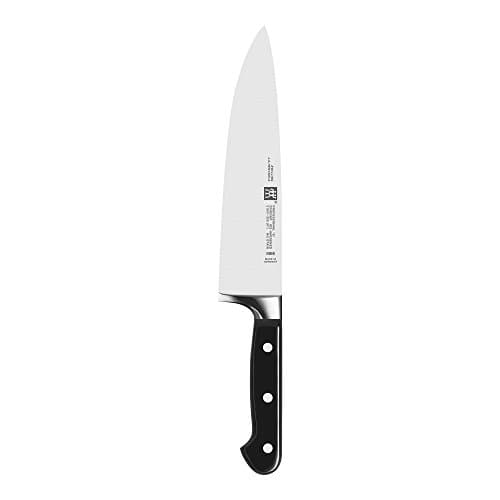
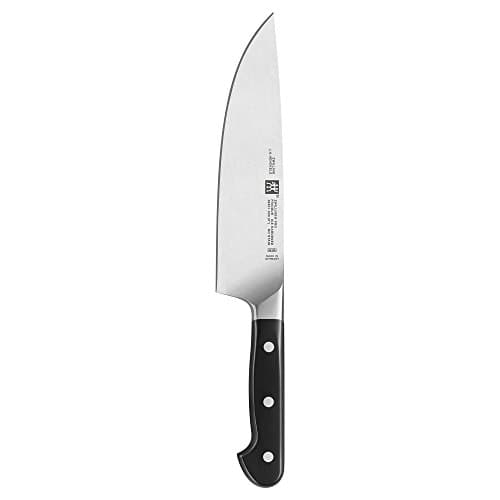
The best Wusthof Classic alternative, and the one to buy if you sharpen your own knives. Forged from a single billet in a company-owned German factory, FRIODUR ice-hardened inside the published 55-58 HRC band, full tang and triple-riveted - with a curved, sloped bolster that leaves the entire edge reachable on a flat stone. It keeps the Classic's construction and heft and fixes the Classic's one real design cost, for less money.

$129.99Amazon

#ad · Full ranking below

By Stephen V.Updated How we review
#ad

We earn a commission when you buy through our Amazon links, at no extra cost to you. It never changes a verdict, and we say so when the cheaper knife is the better buy. How this works.

Buy the Zwilling Pro 8" — it is the best alternative to a Wusthof Classic, because it keeps everything the Classic is good at and fixes the one thing it is not. Forged from a single billet in a company-owned German factory, FRIODUR ice-hardened inside Zwilling's published 55-58 HRC band, full tang and triple-riveted — and with a curved, sloped bolster that leaves the entire edge, heel included, reachable on a flat stone for the life of the knife. The budget pick is the Wusthof Gourmet 8", which keeps the Classic's Solingen manufacture, its steel and its ~14 degree grind, drops the forged weight and the bolster entirely, and is the cheapest knife on this page by a wide margin.

If you searched for a Wusthof Classic Ikon alternative, the answer is on this page too. The Ikon is ranked second, and the honest version of that comparison is in its entry: against the published figures the Ikon's half bolster accounts for about six grams, so what the premium actually buys is sharpening access and a better handle — not a lighter knife.

We do not print a price in the prose, because prices move and a sentence cannot. The Quick Picks table carries the live price and the date we pulled it, with a Check price button on every row. Every knife below was in stock with a live offer when this page was written.

One note on price, because it changes how this page is written.At our last price check the Wusthof Classic 8-inch itself was listed in stock but returned no live offer price through our price pipeline, so we do not tell you what it costs anywhere on this page. Every comparison below is either against Wusthof's own range structure — the Gourmet is its entry stamped line and the Classic Ikon its premium forged one — or against the live prices of the five knives in the Quick Picks table.

What the Wusthof Classic actually is

You cannot choose an alternative without naming the thing you are replacing, so here is the Classic 8-inch from Wusthof's own published specification: forged X50CrMoV15 at roughly 58 HRC, a full bolster and a full tang, and an edge ground with Precision Edge Technology to about 14 degrees per side, at roughly 9.3 ounces. Three of those properties are the product.

The ~14 degree grind is the genuinely unusual one.The German norm is nearer 20 degrees per side. Wusthof grinds narrower, which is why a Classic arrives sharper out of the box than most Western knives and feels keener than 58 HRC alone would suggest. It is also narrower than Shun's published 16 degrees — a fact that surprises people who assume Japanese automatically means thinner.

The forged full tang is where the heft comes from, and heft is not a flaw: it is what lets the knife fall through a butternut squash under its own weight and what makes it feel authoritative in a rock-chop.

And the full bolster is the property that sends people to this page.A full bolster is a thick collar of steel that runs all the way down to the heel. It gives the most secure pinch grip of any Western knife we rank, and it makes the last inch of edge physically unreachable on a flat stone — so over years of sharpening, the heel stays proud while the rest of the edge recedes, and you end up with a knife that will not cut cleanly all the way to the board. Full bolster vs half bolster is the whole mechanism in one page.

Why this page is not our brand-level Wusthof page

We already have alternatives to Wusthof, and it answers a different question: what forged German knife should I buy instead of this brand? Every pick on that page is a Western forged lookalike from another house, and it ranks the Zwilling Professional S first precisely because it matches the Classic point for point, full bolster included.

This page is about the line. If the full bolster is why you are here, a knife that reproduces it is not an improvement — which is why the Professional S is ranked fourth below and not first, and why two of the five picks are Wusthofs. A brand-level page cannot honestly recommend a Wusthof; a line-level page has to, because the Gourmet and the Ikon are two of the best answers there are.

How we ranked them

Five metrics, the same five for every knife. They are judgments from published specifications and from value arithmetic against the live price, not lab measurements — how we review says so in those words. We have not hands-on tested these knives and we do not claim to have.

Keeps the grindis how close the knife comes to the Classic's ~14 degree edge and its steel behavior, because that is what the Classic feels like in the hand. Sharpenable heel is the metric this page exists for: whether the whole edge can actually be sharpened on a flat stone, or whether a bolster is in the way. Forged heft & balance is the weight and construction that make a Classic feel like a Classic. Handle & ergonomics is grip security and comfort over an hour of prep. Value per dollar is what you actually get for the money against the Classic itself.

These scores are fresh, and that is deliberate.We normally carry a product's score between pages so our own rankings cannot contradict each other, and we depart from that only when the rubric genuinely changes. It changes here: "Keeps the grind" and "Sharpenable heel" are new metrics that only mean something on a line-level page, and "Match on construction" from the brand page has been replaced by "Forged heft & balance" because a stamped Wusthof is a legitimate answer to this question and a construction-match metric would score it as a failure rather than as a trade. So the knives below are scored from scratch, which is why one of them sits in a different position here than on the brand page. We would rather tell you that than quietly re-score.

The short answer

Quick picks

#KnifeBest forScorePrice
01
Zwilling Zwilling Pro 8"
Zwilling Pro 8"

The best Wusthof Classic alternative, and the one to buy if you sharpen your own knives. Forged from a single billet in a company-owned German factory, FRIODUR ice-hardened inside the published 55-58 HRC band, full tang and triple-riveted - with a curved, sloped bolster that leaves the entire edge reachable on a flat stone. It keeps the Classic's construction and heft and fixes the Classic's one real design cost, for less money.

Closest match with a sharpenable heel
8.9
$129.99Amazon
02
Wusthof Wusthof Classic Ikon 8"
Wusthof Classic Ikon 8"

The in-family answer, and the one to buy if you want a Classic that sharpens all the way to the heel. Identical forged X50CrMoV15 at 58 HRC, the identical ~14 degree PEtec grind, a half bolster with the heel exposed, and the best handle Wusthof makes. It is also the most expensive knife on this page, and Wusthof positions the Ikon above the Classic in its own range - which is the only reason it is not ranked first.

A Classic with the heel exposed
8.7
$182.80Amazon
03
Wusthof Wusthof Gourmet 8"
Wusthof Gourmet 8"

The budget pick, and the most interesting knife on this page. Precision-stamped in Solingen from the same X50CrMoV15 at ~56 HRC with the same ~14 degree PEtec grind - and with no bolster at all, so the whole edge is sharpenable forever. It drops the forged heft and about a third of the weight, and it is the cheapest knife on this page by a wide margin.

Budget pick
8.4
$59.98Amazon
04
Zwilling Zwilling Professional S 8"
Zwilling Professional S 8"

The most literal substitute there is, and that is exactly why it is ranked here rather than first. Forged in a company-owned German factory, FRIODUR ice-hardened to ~57 HRC, full tang, ~15 degree edge - and a FULL bolster, which is the one Classic property most people searching for an alternative are trying to escape. Superb value if the bolster is not your problem.

Keeping the full bolster for less
8.1
$93.41Amazon
05
Shun Shun Classic 8"
Shun Classic 8"

The alternative for someone who wants a different knife rather than a cheaper Classic. VG-MAX core, Damascus-clad, ~60-61 HRC and a published 16 degree double bevel - harder steel that holds an edge far longer, in a far lighter knife. It matches almost nothing about a Classic, and for some cooks that is the point.

Harder steel and longer edge retention
7.2
$140.14Amazon

#ad · Live prices from the Amazon Product API, as of November 23, 2026. Where we have no verified live price, we show none — a gap beats a number that has rotted.

In detail

The picks, in full

01
Zwilling Zwilling Pro 8"

Closest match with a sharpenable heel

Zwilling Pro 8"

Forged, company-owned German factoryFRIODUR ice-hardened, 55-58 HRC publishedCurved sloped bolsterFull tang, triple-riveted
8.9/10

The best Wusthof Classic alternative, and the one to buy if you sharpen your own knives. Forged from a single billet in a company-owned German factory, FRIODUR ice-hardened inside the published 55-58 HRC band, full tang and triple-riveted - with a curved, sloped bolster that leaves the entire edge reachable on a flat stone. It keeps the Classic's construction and heft and fixes the Classic's one real design cost, for less money.

Keeps the grind
8.5
Sharpenable heel
9.5
Forged heft & balance
9.5
Handle & ergonomics
8.5
Value per dollar
8.5

Pros

  • The curved bolster is the whole argument: the full length of the edge, heel included, meets a flat stone, which a full-bolster Classic can never do
  • Forged from a single billet in a company-owned German factory - the same category of construction as the Classic, not a lookalike
  • FRIODUR ice-hardening is a real published process, and the 55-58 HRC band brackets the Classic's ~58
  • Full tang and triple-riveted handle give genuine forged heft and a balance point near the bolster, so a rock-chop feels the same
  • Cheaper than the Classic Ikon and the Shun at our last price check, while matching the forged Solingen construction class
  • Already our #1 pick on best Zwilling knives, so the two pages agree about the knife

Cons

  • A sloped bolster gives a slightly less locked-in pinch grip than the Classic's full collar - a real trade, not a free win
  • Zwilling publishes a 55-58 HRC band rather than a single figure, so the hardness is scored AS a band, not as a number
  • Zwilling grinds its forged Solingen lines near 15 degrees a side, a degree wider than Wusthof's published 14 - keen, but not identical
  • The Pro line has hollow-edge and traditional variants that look near-identical in a listing, so it is easy to order the wrong one
  • Costs enough that it is not the budget answer - if price is the reason you are here, skip to the Gourmet

Don't buy this if…

…you will never sharpen this knife yourself - if it goes to a professional sharpener or into a guided system that handles the heel for you, the bolster advantage never pays, and the cheaper Zwilling Professional S matches the Classic more literally.

Two Solingen houses, the same steel family, the same hardness band, the same forged single-billet construction. On paper the Zwilling Pro and the Wusthof Classic are nearly the same knife, and in the hand they largely are. What separates them is a piece of geometry most buyers never think about until year five.

The bolster is the whole review.Wusthof's full bolster is a collar of steel running down to the heel; it is the reason a Classic has such a secure pinch grip, and it is the reason the last inch of its edge cannot touch a flat stone. Zwilling's Pro bolster sweeps away from the heel, so the edge runs out clear. Sharpen both knives twenty times over a decade and the Classic develops a proud, uncut heel while the Pro stays straight. That is not a theoretical difference; it is the single most common complaint from people who have owned a full-bolster knife long enough.

What you give up is a little of that locked-in grip. A full bolster acts as a stop for your index finger; a sloped one does not, and if you pinch high on the blade you will notice. This is a trade, and anyone telling you the curved bolster is a free improvement is selling something.

On the grind, be precise: Zwilling grinds its forged Solingen lines near 15 degrees a side against Wusthof's published 14, and it does not publish a separate per-line figure for the Pro. One degree is not something you will feel, but we score it as the near-match it is rather than as identical.

If you want this comparison in full rather than as one entry on a list, Wusthof vs Zwilling is the head-to-head, and our Zwilling Pro review is the single-knife version.

$129.99View on Amazon

Price as of November 23, 2026. Prices change — Amazon's at checkout is the one that counts.

#ad · we may earn a commission from this link to Zwilling Pro 8"

02
Wusthof Wusthof Classic Ikon 8"

A Classic with the heel exposed

Wusthof Classic Ikon 8"

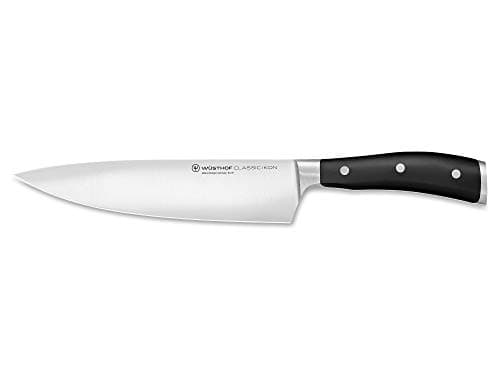
Forged in Solingen, X50CrMoV15, 58 HRC~14 deg/side PEtec edgeHalf bolster, heel exposedDouble-bolster pakkawood handle
8.7/10

The in-family answer, and the one to buy if you want a Classic that sharpens all the way to the heel. Identical forged X50CrMoV15 at 58 HRC, the identical ~14 degree PEtec grind, a half bolster with the heel exposed, and the best handle Wusthof makes. It is also the most expensive knife on this page, and Wusthof positions the Ikon above the Classic in its own range - which is the only reason it is not ranked first.

Keeps the grind
10
Sharpenable heel
9
Forged heft & balance
9.5
Handle & ergonomics
9
Value per dollar
6

Pros

  • It is the Classic's grind and the Classic's steel - nothing on this page keeps the feel of a Classic as exactly, because it is one
  • Half bolster leaves the heel exposed, so the whole edge reaches a flat stone - the Classic's one design cost, removed
  • The double-bolster pakkawood handle is the best-regarded grip in the Wusthof range and is more comfortable than the Classic's over a long prep session
  • Same Solingen factory, same service and spares network, same warranty
  • Our own Classic Ikon review scores it above the Classic on the shared rubric, so this is not a sideways move

Cons

  • Wusthof positions the Ikon ABOVE the Classic in its own range, so this is an alternative that costs more than the knife it replaces - a strange property, and the reason it is ranked second
  • Against the published figures the half bolster accounts for about six grams - if you came looking for a lighter knife, this is not it
  • At ~9.1 oz it is a heavy knife, same as the Classic, so nothing about the weight complaint is solved
  • The pakkawood handle is a preference, not an upgrade for everyone - some cooks prefer the Classic's molded synthetic
  • Same ~58 HRC steel means the same sharpening cadence; nothing here holds an edge longer

Don't buy this if…

…price is any part of why you are looking for an alternative - this is the most expensive knife on the page, and the Wusthof Gourmet keeps the same grind for a fraction of it.

This is the knife the pos-2 search is about, so let us answer it directly: the Classic Ikon is an excellent Wusthof Classic alternative and a poor one if money is the problem. It is the only knife on this page that keeps the Classic's grind exactly, because it is the same forged X50CrMoV15 at the same 58 HRC with the same Precision Edge Technology bevel. Nothing is lost in translation, because nothing is translated.

What it changes is the bolster and the handle. The half bolster leaves the heel exposed, so the full edge reaches a stone — the same fix the Zwilling Pro offers, from inside the brand. The double-bolster pakkawood handle is the nicest thing Wusthof makes and is more comfortable than the Classic's over an hour of prep.

Now the honest part, because this is the claim people get sold. Wusthof markets the half bolster as a lighter, more agile knife. When we checked that against the published figures for our Classic Ikon review, the difference came to about six grams — which is to say, nothing you will feel. Buy the Ikon for the sharpening access and the handle. Do not buy it expecting a lighter knife; if that is what you want, the Gourmet below drops roughly a third of the weight.

It is ranked second here purely on value: paying a premium over the knife you are replacing is a hard thing for an "alternative" to justify, and the Zwilling Pro delivers the same heel fix in the same construction class for less. If brand continuity matters to you — matching pieces, one service network, a block you already own — flip our order and buy the Ikon.

$182.80View on Amazon

$200.009% off

Price as of November 23, 2026. Prices change — Amazon's at checkout is the one that counts.

#ad · we may earn a commission from this link to Wusthof Classic Ikon 8"

03
Wusthof Wusthof Gourmet 8"

Budget pick

Wusthof Gourmet 8"

Precision-stamped in SolingenX50CrMoV15, ~56 HRC~14 deg/side, double bevel6.5 oz, 2.7 mm spine, no bolster
8.4/10

The budget pick, and the most interesting knife on this page. Precision-stamped in Solingen from the same X50CrMoV15 at ~56 HRC with the same ~14 degree PEtec grind - and with no bolster at all, so the whole edge is sharpenable forever. It drops the forged heft and about a third of the weight, and it is the cheapest knife on this page by a wide margin.

Keeps the grind
9.5
Sharpenable heel
10
Forged heft & balance
5
Handle & ergonomics
8
Value per dollar
9.5

Pros

  • Same Solingen manufacture, same steel family and the same ~14 degree PEtec grind as the Classic - the thing that actually cuts is near-identical
  • No bolster at all, which means the entire edge including the heel meets a stone for the life of the knife - the best sharpening access on this page
  • About 6.5 oz against the Classic's ~9.3 - a genuine ~30% weight cut, which is the lighter knife the Ikon's marketing implies and does not deliver
  • The cheapest knife on this page at our last price check, by a wide margin
  • Wusthof's own warranty and service network, at a stamped-knife price

Cons

  • It is a stamped knife, not a forged one - no full tang heft, and it will never feel as authoritative driving through a hard squash
  • ~56 HRC against the Classic's ~58, so the edge rolls sooner and wants honing more often
  • The thinner 2.7 mm spine flexes more than a forged blade under lateral load
  • A lighter knife is a preference, not an upgrade - cooks who like to rock-chop with weight will find it insubstantial
  • The molded handle is functional rather than nice, and is the most obvious place the money was saved

Don't buy this if…

…the forged heft is part of why you wanted a Classic in the first place - this knife deliberately does not have it, and no amount of shared steel changes that.

The Gourmet is the answer to the question most people are actually asking when they type "Wusthof Classic alternative" into a search bar, which is usually some version of is there a cheaper way to get this knife?The answer is: you can have the steel, the city, the grind and the warranty for Wusthof's entry-line money, and what you give up is the forging.

And the thing you give up has a hidden upside.A stamped knife has no bolster, because there is no forged collar to leave behind. That means the full edge, right into the heel, meets a flat stone from the day you buy it until the day you wear it out. It is the best sharpening access on this page — better than the Ikon's half bolster and better than the Zwilling's slope — and it costs the least.

The weight is the other real difference, and it is the one the numbers make vivid: roughly 6.5 ounces against the Classic's ~9.3, a cut of about 30%. If you have ever found a German chef's knife tiring over a big prep session, that is a substantial change. If you like the knife falling through an onion under its own weight, it is a downgrade. Neither reading is wrong; they are different cooks.

The honest cost is hardness and stiffness. At ~56 HRC against ~58, the edge rolls a little sooner, which means the honing rod matters more — see how to use a honing steel, because on this knife it is the difference between sharp-for-a-week and sharp-for-a-month. And a 2.7 mm stamped spine flexes where a forged blade does not.

Our Wusthof Gourmet review is the long version, and it is the page that documents the weight figures we are using here.

$59.98View on Amazon

$100.0040% off

Price as of November 23, 2026. Prices change — Amazon's at checkout is the one that counts.

#ad · we may earn a commission from this link to Wusthof Gourmet 8"

04
Zwilling Zwilling Professional S 8"

Keeping the full bolster for less

Zwilling Professional S 8"

Forged, company-owned German factoryFRIODUR ice-hardened, ~57 HRCFull bolster, full tang~15 deg/side edge
8.1/10

The most literal substitute there is, and that is exactly why it is ranked here rather than first. Forged in a company-owned German factory, FRIODUR ice-hardened to ~57 HRC, full tang, ~15 degree edge - and a FULL bolster, which is the one Classic property most people searching for an alternative are trying to escape. Superb value if the bolster is not your problem.

Keeps the grind
9
Sharpenable heel
4
Forged heft & balance
9.5
Handle & ergonomics
8.5
Value per dollar
9.5

Pros

  • Matches the Classic on construction, origin, hardness band and grind more literally than anything else here
  • Full bolster gives the same locked-in pinch grip the Classic is loved for, if that is what you want
  • The cheapest forged knife on this page at our last price check - the best pure value in the forged-German class
  • FRIODUR ice-hardening at ~57 HRC sits right alongside the Classic's ~58
  • Our #1 pick on the brand-level alternatives to Wusthof page, where matching the Classic point for point is the whole brief

Cons

  • The full bolster means the heel never reaches a flat stone, so this reproduces the Classic's one real long-term flaw rather than fixing it
  • ~15 degrees against the published ~14, so marginally less keen out of the box
  • Older, plainer handle design than the Pro line - functional, not a highlight
  • If you are here because of the bolster, this knife is the wrong answer in a way no other metric compensates for
  • ~57 HRC is the same sharpening cadence as a Classic; nothing here lasts longer between stones

Don't buy this if…

…the full bolster is why you are reading this page - you would be buying the problem again, and the Zwilling Pro is the same house, the same construction and a sharpenable heel.

We want to be careful with this one, because it is the top pick on our brand-level alternatives to Wusthof page and nothing about it has got worse. It is still the most literal forged-German substitute for a Classic on the market, and at our last price check it was the best value in that class by a clear margin.

What changed is the question. On the brand page the brief is "match the Classic", and a full bolster is part of matching it. On this page the brief is "what instead of the Classic specifically", and the full bolster is the Classic property that most often sends people looking. Reproducing it scores 4 out of 10 on a metric that did not exist on the other page, and that is the whole of the difference in position.

So read the ranking as conditional rather than absolute. If your reason for wanting an alternative is price, and you sharpen on a guided system or send knives out, buy this one — you will get forged Solingen construction and the grip you already like for less than any other forged knife here. If your reason is the bolster, the Zwilling Pro is the same factory and the same build with the heel left clear.

Victorinox vs Zwillingis where this knife's value argument gets tested against the cheapest credible alternative, and our Professional S review is the single-knife version.

$93.41View on Amazon

$169.9945% off

Price as of November 23, 2026. Prices change — Amazon's at checkout is the one that counts.

#ad · we may earn a commission from this link to Zwilling Professional S 8"

05
Shun Shun Classic 8"

Harder steel and longer edge retention

Shun Classic 8"

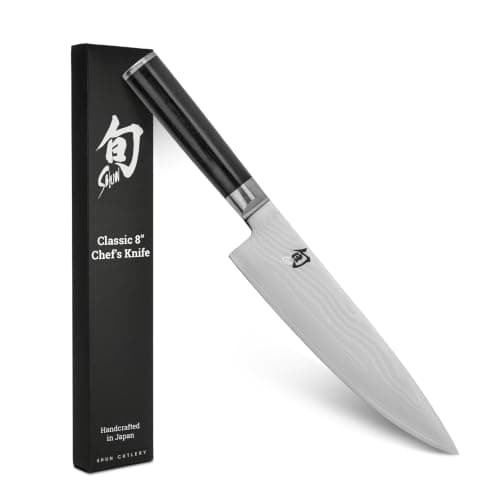
VG-MAX core, Damascus-clad~60-61 HRC~16 deg double-bevel edgeD-shaped pakkawood handle
7.2/10

The alternative for someone who wants a different knife rather than a cheaper Classic. VG-MAX core, Damascus-clad, ~60-61 HRC and a published 16 degree double bevel - harder steel that holds an edge far longer, in a far lighter knife. It matches almost nothing about a Classic, and for some cooks that is the point.

Keeps the grind
6.5
Sharpenable heel
9
Forged heft & balance
5.5
Handle & ergonomics
8
Value per dollar
7

Pros

  • ~60-61 HRC against the Classic's ~58 means the edge genuinely lasts longer between sharpenings
  • No Western bolster, so the whole edge reaches a stone
  • Far lighter and more nimble than a forged German knife, which suits precision work and long prep sessions
  • The Damascus cladding is cosmetic but the VG-MAX core is a genuinely premium steel, and the knife feels it
  • Sits between the Zwilling Pro and the Classic Ikon on price at our last price check, so this is a lateral move rather than a splurge

Cons

  • Its published 16 degree bevel is WIDER than the Classic's ~14 - this knife is not sharper on paper, it holds its sharpness longer
  • Hard steel chips where soft German steel rolls, so bones, frozen food and a careless twist are real risks
  • Light and flat where a Classic is heavy and curved - it does not rock-chop the same way and will feel wrong if that is your motion
  • The D-shaped handle is mildly right-hand biased and is genuinely polarizing
  • Wants more careful maintenance and a 15-16 degree-capable sharpener; a 20 degree pull-through will damage it

Don't buy this if…

…you want the Classic experience for less - this is a different knife with a different philosophy, and three of our five metrics are measuring how much of a Classic it is not.

The Shun finishes last on this page and it is the best knife on it by several measures, which tells you something about what the page is measuring. Three of our five metrics ask how much of a Wusthof Classic a knife is, and the honest answer for the Shun is: almost none of it.

Start with the fact that surprises people. Shun publishes a 16 degree double bevel; Wusthof publishes about 14 for the Classic. The German knife is ground narrower. What the Shun gives you is not a thinner edge, it is a harder one — VG-MAX at roughly 60-61 HRC against X50CrMoV15 at roughly 58 — and hard steel holds its geometry far longer. You sharpen it less often, not less steeply.

The second real difference is weight and profile. A Classic is heavy with a pronounced curve, built to rock against a board. The Shun is light with a flatter belly, built to push cut. If your hands have learned the German motion, this knife will feel like it is fighting you for a fortnight. If you have always found German knives clubby, it will feel like relief.

The cost is fragility and maintenance. Hard steel chips rather than rolls, which means no bones, no frozen food and no prying — and it means your sharpener has to reach 15-16 degrees, so a 20 degree pull-through is off the table. Best knife sharpeners for Japanese knives is the tool side of that, and Shun vs Wusthof is this comparison at full length.

Ranked fifth, recommended without hesitation to the right person: the cook who wants an edge that lasts months rather than weeks, and who is done with heavy knives.

$140.14View on Amazon

Price as of November 23, 2026. Prices change — Amazon's at checkout is the one that counts.

#ad · we may earn a commission from this link to Shun Classic 8"

Which alternative is yours?

You sharpen your own knives on a stone. The Zwilling Pro. The curved bolster is worth more over a decade than any other difference on this page, and you are the person who will actually collect that value.

The Classic is too expensive. The Wusthof Gourmet. Same city, same steel family, same grind, no bolster, about a third less weight, and the cheapest knife on this page. The honest cheap answer.

You want a Classic that sharpens to the heel and money is not the issue. The Classic Ikon. It is the Classic with the heel exposed and a better handle, and Wusthof prices the Ikon above the Classic.

You like the full bolster and just want to pay less. The Zwilling Professional S. It reproduces the Classic most literally of anything here, bolster included, and it is the cheapest forged knife on this page.

You are tired of heavy knives and want an edge that lasts. The Shun Classic. A different knife on purpose.

You want exactly a Wusthof Classic. Then buy the Wusthof Classic. It is an excellent knife, it is the top forged pick on best German chef knives, and no page on this site will tell you otherwise. Everything above is a trade, and a trade is only worth making if one of these specific properties is a problem for you.

The one thing to decide before you choose

Will you sharpen this knife yourself?Everything on this page pivots on that answer. If yes, the bolster matters enormously and the ranking above is the ranking. If no — if the knife goes to a professional sharpener once a year, or through a guided system that handles the heel — then "sharpenable heel" is worth nothing to you, the Zwilling Professional S becomes the value answer, and the Wusthof Classic itself stops having a flaw.

Best double-sided whetstones is where that decision gets made in practice: a flat stone is exactly the tool a full bolster defeats, and it is also the cheapest way to keep any of these knives sharp.

What none of these change

All five are 8-inch Western-pattern chef's knives in the same broad class, so none of them solves a hand-size problem, a left-handed problem or a storage problem. If the Classic feels too big or too heavy in your hand rather than too expensive, that is a different page: chef knife sizes and best knives for small handsare the two worth reading first. And none of them will stay sharp on its own — knife care and maintenance is what actually decides how good any of these knives is in year three.
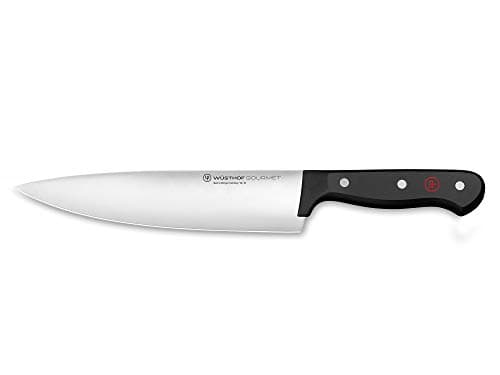
How we picked

We did not lab-test these knives

Everyone in this category says they tested twenty knives in a professional kitchen. We have not hands-on tested any of these, and we say so. What we did instead: compiled the published specifications — steel type and hardness (HRC), edge angle, blade geometry, weight and build — applied established sharpening standards, ran the value math (spec quality ÷ live price), and scored each product against a published rubric. The scores are judgments from documented research — not measurements we took, because we do not have a test lab and we will not pretend we do. Where a number came from someone else's work, we name them in Sources.

Questions

Frequently asked

What is the best alternative to a Wusthof Classic?
The Zwilling Pro 8-inch, for most people who sharpen their own knives. It is forged in a company-owned German factory inside the same 55-58 HRC band, with a full tang and the same category of heft — and its curved, sloped bolster leaves the entire edge reachable on a flat stone, which a full-bolster Classic never can. It is also cheaper than every other forged knife on this page bar the stamped Gourmet. If price is your reason, the Gourmet is the cheap answer.
Is there a Wusthof Classic Ikon alternative?
The Zwilling Pro is the closest one: both are forged Solingen-class knives whose bolster leaves the heel sharpenable, and the Zwilling costs less. Be clear about what you are replacing, though — against the published figures the Ikon's half bolster accounts for about six grams, so if you were buying it for lightness, the Wusthof Gourmet drops roughly a third of the weight for a fraction of the price.
What is the difference between the Wusthof Classic and the Gourmet?
Construction. The Classic is forged with a full bolster and a full tang at about 9.3 oz and roughly 58 HRC; the Gourmet is precision-stamped in the same city from the same X50CrMoV15 at about 56 HRC, with no bolster and around 6.5 oz. Both carry the same ~14 degree Precision Edge Technology grind, which is why the Gourmet cuts far better than its price suggests. You are paying for heft, hardness and stiffness, not for a better edge.
Is a full bolster actually a problem?
Only if you sharpen the knife yourself on a flat stone, and then it is a real one. A full bolster runs down to the heel, so the last inch of edge cannot reach the stone; over years of sharpening the heel stays proud while the rest of the edge recedes, and the knife stops cutting cleanly all the way to the board. If your knives go to a professional sharpener or through a guided system, it never matters.
Is a Shun sharper than a Wusthof Classic?
Not on the published geometry — Shun lists a 16 degree double bevel against Wusthof's roughly 14 for the Classic, so the German knife is ground narrower. What the Shun has is harder steel, VG-MAX at around 60-61 HRC against roughly 58, so it holds its edge substantially longer. Longer-lasting, not sharper.
Should I just buy the Wusthof Classic?
If none of its three trade-offs bothers you — the price, the weight, or the full bolster — then yes. It is a genuinely excellent forged knife with the deepest spares and service network of any brand we rank, and it is the top forged pick on our best German chef knives roundup. An alternative is only worth buying if one of those properties is specifically a problem for you.

Keep reading

Receipts

Sources

We do not run a testing lab, and we do not pretend to. Where a spec or a measured number came from someone else's work — a manufacturer's page, a published standard — we name them and link them. Where we could not verify something, we say so on the page rather than quietly leaving it out. Read our full method.