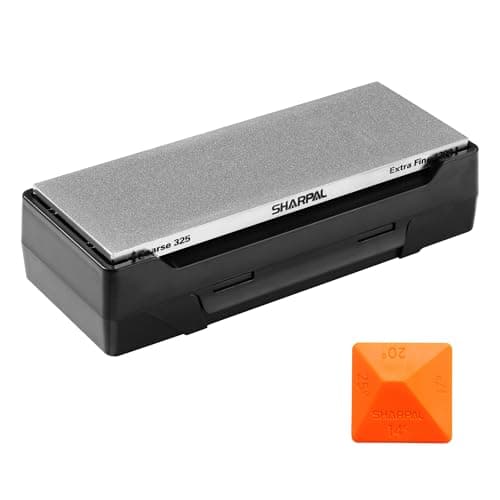
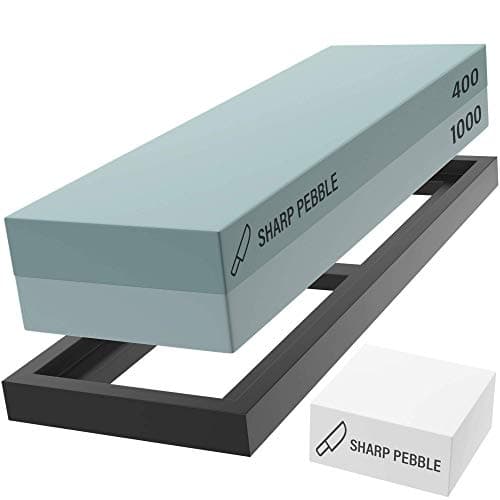
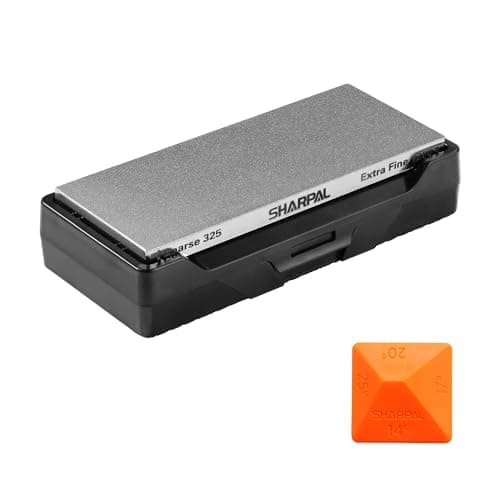
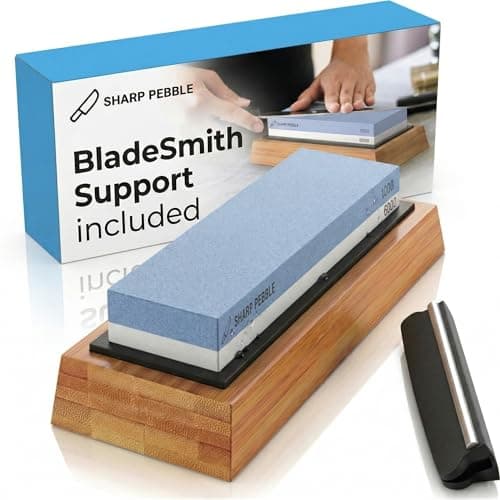
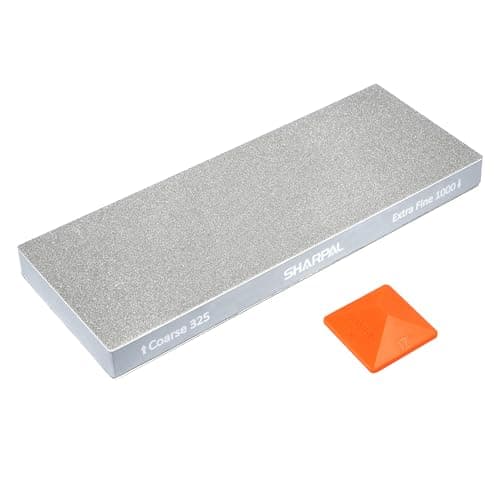
Buy the SHARPAL 168H — it is the best double-sided whetstone for most kitchens, and it wins because its two grits are the right two. A full 8 x 3 inch plate with coarse 325 grit on one face and extra-fine 1000 on the other, which means one stone takes a knife that will not cut a tomato all the way back to a genuinely sharp kitchen edge. It is diamond on a rigid substrate, so it never needs soaking and never needs flattening. The budget pick is the Sharp Pebble 400/1000 whetstone kit— the same coarse-to-medium logic in a water stone, with a flattening stone and an angle guide in the box, for the least money on this page.
The honest margin matters here, so here it is up front. The 168H beats the SHARPAL 162N ranked second by a tenth of a point, and that tenth is entirely value. The 162N is the better stone: same 8 x 3 format, same coarse 325 face, a finer 1200 grit on the back, and a storage case that doubles as a base. If the price gap between the two closes, buy the 162N. At the gap we saw at our last price check, most people should not.
We do not print a price in the prose, because prices move and a sentence cannot. The Quick Picks table carries the live price and the date we pulled it, with a Check price button on every row. Every stone below was in stock with a live offer when this page was written.
A double-sided stone is a grit pair, not a stone
This is the organizing fact for the whole page, and it is the thing almost no listing makes clear. When you buy a double-sided whetstone you are not choosing between brands — you are choosing which two points on the grit scale you will own. Everything the stone can and cannot do for you follows from that pair, and the pair is printed on the box.
There are three pairs in the whole market, and they do three different jobs:
Coarse-to-medium (roughly 325-400 up to 1000). This is a rescue pair. The coarse face removes real metal and resets a bevel that has been rounded over by years of drawer abuse or a pull-through sharpener; the 1000 face then puts a working edge on it. A knife sharpened on this pair will slice paper and cut a ripe tomato cleanly. It will not have a polished bevel, and for a kitchen knife that does not matter.
Medium-to-polish (1000 up to 5000-6000). This is a refinement pair, and it is the pair most first-time buyers go home with, because 1000/6000 is the most commonly stocked combination and 6000 sounds like more. It has no coarse side. If your knife is genuinely dull, 1000 grit is where you start, and starting at your coarsest grit means a long, discouraging session that often ends with the owner deciding whetstones do not work.
Coarse-to-fine on diamond (325 up to 1000-1200). The same rescue logic as the first pair, on a plate that cuts faster, stays flat forever, and needs no water bath. Diamond abrasive also sharpens the hard modern steels that can glaze a cheap water stone.
So the first question is not which stone. It is: is your knife dull, or is it sharp and you want it keener?If it is dull — and if you are buying your first stone, it almost certainly is — you need a coarse side, and four of the seven stones below do not have one. That single test reorders this entire category, and it is why the page looks the way it does.
How we ranked them
Five metrics, the same five for every stone. They are judgments from published specifications and from value arithmetic against the live price, not lab measurements — how we review says so in those words. We do not have a test lab and we do not claim one.
Grit pairing is the metric this page exists for: how much of the job the two faces cover between them, and how useful the span is to someone sharpening kitchen knives. Cutting speed is how fast the coarse face removes steel, which is what decides whether a rescue is twenty minutes or an hour. Working surfaceis the usable face area, because an 8-inch chef's knife on a 6-inch stone means more passes and a greater chance of rocking the edge. Setup & angle control covers everything between taking it out of the box and making the first stroke: soaking, flattening, whether it slides on the counter, and whether the kit holds your angle for you. Value is what the capability costs against the rest of this field.
These scores are fresh, and that is deliberate.We normally carry a product's score across pages so our own rankings cannot contradict each other, and we only depart from that when the rubric genuinely changes. It changes here. "Grit pairing" and "Working surface" are new metrics that only mean something when every candidate has two faces, and Durability has been dropped because it no longer discriminates — the three diamond plates are identical in that respect and the four water stones are close enough that the metric just added noise. So the stones below are scored from scratch on this rubric, which is why two of them sit in a different order here than on best diamond sharpening stones. We would rather tell you that than quietly re-score.
One more thing we will not do: invent numbers. Several of the water stones below do not publish their plate dimensions anywhere we can source, so they are scored as unpublished on working surface rather than given a flattering guess. Where that applies, the entry says so.
Which pair should you actually buy?
Your knives are dull right now.A coarse-to-medium pair: the SHARPAL 168H, or the Sharp Pebble 400/1000 if you want a water stone and the lowest price. This is the answer for most people buying their first stone, and it is the answer the market's most-stocked combination gets wrong.
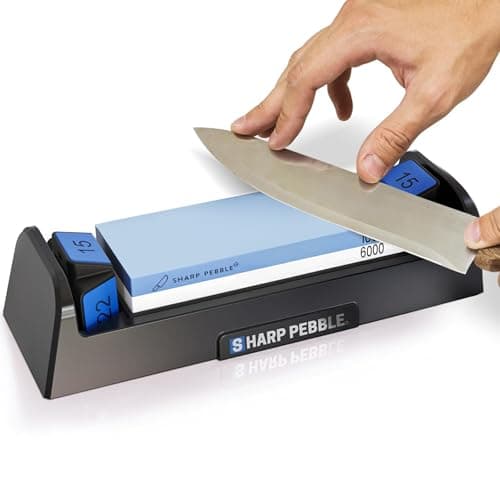
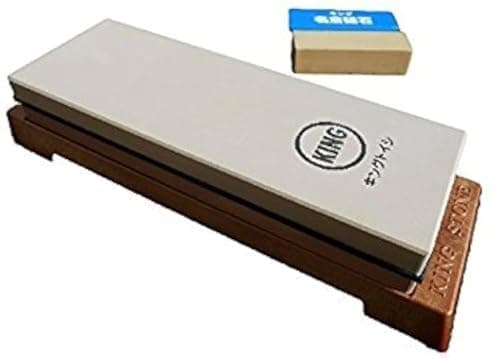
Your knives are sharp and you want them keener. A 1000/6000 pair: the Sharp Pebble Complete kit for the four guide angles, or the KING if you sharpen freehand already.
You want one stone, forever, and no maintenance. The SHARPAL 162N. It is the best stone here; it just costs the most.
You have almost no drawer space. The SHARPAL 156N, accepting that a 6-inch face and an 8-inch knife is a compromise you will feel.
You own hard Japanese knives at 60-plus HRC. Diamond, and the finer fine side: the 162N. Hard steel glazes soft water stones, and 1200 diamond is the keenest finish on this page. Best knife sharpeners for Japanese knives is the wider version of that decision.
The two numbers to check before you buy any of them
The coarse grit. If the lower number on the box is 1000 or higher, the stone cannot rescue a dull knife in a reasonable session. That is the single most useful filter in this entire category, and it rules out four of the seven stones on this page for a first-time buyer.
Your knives' edge angle. German and American kitchen knives are commonly finished near 20 degrees per side; many Japanese knives are nearer 15. A guide that only sets one of those will, over a few sharpenings, convert your knives to its angle. The Sharp Pebble Complete kit is the only stone here that offers a choice.
Double-sided versus two separate stones
A fair question, and the answer is mostly about commitment. Two single-grit stones let you choose exactly the pair you want, replace one without the other, and flatten each independently; they also cost more, take more space and are a bigger decision to get wrong. A double-sided stone is one purchase, one storage slot and a pair someone else chose for you.
The real argument for double-sided is that a combination stone gets used. Most people who buy two stones use the coarse one twice and then stop, because sharpening became a project. One block with two faces is a ten-minute job on a Sunday. If you have already got past that hurdle, the single-grit stones on best sharpening stones— Shapton, Naniwa, the DMT plates — are better stones than anything here, one grit at a time.
What none of these will do
None of the seven will fix a chipped edge quickly. A chip needs steel removed below the damage, which is extra-coarse work — how to fix a chipped knifecovers what that actually takes. None of them will sharpen a serrated knife, which needs a tapered rod rather than a flat face. None of them can reach the heel of a full-bolster Western knife, because the bolster is physically in the way — Wusthof Classic alternatives is where that gets fixed at the source, by buying a knife whose heel runs out clear. And none of them replaces honing: a stone restores an edge every few weeks or months, while a honing steel keeps it straight between sharpenings, and sharpening vs honing is the distinction that makes the biggest difference to how sharp your knives actually are day to day.