A repeatable angle without freehand practice
Work Sharp Precision Adjust
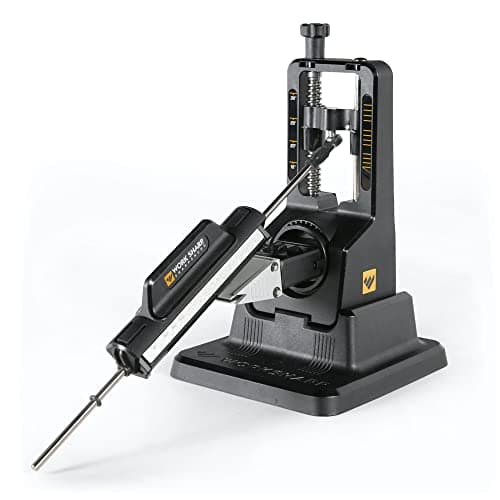
The best-value way to get a repeatable, chosen bevel angle without learning to sharpen freehand. The blade is held in a clamp and an abrasive on a pivoting rod is set anywhere from 15 to 30 degrees in 1-degree increments, so the angle is a number you set rather than a thing your hands have to hold. Slow, fiddly with long blades, and worth it if angle consistency is what you keep failing at.
- Angle control
- 9.5
- Abrasive range
- 7.5
- Edge quality
- 8.5
- Ease of use
- 7.5
- Value
- 9.5
Pros
- You choose the angle and it stays chosen - the one thing no pull-through or preset electric sharpener can offer
- One-degree increments across 15 to 30 degrees covers Japanese kitchen edges, Western kitchen edges and pocket knives on one tool
- The clamp holds the blade, so a repeatable bevel does not depend on your hands being steady or your practice being current
- Removes far less steel than a belt or wheel machine, so a knife survives many more sharpenings over its life
- Will sharpen serrated edges, which most guided systems and all pull-throughs cannot
- The cheapest tool we rank that offers a continuously adjustable angle
Cons
- It is slow by design - think ten minutes a knife, not ninety seconds, and a genuinely abused edge takes longer
- The clamp has to be re-seated to cover a long blade, and a 10-inch slicer is awkward in any clamp of this class
- No motor, so a very dull knife is real physical work
- The included abrasive range stops short of a polishing finish; the Elite's wider set and strop exist for a reason
- Setup and clamping add a few minutes before you have sharpened anything, every time
- Plastic-bodied: it is a precise mechanism, not a heirloom tool
Don't buy this if…
…nobody in your house will sit down for ten minutes with a sharpener - buy a fast, foolproof electric and accept that it imposes its own angle, because a tool used twice a year sharpens nothing.
Almost every sharpener you can buy for a kitchen decides your knife's angle for you. A pull-through has its carbides molded at a fixed angle. A multi-stage electric guides the blade into a wheel at whatever geometry the manufacturer chose. Both will, over a few sharpenings, convert your knife to their angle whether or not that was the angle it was ground at. The Precision Adjust is the cheapest tool we rank that does not do that, and that is the entire reason it exists.
The mechanism is simple enough to describe in a sentence: the knife is clamped so it cannot move, and an abrasive plate on a pivoting rod swings against the edge at an angle you set on a dial. Work Sharp publishes that range as 15 to 30 degrees in one-degree increments. The number is the point. A 15-degree Japanese gyuto and a 20-degree German chef's knife can share one tool without either being quietly reground, and next year the same number produces the same bevel.
Why one degree of resolution is not a specification-sheet flourish
Because the edge angle is the one number that decides whether a sharpener is right or wrong for your knives, and most people never look it up. German and American kitchen knives are commonly finished near 20 degrees per side. Many Japanese knives are nearer 15 — some Wusthof Classic blades are ground narrower still, near 14. Pocket knives are often 25 or more.
Put a 15-degree Japanese edge through a 20-degree tool and you do not get a sharp knife at 20 degrees in one pass. You get a knife with a blunt shoulder behind a thin edge, and after three or four sessions you have a 20-degree knife that cost you Japanese money. That is the failure the Precision Adjust is built to prevent, and it prevents it by making the angle a decision rather than a default. Knife sharpening angles is the full version of this argument.
What it is like to actually use
Slow, in a way that is worth being honest about. You clamp the blade, set the angle, work through the abrasives, flip, repeat. On a kitchen knife in reasonable shape this is a ten-minute job. On a knife that has been cutting on a glass board for three years it is longer, because there is no motor and every bit of steel removed is removed by your arm.
The clamp is the other honest limitation. It grips a section of the blade, so a long knife has to be re-seated to reach the whole edge, and the heel and the tip both need a little care. This is true of every clamped guided-rod system at this price, not a Work Sharp flaw, but it means a 10-inch slicer is a chore and a 3.5-inch paring knife is trivially easy.
What you get for the patience is consistency that freehand sharpening takes a year of practice to match. The bevel comes off even along its whole length, both sides meet where they should, and the result is repeatable — which, for most people, is the thing that has been going wrong. Why is my knife still dull after sharpening is mostly a list of angle-consistency failures.
Where the abrasive range runs out
The standard kit covers coarse through fine, which is enough to reset a bevel and leave a properly sharp working edge. What it does not include is the finishing end: the very fine grades and the leather strop that turn a sharp edge into a keen one. Work Sharp sells both in the Precision Adjust Elite, which is the same clamp and the same 15-to-30-degree mechanism with a wider abrasive set, a strop and a case.
Our position on that upgrade has not changed: if you own four to six kitchen knives, buy this one and not the Elite. The geometry is identical, so the premium buys abrasive grades most home cooks will never select. If you own a mixed collection at different angles and you will actually work through seven grades and a strop, the Elite earns its money. Best Work Sharp sharpeners ranks the whole range against each other.
The honest case against it
Two arguments, and both are real.
A whetstone is cheaper and goes further. A double-sided stone costs less than this, has no mechanism to wear out, and in trained hands produces a better edge than any guided system. What it demands is that you learn to hold an angle, which takes practice and patience and which plenty of people never get around to. If you are willing, best double-sided whetstones is the cheaper path to the same destination.
An electric is faster and will get used. A multi-stage electric sharpens a knife in under two minutes and asks nothing of you. It removes more steel and it imposes its geometry, but a sharp knife on a Tuesday beats a correct knife in theory. Do electric knife sharpeners ruin knives puts that trade in proportion, and alternatives to Work Sharp ranks the substitutes from both directions.
Verdict
Buy it if your knives are worth matching to their own angle and you have ten minutes. Scores 8.5 on our rubric, winning angle control and value and losing abrasive range and ease of use — which is a fair summary of the tool. It is the #1 pick on best sharpening systems and ranked inside the band on best knife sharpeners under $100, and nothing on this page changes either placement.
Price as of November 23, 2026. Prices change — Amazon's at checkout is the one that counts.
#ad · we may earn a commission from this link to Work Sharp Precision Adjust