Skip to content
The Edge Bench

Stones, sharpeners & how-to · Sharpening

Alternatives to Work Sharp, ranked by what they keep

Work Sharp sells a clamped guide with a numbered angle. Each alternative here keeps some of that and trades the rest - so the honest way to rank them is by which property you came for.

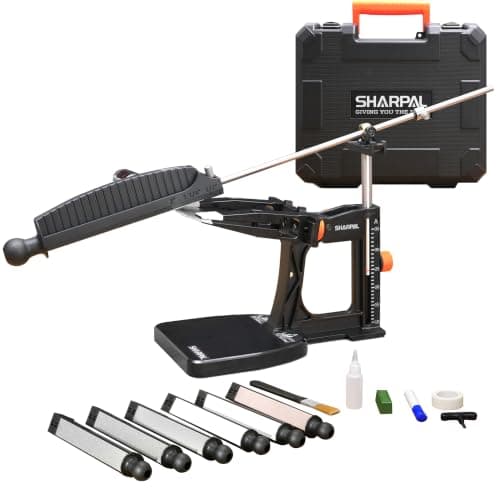
Sharpal SHARPAL 202H Precision Sharpening System

Our top pick · The direct upgrade on every Work Sharp property

SHARPAL 202H Precision Sharpening System

9.0

The closest thing to a Work Sharp Precision Adjust with the limits taken off. Same clamp-and-rod principle, a published 10-to-35-degree range against Work Sharp's 15-to-30, a four-grit diamond ladder, 3000/6000 whetstones and a strop, in an all-metal frame rather than molded plastic.

$149.99Amazon

#ad · Full ranking below

By Stephen V.Updated How we review
#ad

We earn a commission when you buy through our Amazon links, at no extra cost to you. It never changes a verdict, and we say so when the cheaper knife is the better buy. How this works.

The SHARPAL 202H Precision Sharpening System is the best alternative to Work Sharp, and it is for the reader who liked the clamped Precision Adjust idea and wanted more of it. It keeps the clamp and the numbered angle, widens the published range to 10–35 degrees against Work Sharp's 15–30, and adds a four-grit diamond ladder, 3000/6000 whetstones and a strop inside an all-metal frame. The budget pick is the Lansky Deluxe 5-Stone system— the cheapest thing here that keeps the clamp-and-rod principle at all, with 17, 20, 25 and 30 degree presets and five hones.

A note before the rankings, because it would be dishonest to skip it. Work Sharp is not a brand we are steering people away from: the Precision Adjust is the top pick on best knife sharpeners under $100 and the brand lineup is ranked on its own page at best Work Sharp sharpeners. People search for alternatives for specific reasons, and this page is organized around those reasons rather than around a complaint.

We do not print a price in the prose. The Quick Picks table carries the live price and the date we pulled it.

What Work Sharp is actually known for

Everything below is ranked against four published properties, taken from Work Sharp's own product specifications rather than from reviews.

A clamped blade and a numbered angle.The Precision Adjust and Precision Adjust Elite hold the knife in a clamp and set the abrasive rod from 15 to 30 degrees in one-degree increments. This is the brand's core idea: the tool holds the angle, not your hands.

A diamond-then-ceramic abrasive ladder. Diamond plates or rods to shape, ceramic to finish. Effective, and it stops short of the fine finishing grits a stone reaches.

A flexible belt option. The Mk.2 drives an abrasive belt that conforms to a curved edge, which is a genuine capability nothing clamped can match.

A consumer price and a plastic frame. The Precision Adjust costs well under a hundred dollars, and the frame is molded plastic. That is most of why it costs what it does, and it is the property enthusiasts most often want to trade away.

So why do people look for an alternative?

The autocomplete cluster for this query is specific, and it is almost entirely about particular models rather than the brand in general: the ws3000, the Mk.2, the Precision Adjust, the Field Sharpener, the Ken Onion. Read together with the published specifications above, there are four real reasons:

You need an angle outside 15–30 degrees.Single-bevel Japanese knives, some razors and some woodworking edges sit below 15; heavy chopping tools sit above 30. Work Sharp's clamped range cannot reach either end.

You want a better clamp. On any clamped system the clamp is the weak point, because every bit of play in it becomes angle error at the edge. This is the single most common upgrade reason.

You want a finer finish. The range tops out at ceramic. If you want a polished edge off 6000 grit and leather, you need something else.

You want the machine to do the work.This is the Mk.2 reader, and the honest alternative is not another clamp at all — it is a diamond electric.

The short answer

Quick picks

#KnifeBest forScorePrice
01
Sharpal SHARPAL 202H Precision Sharpening System
SHARPAL 202H Precision Sharpening System

The closest thing to a Work Sharp Precision Adjust with the limits taken off. Same clamp-and-rod principle, a published 10-to-35-degree range against Work Sharp's 15-to-30, a four-grit diamond ladder, 3000/6000 whetstones and a strop, in an all-metal frame rather than molded plastic.

The direct upgrade on every Work Sharp property
9.0
$149.99Amazon
02
KME KME Precision Knife Sharpener System
KME Precision Knife Sharpener System

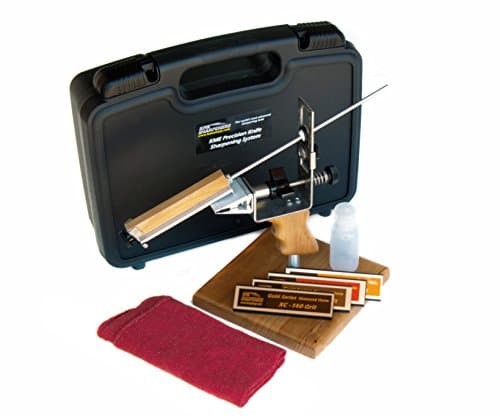
The alternative for the one thing a Work Sharp buyer most often wants to upgrade: the clamp. A rotating, neoprene-lined clamp holds the blade with no play, continuous adjustment from 17 to 30 degrees, and four diamond hones from 140 to 1500 - the most repeatable bevel of anything here.

A clamp with no play in it
8.4
$244.90Amazon
03
Chef'sChoice Chef'sChoice Trizor 15XV Electric Sharpener
Chef'sChoice Trizor 15XV Electric Sharpener

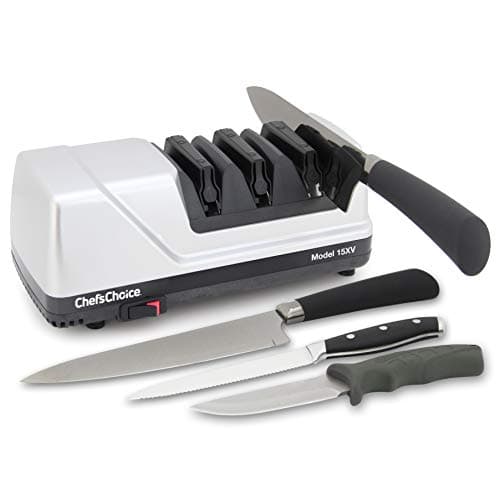
The alternative for the reader who wanted the Mk.2's 'let the machine do it' rather than the clamp's precision. Three stages of 100% diamond, no clamping, no technique - and it regrinds a 20-degree factory edge to 15 degrees, which is a change a Work Sharp would never make without being told to.

Replacing the Work Sharp belt machine, not the clamp
7.4
$128.99Amazon
04
Lansky Lansky Deluxe 5-Stone Sharpening System
Lansky Deluxe 5-Stone Sharpening System

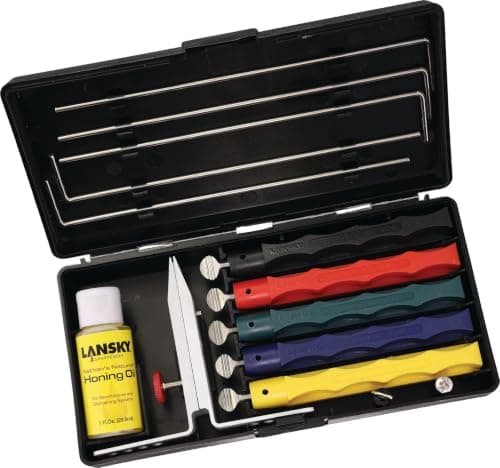
The budget pick and the cheapest thing that keeps the clamp-and-rod idea at all. Four preset angles - 17, 20, 25 and 30 degrees - and five hones from 70 to 1000 grit, in the system that invented this category and still undercuts everything else here by a wide margin.

Budget pick: the clamped principle at the lowest price
7.8
Check price →
05
SHARPAL SHARPAL 162N Double-Sided Diamond Stone
SHARPAL 162N Double-Sided Diamond Stone

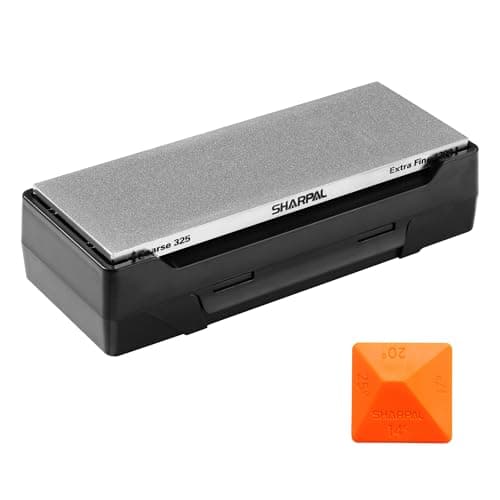
The alternative that gives up angle guidance entirely and keeps the abrasive. A flat 8 x 3 inch monocrystalline diamond plate, coarse on one face and fine on the other - no clamp, no limit on blade length, and no angle except the one your hands hold.

Going freehand with no angle limits at all
7.9
$59.49Amazon
06
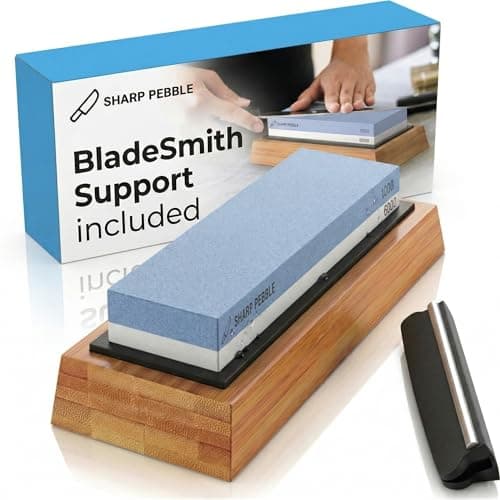
Sharp Pebble Sharp Pebble Premium 1000/6000 Whetstone
Sharp Pebble Premium 1000/6000 Whetstone

The cheapest route to a finish no Work Sharp reaches. A 1000-grit side to sharpen and a 6000-grit side to polish, on a non-slip bamboo base, with an angle guide in the box - the finishing capability the Work Sharp range stops short of, for less than any of its sharpeners cost.

A finer finish than the Work Sharp range reaches
7.7
$36.06Amazon

#ad · Live prices from the Amazon Product API, as of November 23, 2026. Where we have no verified live price, we show none — a gap beats a number that has rotted.

In detail

The picks, in full

01
Sharpal SHARPAL 202H Precision Sharpening System

The direct upgrade on every Work Sharp property

SHARPAL 202H Precision Sharpening System

10-35 deg adjustableDiamond 220/325/600/1000Whetstone 3000/6000 + stropAll-metal frame, carry case
9.0/10

The closest thing to a Work Sharp Precision Adjust with the limits taken off. Same clamp-and-rod principle, a published 10-to-35-degree range against Work Sharp's 15-to-30, a four-grit diamond ladder, 3000/6000 whetstones and a strop, in an all-metal frame rather than molded plastic.

Match on mechanism
9.5
Angle range
9.5
Abrasive range
9.5
Build
9
Value
7.5

Pros

  • A published 10-to-35-degree range reaches both ends Work Sharp cannot - below 15 for single-bevel and razor work, above 30 for heavy tools
  • Four diamond grits plus 3000/6000 whetstones plus a strop is a complete progression from repair to polish in one box
  • All-metal frame removes the flex that is the main criticism of plastic-framed clamped systems
  • Keeps the exact mechanism a Work Sharp buyer already understands, so nothing has to be relearned
  • Already our fourth pick on the guided-systems roundup, so this is a consistent verdict

Cons

  • Costs substantially more than the Precision Adjust it replaces
  • More abrasives and a wider range means a longer setup and more decisions per knife
  • Heavier and bulkier than the plastic Work Sharp frames, so less likely to live in a kitchen drawer
  • Still a clamped manual system - slow by design, and long blades need the clamp re-seated

Don't buy this if…

…15 to 30 degrees already covers every knife you own - you would be paying for range you will never select, and the Precision Adjust does the rest of the job.

It wins because it is an alternative in the narrowest and most useful sense: it keeps everything a Work Sharp buyer liked and removes the three limits they tend to run into. The angle range is wider at both ends, the abrasive ladder goes from a 220 repair grit to a 6000 polish, and the frame is metal.

The angle range is the part worth dwelling on, because it is the only published difference that changes what the tool can do rather than how well it does it. Below 15 degrees you are into single-bevel Japanese knives and straight razors — single bevel vs double bevel knives explains why those exist. Above 30 degrees you are into chopping tools that want a blunt, strong edge. A Work Sharp cannot be set to either.

Honest about the cost: this is roughly two and a half times the Precision Adjust, and for a drawer of ordinary kitchen knives that money buys nothing you will use. The reader this is right for owns at least one knife outside 15–30 degrees, or wants a finish a ceramic rod cannot give.

$149.99View on Amazon

$179.9917% off

Price as of November 23, 2026. Prices change — Amazon's at checkout is the one that counts.

#ad · we may earn a commission from this link to SHARPAL 202H Precision Sharpening System

02
KME KME Precision Knife Sharpener System

A clamp with no play in it

KME Precision Knife Sharpener System

17-30 deg, continuous adjustDiamond hones 140/300/600/1500Rotating, neoprene-lined clampBase included
8.4/10

The alternative for the one thing a Work Sharp buyer most often wants to upgrade: the clamp. A rotating, neoprene-lined clamp holds the blade with no play, continuous adjustment from 17 to 30 degrees, and four diamond hones from 140 to 1500 - the most repeatable bevel of anything here.

Match on mechanism
9
Angle range
7.5
Abrasive range
9
Build
9.5
Value
7

Pros

  • The rotating neoprene-lined clamp is the best blade-holding mechanism here, and clamp play is where clamped systems lose accuracy
  • Continuous angle adjustment rather than clicks or presets, so the setting is genuinely whatever you choose
  • A 140-grit diamond hone at the coarse end means real repair work - chips and reprofiles - is in scope
  • Flipping the knife in the clamp rather than unclamping it preserves the setting between sides
  • Already our fifth pick on the guided-systems roundup and the most precise tool on it

Cons

  • The published range starts at 17 degrees, so it is narrower than Work Sharp at the fine end - a 15-degree Japanese edge is out of reach
  • The most expensive pick on this page by a clear margin
  • Designed around pocket and outdoor knives; a long kitchen blade needs re-clamping and careful blending
  • Finishes at 1500-grit diamond rather than a fine waterstone, so the top end of polish needs a separate strop

Don't buy this if…

…your knives are 15-degree Japanese kitchen knives - the clamp is superb and the angle range will not reach them. The 202H above will.

Second, and first by a distance on the metric a lot of readers actually came for. If the reason you are looking past Work Sharp is that your Precision Adjust has a little play in the clamp and your bevels are not quite symmetrical, this is the fix, and nothing else on this page is.

The mechanism deserves the praise. A rotating clamp means the knife turns within the jig rather than being released and re-set, so the angle you dialled in for the first side is the same angle on the second. The neoprene lining both grips and protects the blade. These are small engineering decisions that compound into a visibly cleaner bevel.

The published limit is the fine end. At 17 degrees minimum it cannot reach the 15-degree edges that many Japanese kitchen knives are ground at, which is an odd gap on an otherwise superior tool and the reason it sits second here rather than first. For pocket knives, hunting knives and German kitchen knives it is the most accurate thing on this page.

$244.90View on Amazon

Price as of November 23, 2026. Prices change — Amazon's at checkout is the one that counts.

#ad · we may earn a commission from this link to KME Precision Knife Sharpener System

03
Chef'sChoice Chef'sChoice Trizor 15XV Electric Sharpener

Replacing the Work Sharp belt machine, not the clamp

Chef'sChoice Trizor 15XV Electric Sharpener

3-stage electric100% diamond abrasivesConverts 20 to 15 degreesTrizor XV geometry
7.4/10

The alternative for the reader who wanted the Mk.2's 'let the machine do it' rather than the clamp's precision. Three stages of 100% diamond, no clamping, no technique - and it regrinds a 20-degree factory edge to 15 degrees, which is a change a Work Sharp would never make without being told to.

Match on mechanism
5.5
Angle range
6
Abrasive range
9
Build
8.5
Value
8

Pros

  • No clamping, no angle setting, no technique - a drawer of knives is sharp in one sitting
  • 100% diamond at every stage, so hard steels cut as fast as soft ones
  • The 15-degree conversion is a real published geometry change and genuinely improves how a German knife cuts
  • Three stages cover shaping, refining and polishing with nothing else to buy
  • Takes serrated edges, which no clamped system here does well

Cons

  • You give up angle choice entirely - the opposite of why most people bought a Work Sharp
  • The conversion to 15 degrees removes real metal and is not reversible
  • A narrower edge on soft German steel needs honing more often than the edge it replaced
  • No use at all on a knife that needs a tip repaired or a chip ground out

Don't buy this if…

…you chose Work Sharp because you wanted to set the angle - handing that decision to a machine is the one thing this pick does.

This is the pick that scores worst on matching Work Sharp's mechanism and is still the right answer for a specific reader: the one whose Work Sharp was the Mk.2 belt machine, who liked that it was fast and hands-off, and who wants that without the noise, the metal dust and the garage.

What it does differently is worth being precise about. A Work Sharp clamp asks you for a number. This machine has already decided: 15 degrees a side, in the geometry Chef'sChoice calls Trizor XV. On a block of German knives that is usually an improvement, and it is permanent.

It is ranked first on best Chef'sChoice knife sharpeners and second on best electric knife sharpeners, so this is a consistent verdict. It sits mid-table here only because the page is ranked on how much of Work Sharp's idea each alternative keeps, and this keeps almost none of it.

$128.99View on Amazon

$165.9922% off

Price as of November 23, 2026. Prices change — Amazon's at checkout is the one that counts.

#ad · we may earn a commission from this link to Chef'sChoice Trizor 15XV Electric Sharpener

04
Lansky Lansky Deluxe 5-Stone Sharpening System

Budget pick: the clamped principle at the lowest price

Lansky Deluxe 5-Stone Sharpening System

17 / 20 / 25 / 30 deg presetsFive hones: 70, 120, 280, 600, 1000Alumina oxide ceramicHoning oil + storage case
7.8/10

The budget pick and the cheapest thing that keeps the clamp-and-rod idea at all. Four preset angles - 17, 20, 25 and 30 degrees - and five hones from 70 to 1000 grit, in the system that invented this category and still undercuts everything else here by a wide margin.

Match on mechanism
8
Angle range
6.5
Abrasive range
8.5
Build
6.5
Value
9.5

Pros

  • The cheapest way to keep a clamped, angle-referenced bevel instead of going freehand
  • A 70-grit hone at the coarse end does genuine repair work that Work Sharp's finest plates cannot
  • Five hones means a full progression from damage to a 1000-grit finish
  • Four presets cover the overwhelming majority of real knives, including the common 20-degree kitchen edge
  • Already our third pick on the guided-systems roundup, so the verdict is consistent

Cons

  • Preset angles rather than continuous adjustment - no setting between 20 and 25 degrees, and nothing below 17
  • The clamp is the weakest here, and clamp play is exactly the complaint that sends people looking for alternatives
  • Alumina oxide hones cut slower than diamond on hard modern steels
  • Small hones make a long kitchen blade a patient job

Don't buy this if…

…you are leaving Work Sharp because you wanted finer angle resolution - presets are a step backwards from one-degree increments, and the 202H is the pick that goes forwards.

The budget pick, and it lands fourth because this page rewards keeping Work Sharp's properties and the Lansky keeps the principle while weakening two of the specifics. Presets instead of one-degree increments is a real step down in resolution, and the clamp has more play than either system above.

What it does keep is the thing that matters most: the bevel is referenced to an angle rather than to your wrist. For a reader who wants to spend less rather than more and still not sharpen freehand, nothing else here is close on price.

The coarse end is a genuine advantage worth naming. A 70-grit hone is far more aggressive than anything in the Work Sharp range, so a badly chipped or rolled edge is in scope here — see how to fix a chipped knife for what that job involves.

Check price on Amazon →

No buyable offer at the last price check (November 23, 2026). We show nothing rather than a stale number.

#ad · we may earn a commission from this link to Lansky Deluxe 5-Stone Sharpening System

05
SHARPAL SHARPAL 162N Double-Sided Diamond Stone

Going freehand with no angle limits at all

SHARPAL 162N Double-Sided Diamond Stone

Double-sided, coarse + fine diamond8 x 3 in. working surfaceMonocrystalline diamond on a flat substrateNon-slip base included
7.9/10

The alternative that gives up angle guidance entirely and keeps the abrasive. A flat 8 x 3 inch monocrystalline diamond plate, coarse on one face and fine on the other - no clamp, no limit on blade length, and no angle except the one your hands hold.

Match on mechanism
4
Angle range
10
Abrasive range
7.5
Build
9
Value
9

Pros

  • No angle restriction of any kind - the one route here that handles a single-bevel knife, a razor and a cleaver with the same tool
  • An 8 x 3 inch plate takes a 10-inch blade in a single stroke, which no clamped system manages
  • Monocrystalline diamond cuts hard modern steels quickly and stays flat, unlike a water stone
  • Needs no water, no soaking and no flattening - it is the lowest-maintenance sharpening surface there is
  • Already the top pick on our diamond-stone roundup

Cons

  • No angle guidance whatsoever, which is precisely the property Work Sharp exists to provide
  • Freehand consistency is a learned skill and the first several knives will be worse, not better
  • Two grits only, so the finish stops short of a polished edge without a finer stone or a strop
  • Diamond plates feel coarse and loud compared with a waterstone, which puts some people off

Don't buy this if…

…the reason you own a Work Sharp is that freehand sharpening did not work for you - this removes the guide rather than improving it. Add the pyramid angle guide if you try it anyway.

Fifth on the rubric and the honest answer for one specific reader: the person who wants no angle ceiling at all and is willing to supply the skill themselves. It scores a perfect ten on angle range for the obvious reason that a flat stone imposes no angle, and four on mechanism match for the same reason.

The practical advantages over any clamped system are real and often understated. Surface area means a long blade is one continuous stroke rather than three clamp positions blended together. Nothing needs to be dialled in. And a diamond plate stays flat forever, where a water stone dishes and needs truing — how to flatten a whetstone is the chore this avoids entirely.

If you take this route, pair it with an angle guide. It is a few dollars, it is ranked on best knife sharpeners under $25, and it addresses the single reason freehand attempts usually fail.

$59.49View on Amazon

$69.9915% off

Price as of November 23, 2026. Prices change — Amazon's at checkout is the one that counts.

#ad · we may earn a commission from this link to SHARPAL 162N Double-Sided Diamond Stone

06
Sharp Pebble Sharp Pebble Premium 1000/6000 Whetstone

A finer finish than the Work Sharp range reaches

Sharp Pebble Premium 1000/6000 Whetstone

1000 + 6000 grit comboNon-slip bamboo baseAngle guide includedWater stone, short soak
7.7/10

The cheapest route to a finish no Work Sharp reaches. A 1000-grit side to sharpen and a 6000-grit side to polish, on a non-slip bamboo base, with an angle guide in the box - the finishing capability the Work Sharp range stops short of, for less than any of its sharpeners cost.

Match on mechanism
4
Angle range
10
Abrasive range
7.5
Build
7.5
Value
9.5

Pros

  • 6000 grit is finer than anything in the Work Sharp range, which tops out at a ceramic rod
  • Two grits in one stone covers sharpening and polishing in a single purchase
  • An angle guide is included, so the main freehand failure is addressed in the box
  • Cheapest pick on this page, and cheaper than the Work Sharp it would replace
  • Already our top pick on the sharpening-stones roundup

Cons

  • A water stone needs soaking, makes a mess, and dishes with use so it has to be flattened periodically
  • No clamp and no fixed angle - the guide helps at the start of a stroke and no further
  • 1000 grit is not coarse enough for a chipped or badly neglected edge
  • Soft water stones wear faster than diamond, so it is a consumable rather than a lifetime tool

Don't buy this if…

…you want a tool rather than a skill - a stone is the least guided thing on this page, and a clamped system is a better use of the money if guidance is the point.

Last on the rubric, and the pick with the clearest single argument of anything here: Work Sharp does not sell a 6000-grit finish, and this does, for less money than any Work Sharp sharpener costs. If your dissatisfaction is specifically about how polished the edge is, this is the answer and no clamped system under two hundred dollars is.

The trade is a real one and it is the same trade as the diamond plate above: you provide the angle. The included guide is better than nothing and worse than a clamp. Our best sharpening stones for beginners page is the honest account of how steep the learning curve is, and whetstone grits explained covers what 1000 and 6000 each actually do.

Worth saying: a stone and a Work Sharp are not mutually exclusive and the best setup for a lot of people is both — the clamped system for geometry, the fine stone or a strop for the last step.

$36.06View on Amazon

$45.9922% off

Price as of November 23, 2026. Prices change — Amazon's at checkout is the one that counts.

#ad · we may earn a commission from this link to Sharp Pebble Premium 1000/6000 Whetstone

Pick by the reason you are here

You need an angle below 15 or above 30 degrees. The SHARPAL 202H. It is the only pick that keeps the clamp and reaches both ends.

Your clamp has play and your bevels are uneven. The KME. Best blade-holding mechanism here, as long as 17 degrees is low enough for your knives.

You want to spend less, not more. The Lansky. Presets rather than increments, and the clamped principle intact.

You wanted the belt machine's speed without the belt machine.The Chef'sChoice Trizor 15XV, accepting that it chooses the angle for you.

You want a finish the Work Sharp range cannot reach. The Sharp Pebble 1000/6000 stone, or the diamond plate if you prefer a surface that never needs flattening.

Three reasons to buy Work Sharp anyway

Nothing here is better value for a drawer of ordinary kitchen knives. If every knife you own sits between 15 and 30 degrees and you want a repeatable edge without learning a skill, the Precision Adjust does that for well under a hundred dollars and this whole page is an upgrade you do not need.

The flexible belt is genuinely unmatched. If you sharpen curved or recurved blades, garden tools or axes, the Mk.2 does something no clamp and no flat stone can, and nothing on this page replaces it properly.

The pocket format has no real rival. The Guided Field Sharpener puts both diamond grits, two ceramic rods, a strop and two molded angles into a few ounces. No alternative here is remotely that portable.

What none of these alternatives fix

Every clamped system on this page, Work Sharp included, is slow, needs the clamp re-seated on a long blade, and asks you to blend the resulting sections. If what you want is a sharp 10-inch slicer in two minutes, the answer is a diamond electric or a long bench stone, not a better clamp.

How we picked

We did not lab-test these knives

Everyone in this category says they tested twenty knives in a professional kitchen. We have not hands-on tested any of these, and we say so. What we did instead: compiled the published specifications — steel type and hardness (HRC), edge angle, blade geometry, weight and build — applied established sharpening standards, ran the value math (spec quality ÷ live price), and scored each product against a published rubric. The scores are judgments from documented research — not measurements we took, because we do not have a test lab and we will not pretend we do. Where a number came from someone else's work, we name them in Sources.

Questions

Frequently asked

What is the closest thing to a Work Sharp Precision Adjust?
The SHARPAL 202H. It keeps the clamp and the numbered-angle principle and extends the published range to 10–35 degrees against Work Sharp's 15–30, with a wider abrasive ladder and a metal frame. The Lansky Deluxe keeps the same principle at the lowest price, using presets rather than increments.
Is the KME better than a Work Sharp?
On clamp quality and repeatability, clearly. On range, not entirely: the KME's published minimum is 17 degrees, so it cannot reach the 15-degree edges many Japanese kitchen knives are ground at, where a Work Sharp can. It also costs considerably more.
What should I buy instead of the Work Sharp Mk.2?
If you liked that it was fast and hands-off, a diamond electric — the Chef'sChoice Trizor 15XV here. Be aware it reprofiles a 20-degree edge to 15 degrees permanently. If you liked that it handled curved outdoor blades, nothing here replaces that properly and the Mk.2 remains the right tool.
Do I need a guided system at all, or just a stone?
A stone is cheaper, reaches finer finishes and has no angle limits; a guided system gives repeatability without skill. If freehand attempts have already disappointed you, a guide is the fix, and an angle guide on a stone is the cheapest version of one.

Keep reading

Receipts

Sources

We do not run a testing lab, and we do not pretend to. Where a spec or a measured number came from someone else's work — a manufacturer's page, a published standard — we name them and link them. Where we could not verify something, we say so on the page rather than quietly leaving it out. Read our full method.