Skip to content
The Edge Bench

Stones, sharpeners & how-to · Sharpening

The best Chef'sChoice knife sharpeners, ranked

All three run diamond abrasives and all three are fast. The decision that actually matters is whether you want your knives regrounded to 15 degrees or kept where they are.

Chef'sChoice Chef'sChoice Trizor 15XV Electric Sharpener

Our top pick · Regrinding German knives to a keener angle

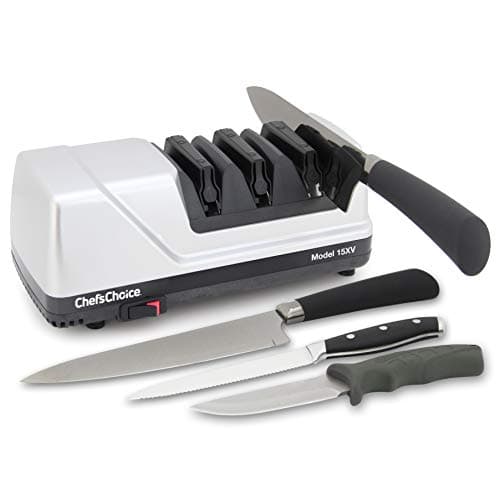
Chef'sChoice Trizor 15XV Electric Sharpener

8.5

The best Chef'sChoice sharpener, and the most transformative thing you can do to a block of German knives. Three stages of 100% diamond abrasive deliberately regrind a 20-degree factory edge to the narrower 15-degree Trizor XV geometry - a genuinely keener edge, at the cost of a conversion you cannot undo.

$128.99Amazon

#ad · Full ranking below

By Stephen V.Updated How we review
#ad

We earn a commission when you buy through our Amazon links, at no extra cost to you. It never changes a verdict, and we say so when the cheaper knife is the better buy. How this works.

The Chef'sChoice Trizor 15XV is the best Chef'sChoice knife sharpener, and it is for someone with German or American knives who wants them cutting like Japanese ones. It is a three-stage, 100% diamond electric that deliberately converts a 20-degree factory edge to the narrower 15-degree Trizor XV geometry. The budget pick is the Diamond UltraHone, model 312— the cheapest of the three, also 100% diamond, and the one to buy if you want your knives sharpened at roughly the angle they already have rather than reground to a new one.

That is the whole decision on this page, and almost nobody comparing these machines in a listing search realizes it. A Chef'sChoice sharpener does not ask what angle your knife is. It applies its own. Choosing between these three models is choosing which angle your collection ends up at, and that choice is effectively permanent: metal removed to reach 15 degrees does not come back.

We do not print a price in the prose. The Quick Picks table carries the live price and the date we pulled it, with a Check price button on every row.

What all three share, and why that simplifies things

Chef'sChoice publishes one consistent claim across this range and it is a real one: 100% diamond abrasives at every stage. That matters more than it sounds. Diamond is harder than any knife steel, so it cuts hard steels at the same rate as soft ones — a carbide or alumina wheel slows down badly on a hard blade. It is also the reason these machines are quick.

All three are also multi-stage: a coarser stage establishes a bevel, a finer stage refines it, and the final stage polishes or strops. And all three handle straight and serrated edges, which a slotted sharpener often cannot.

So the usual questions — is the abrasive good enough, is it fast enough, will it do my bread knife — all have the same answer across the range. What is left is geometry.

The 15-degree decision

The Trizor 15XV exists to do one thing: take a knife ground at roughly 20 degrees a side and reprofile it to roughly 15. A narrower included angle genuinely cuts better. It is also structurally weaker, so it chips and rolls more readily, and on a softer German steel it will need maintaining more often than the edge it replaced.

That trade is defensible and it is the Trizor's whole appeal. What it is not is reversible. The first few passes remove a meaningful amount of steel to change the bevel, and a knife converted to 15 degrees stays converted unless you grind it back. Knife sharpening angles sets out what each number does to an edge, and knife hardness explained covers why a hard steel tolerates a narrow angle better than a soft one.

If that makes you hesitate, that hesitation is the correct instinct and the 312 is your machine. If you have a block of German knives you find slightly dull-feeling even when freshly sharpened, the Trizor is the single most effective thing you can do to them.

How we ranked them

Five metrics, identical across all three, and they are judgments from published specifications rather than measurements — how we review explains the basis. Angle control is what say you get over the geometry. Abrasive quality is what the machine cuts with. Edge quality is the finish at its best. Speed & ease is how quickly a drawer of knives gets done. Value is capability against cost.

The short answer

Quick picks

#KnifeBest forScorePrice
01
Chef'sChoice Chef'sChoice Trizor 15XV Electric Sharpener
Chef'sChoice Trizor 15XV Electric Sharpener

The best Chef'sChoice sharpener, and the most transformative thing you can do to a block of German knives. Three stages of 100% diamond abrasive deliberately regrind a 20-degree factory edge to the narrower 15-degree Trizor XV geometry - a genuinely keener edge, at the cost of a conversion you cannot undo.

Regrinding German knives to a keener angle
8.5
$128.99Amazon
02
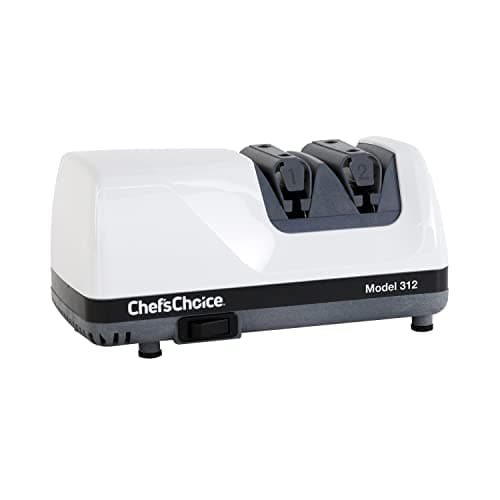
Chef'sChoice Chef'sChoice Diamond UltraHone (Model 312)
Chef'sChoice Diamond UltraHone (Model 312)

The budget pick and the Chef'sChoice for someone who wants their knives sharpened rather than redesigned. Two stages of 100% diamond at a 20-degree class angle, finishing on an ultra-hone stage - the same abrasive quality as the Trizor without the irreversible regrind.

Budget pick and keeping your existing bevels
8.5
$94.95Amazon
03
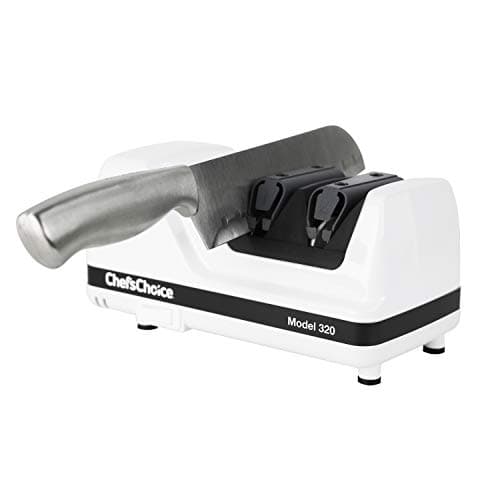
Chef'sChoice Chef'sChoice FlexHone/Strop Electric Sharpener
Chef'sChoice FlexHone/Strop Electric Sharpener

The Chef'sChoice that finishes an edge most carefully, and the hardest of the three to place. 100% diamond abrasives with a flexible stropping and honing stage - a softer final pass than a rigid wheel, which polishes well and gives you less control over the final geometry than either machine above.

A stropped finish from a machine
8.0
$113.89Amazon

#ad · Live prices from the Amazon Product API, as of November 23, 2026. Where we have no verified live price, we show none — a gap beats a number that has rotted.

In detail

The picks, in full

01
Chef'sChoice Chef'sChoice Trizor 15XV Electric Sharpener

Regrinding German knives to a keener angle

Chef'sChoice Trizor 15XV Electric Sharpener

3-stage electric100% diamond abrasivesConverts 20 to 15 degreesTrizor XV geometry
8.5/10

The best Chef'sChoice sharpener, and the most transformative thing you can do to a block of German knives. Three stages of 100% diamond abrasive deliberately regrind a 20-degree factory edge to the narrower 15-degree Trizor XV geometry - a genuinely keener edge, at the cost of a conversion you cannot undo.

Angle control
6
Abrasive quality
9.5
Edge quality
9.5
Speed & ease
9.5
Value
8

Pros

  • The 15-degree conversion is a real, published change in geometry rather than a marketing adjective - the knife genuinely cuts differently afterwards
  • 100% diamond at all three stages, so hard steels cut as readily as soft ones
  • Three stages means one machine shapes, refines and polishes with no separate purchase
  • Fast enough that a full knife block is one sitting, which is why it gets used
  • Handles serrated edges as well as straight, which slotted sharpeners often cannot

Cons

  • The conversion is permanent - reaching 15 degrees removes real metal, and the knife stays at 15 degrees
  • A 15-degree edge on softer German steel is more fragile and needs honing more often than the 20-degree edge it replaced
  • No angle choice at all: you get Trizor XV geometry or you buy a different machine
  • The most expensive pick here, and the premium buys a geometry change rather than a better finish

Don't buy this if…

…you want your knives sharpened as they are - the 312 below sharpens at a 20-degree class angle and leaves your bevels where the maker put them.

It wins this page on edge quality and speed and it loses badly on angle control, which is exactly what it is designed to do. Buying a Trizor is a decision to let a machine choose your geometry because you prefer its choice to your knife maker's. Stated that plainly, it is a reasonable thing to want.

The reason it works is that most Western kitchen knives are ground conservatively. A factory bevel near 20 degrees a side is a durability decision made for a customer the maker cannot see. If you cook at home on a wooden board and hone weekly, you are not that customer, and 15 degrees is a better setting for you than the one you were sold.

Two cautions worth having in writing. First, do not put a hard, thin Japanese knife through it: those knives already sit near 15 degrees or below and the machine has nothing to offer them but metal loss. Second, once converted, the edge needs the habit that goes with a narrow bevel — do you need a honing rod is the honest answer to whether that habit is optional. It is not, here.

$128.99View on Amazon

$165.9922% off

Price as of November 23, 2026. Prices change — Amazon's at checkout is the one that counts.

#ad · we may earn a commission from this link to Chef'sChoice Trizor 15XV Electric Sharpener

02
Chef'sChoice Chef'sChoice Diamond UltraHone (Model 312)

Budget pick and keeping your existing bevels

Chef'sChoice Diamond UltraHone (Model 312)

100% diamond, both stages20-degree class edges2-stage bevel then ultra-honeStraight and serrated
8.5/10

The budget pick and the Chef'sChoice for someone who wants their knives sharpened rather than redesigned. Two stages of 100% diamond at a 20-degree class angle, finishing on an ultra-hone stage - the same abrasive quality as the Trizor without the irreversible regrind.

Angle control
7.5
Abrasive quality
9
Edge quality
8
Speed & ease
9
Value
9

Pros

  • Sharpens at a 20-degree class angle, which is where most German and American knives were already ground - nothing is converted
  • 100% diamond abrasives, the same claim that makes the Trizor fast, at the lowest price in the range
  • The cheapest Chef'sChoice here and the one with the least to go wrong
  • Two stages plus an ultra-hone finish is a complete progression for a kitchen knife
  • Takes straight and serrated edges

Cons

  • No angle adjustment, so a 15-degree Japanese edge is out of scope entirely
  • Two stages rather than three - less capable on a badly damaged edge than the Trizor
  • Still an electric: metal removal is quicker than you expect and over-sharpening is the common mistake
  • Finishes below the Trizor on outright edge quality, which the scores reflect

Don't buy this if…

…you actively want a keener angle than your knives came with - that is the Trizor's entire purpose and this machine will not do it.

It ties the Trizor on the rubric and sits second on a stated tie-break: the Trizor takes the position on outright edge quality, which is the metric a sharpener is finally judged on. On value and on respecting the geometry your knives already have, this is the better machine, and for a lot of readers it is the right one.

The case for it is conservative in the good sense. A 20-degree class edge on a German knife is durable, easy to maintain on a rod, and forgiving of a hard board and a dishwasher-owning household. If your knives cut acceptably and simply go dull, this fixes that problem and changes nothing else.

It is also the pick we already rank third on best electric knife sharpeners and it appears inside best knife sharpeners under $100, so this is a consistent verdict rather than a fresh one.

$94.95View on Amazon

$99.995% off

Price as of November 23, 2026. Prices change — Amazon's at checkout is the one that counts.

#ad · we may earn a commission from this link to Chef'sChoice Diamond UltraHone (Model 312)

03
Chef'sChoice Chef'sChoice FlexHone/Strop Electric Sharpener

A stropped finish from a machine

Chef'sChoice FlexHone/Strop Electric Sharpener

100% diamond abrasivesFlexible stropping/honing stageMulti-stageHandles straight and serrated
8.0/10

The Chef'sChoice that finishes an edge most carefully, and the hardest of the three to place. 100% diamond abrasives with a flexible stropping and honing stage - a softer final pass than a rigid wheel, which polishes well and gives you less control over the final geometry than either machine above.

Angle control
6.5
Abrasive quality
9
Edge quality
8.5
Speed & ease
8.5
Value
7.5

Pros

  • The flexible strop stage is a genuinely different final pass - closer to what a leather strop does by hand than a rigid wheel manages
  • 100% diamond abrasives, consistent with the rest of the range
  • Multi-stage, so shaping and finishing are one machine
  • Takes straight and serrated edges
  • A flexible stage conforms slightly to the blade, which is forgiving of a less-than-perfect presentation

Cons

  • A flexible stage means the final geometry is less defined than a rigid wheel - good polish, vaguer apex
  • Costs more than the 312 for a finishing refinement rather than more capability
  • No angle selection, like the rest of the range
  • Scores lowest here: a specialist finishing stage does not outweigh the Trizor's geometry change or the 312's value

Don't buy this if…

…this is your only sharpener and your knives are properly blunt - put the money in the 312 or the Trizor, which are better at the heavy end of the job.

It finishes third, and the reason is placement rather than quality. The flexible stropping stage is the most interesting idea in the Chef'sChoice range — a compliant final pass that polishes an apex rather than grinding it — and it is the sort of thing a keen sharpener appreciates. But a keen sharpener usually wants angle control too, and no machine here offers it.

The honest comparison is against a leather strop and a bit of compound, which costs a fraction of this and does the same job better at the price of a few minutes. Our sharpening vs stropping page covers what stropping does and does not achieve.

Where it makes real sense: a household that wants a machine, wants the whole job done by that machine, and cares about the last ten per cent of keenness more than about preserving a specific bevel angle.

$113.89View on Amazon

Price as of November 23, 2026. Prices change — Amazon's at checkout is the one that counts.

#ad · we may earn a commission from this link to Chef'sChoice FlexHone/Strop Electric Sharpener

Which Chef'sChoice should you actually buy?

You have a block of German knives and they feel dull even when sharp. The Trizor 15XV. That feeling is the 20-degree bevel, and converting to 15 degrees is the fix.

You want them sharp and otherwise unchanged. The 312. Same diamond abrasive, no reprofiling, lowest price.

You want the most polished finish a machine can give. The FlexHone/Strop, understanding that the compliant stage trades definition for polish.

You own hard Japanese knives.None of these. A Japanese edge is already at or below 15 degrees and these machines have nothing to offer it but steel loss — best knife sharpeners for Japanese knives is the right page.

The mistake to avoid with any of them

Over-sharpening. A diamond electric removes metal faster than people expect, and the common pattern is a household that runs every knife through every stage every few weeks and wonders why the blades are visibly narrower after five years. Use the coarse stage only when the edge is actually damaged, use the finishing stage for routine touch-ups, and put a rod between sharpenings — how often to sharpen knives gives the realistic intervals.

What these machines cannot do

They cannot choose an angle, they cannot fix a bent tip or a broken point, and they cannot reach the very fine finishing grits a stone can. If any of those matter, the decision is a clamped guided system or a whetstone instead — best Work Sharp sharpeners is the brand lineup for the clamped route and how to fix a chipped knife covers real damage.

How we picked

We did not lab-test these knives

Everyone in this category says they tested twenty knives in a professional kitchen. We have not hands-on tested any of these, and we say so. What we did instead: compiled the published specifications — steel type and hardness (HRC), edge angle, blade geometry, weight and build — applied established sharpening standards, ran the value math (spec quality ÷ live price), and scored each product against a published rubric. The scores are judgments from documented research — not measurements we took, because we do not have a test lab and we will not pretend we do. Where a number came from someone else's work, we name them in Sources.

Questions

Frequently asked

Does the Trizor 15XV really change the angle of my knives?
Yes, and that is its stated purpose. It reprofiles a roughly 20-degree factory edge to the narrower 15-degree Trizor XV geometry. The first conversion removes a meaningful amount of steel and it is not reversible without grinding the bevel back, so decide before the first pass rather than after.
Which Chef'sChoice is best for German knives?
Both, for different reasons. The Trizor 15XV if you want them keener than the factory made them and you will hone weekly. The 312 if you want them maintained at the durable 20-degree class angle they were designed around.
Can a Chef'sChoice sharpener do serrated knives?
All three are specified for straight and serrated edges, which is unusual in this class. Expect maintenance rather than restoration on a serrated blade: no machine of this type reaches properly into small scallops, and how to sharpen a serrated knife explains the limit.
Is a Chef'sChoice better than a whetstone?
Faster, less skilled, and less controlled. A stone lets you choose the angle and reach finer finishes; a diamond electric gets a drawer of knives sharp tonight. The best answer for many kitchens is an electric for recovery and a rod for upkeep.

Keep reading

Receipts

Sources

We do not run a testing lab, and we do not pretend to. Where a spec or a measured number came from someone else's work — a manufacturer's page, a published standard — we name them and link them. Where we could not verify something, we say so on the page rather than quietly leaving it out. Read our full method.