Skip to content
The Edge Bench

Stones, sharpeners & how-to · Sharpening

Do you need a honing rod?

Most answers to this hedge. Here is the decision written out - who genuinely benefits, who does not, and the cheapest rod that settles it either way.

Victorinox Victorinox Swiss Classic Fibrox Honing Steel, 10 in

Our top pick · The one to actually buy

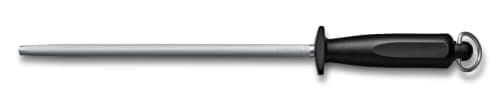
Victorinox Swiss Classic Fibrox Honing Steel, 10 in

8.7

If the answer for you is yes, this is the rod to buy and stop thinking about it. Fine-cut, 10 inches, and the same Fibrox handle that put Victorinox knives in half the professional kitchens in America. It will outlive the knives you bought it for.

$28.00Amazon

#ad · Full ranking below

By Stephen V.Updated How we review
#ad

We earn a commission when you buy through our Amazon links, at no extra cost to you. It never changes a verdict, and we say so when the cheaper knife is the better buy. How this works.

The short answer: yes, if your knives are Western steel and you cook more than once or twice a week— and it is one of the highest-return few dollars in a kitchen. No, if your knives are hard Japanese steel and you were about to buy a traditional ridged one, because that rod is wrong for them. And no, if the reason you are asking is that your knife is already blunt, because a rod will not fix that and you have been sold the wrong tool.

Nearly every published answer to this question hedges, and the hedge is not dishonest — it is what happens when "useful maintenance tool" and "strictly necessary" get treated as the same claim. They are not. A rod is not necessary the way a knife is necessary. It is necessary the way tyre pressure is necessary: skip it and nothing breaks, but everything works worse than it should and the expensive thing wears out faster.

The decision, in four lines

If this is youAnswer
Western/German knives, you cook several times a weekYes — a fine-cut steel rod, and use it constantly
Hard Japanese knives at 60+ HRCYes, but ceramic only — never a ridged steel
A mixed drawerYes — buy the ceramic, it is safe on both
You cook rarely and your knife is already dullNo — buy a stone or a sharpener first

Both picks below are steel rods for the first row, because that is the case the question is nearly always asked from. If you landed in row two or three, the ceramic rods for hard steel are the page you want instead.

The short answer

Quick picks

#KnifeBest forScorePrice
01
Victorinox Victorinox Swiss Classic Fibrox Honing Steel, 10 in
Victorinox Swiss Classic Fibrox Honing Steel, 10 in

If the answer for you is yes, this is the rod to buy and stop thinking about it. Fine-cut, 10 inches, and the same Fibrox handle that put Victorinox knives in half the professional kitchens in America. It will outlive the knives you bought it for.

The one to actually buy
8.7
$28.00Amazon
02
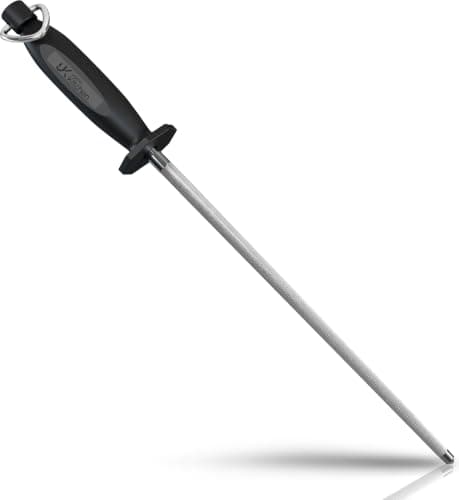
Utopia Kitchen Utopia Kitchen Honing Rod, 10 in
Utopia Kitchen Honing Rod, 10 in

The rod to buy if you are not yet convinced the habit will stick. A plain 10-inch carbon steel rod with a basic handle, at a price low enough that finding out costs almost nothing - and it does the realigning job on a Western edge perfectly well.

Cheapest way to find out
8.1
$10.44Amazon

#ad · Live prices from the Amazon Product API, as of Sep 6, 2026. Where we have no verified live price, we show none — a gap beats a number that has rotted.

In detail

The picks, in full

01
Victorinox Victorinox Swiss Classic Fibrox Honing Steel, 10 in

The one to actually buy

Victorinox Swiss Classic Fibrox Honing Steel, 10 in

Fine-cut steel rod10 inFibrox gripRealigns, does not sharpen
8.7/10

If the answer for you is yes, this is the rod to buy and stop thinking about it. Fine-cut, 10 inches, and the same Fibrox handle that put Victorinox knives in half the professional kitchens in America. It will outlive the knives you bought it for.

Effectiveness
8.5
Length & reach
8.5
Build
8.5
Grip & safety
9
Value
9

Pros

  • Long enough for every blade in a normal kitchen
  • Grippy handle and a full guard - this is the safety-relevant part of a rod
  • Priced where you will not resent it if the habit does not stick

Cons

  • Does very little for hard Japanese steel
  • No angle guide, so the technique is on you

Don't buy this if…

your knives are Japanese and hard - the ridges can chip a brittle apex rather than straighten it.

$28.00View on Amazon

Price as of Sep 6, 2026. Prices change — Amazon's at checkout is the one that counts.

#ad · we may earn a commission from this link to Victorinox Swiss Classic Fibrox Honing Steel, 10 in

02
Utopia Kitchen Utopia Kitchen Honing Rod, 10 in

Cheapest way to find out

Utopia Kitchen Honing Rod, 10 in

Carbon steel rod10 inBasic handleFull working length
8.1/10

The rod to buy if you are not yet convinced the habit will stick. A plain 10-inch carbon steel rod with a basic handle, at a price low enough that finding out costs almost nothing - and it does the realigning job on a Western edge perfectly well.

Effectiveness
7.5
Length & reach
9
Build
7
Grip & safety
7.5
Value
9.5

Pros

  • Full 10-inch length despite the price
  • Does the core job - a rolled Western edge comes back either way
  • Low enough stakes that an unused rod in a drawer is not a real loss

Cons

  • Handle and finish are noticeably basic next to a Victorinox or Wusthof
  • Coarser cut than a premium fine rod, so it is less refined on a keen edge

Don't buy this if…

you already know you will use it daily - the small step up to a proper fine-cut rod is worth it over a decade of use.

$10.44View on Amazon

$10.995% off

Price as of Sep 6, 2026. Prices change — Amazon's at checkout is the one that counts.

#ad · we may earn a commission from this link to Utopia Kitchen Honing Rod, 10 in

What you are actually buying

Not sharpness. A rod buys you time between sharpenings, and that is worth more than it sounds, because every sharpening is steel you never get back. A knife that gets honed before each long prep session might need a stone twice a year. The same knife with no rod anywhere near it needs one every few weeks, and each of those visits grinds away metal permanently. Over a decade the honed knife is measurably less worn.

The mechanism is narrow and worth understanding, because it tells you exactly when the rod will and will not work. Cutting deflects the last few microns of the apex sideways. The steel has not gone anywhere — it is bent, and a bent apex presents a rounded shoulder to the tomato skin instead of a point. Six passes on a rod stand it back up and the knife bites again. That is the entire trick, and it is why honing produces an instant dramatic result on an edge that rolled and precisely nothing on an edge that wore away.

The case where the answer is no

If the knife you are trying to rescue has been dull for months, a rod is the wrong purchase and buying one will feel like being lied to. There is no rolled metal left to realign; the apex has been abraded flat and needs grinding back. Spend the money on a stone or a sharpener, get the edge back, and then buy a rod to keep it. Our two-test diagnostic tells you which situation you are in before you spend anything, and the beginner stone guide is the cheapest honest route back to a sharp edge.

The case people get wrong

Hard Japanese knives. The advice "everyone should own a honing rod" came out of Western professional kitchens running softer steel, and it does not transfer cleanly. At 60–63 HRC the steel is more brittle and rolls far less, so there is much less to realign — and the ridges on a traditional steel rod have something hard and brittle to catch. Ceramic is the correct material there, because it has no ridges and works by very light abrasion instead. Honing rod materials covers the physics, and the Japanese-knife rod roundup picks the rods.

The rod that came with your knife block

There is a reasonable chance you already own one. Block sets nearly always include a rod, and it is nearly always still in the block, unused, because nobody explained what it was for. Pull it out before you buy anything. If it is a plain steel rod and your knives are Western, it is very probably fine — the difference between a bundled rod and a good one is real but small, and it is dwarfed by the difference between honing and not honing. Check the length against your longest knife; if it is shorter, that is the one genuine reason to replace it.

How to use it, in one paragraph

Stand the rod vertically with its tip on a board. Set the blade against the rod near the handle, at roughly the angle the knife was sharpened to, and draw it down and toward you so the contact point travels from heel to tip. Alternate sides. Five to ten light passes per side is plenty — pressure is not what makes this work, and speed is a good way to open a finger. The full walkthrough is at how to use a honing steel, and the angle question has its own page at what angle to hone a knife at.

How we picked

We did not lab-test these knives

Everyone in this category says they tested twenty knives in a professional kitchen. We have not hands-on tested any of these, and we say so. What we did instead: compiled the published specifications — steel type and hardness (HRC), edge angle, blade geometry, weight and build — applied established sharpening standards, ran the value math (spec quality ÷ live price), and scored each product against a published rubric. The scores are judgments from documented research — not measurements we took, because we do not have a test lab and we will not pretend we do. Where a number came from someone else's work, we name them in Sources.
Questions

Frequently asked

Is a honing rod really necessary?
Not in the sense that you cannot cook without one. It is necessary in the sense that without it your knives spend most of their life duller than they should be and get ground down faster, because you sharpen more often. For a Western block used several times a week it is the single cheapest improvement available.
Can I skip the rod and just sharpen more often?
You can, and it costs you the knife. Sharpening removes metal permanently; honing removes essentially none. Substituting one for the other means a blade that visibly narrows over years. The rod exists specifically so you can sharpen less.
Will a honing rod fix my dull knife?
Only if it is rolled rather than worn. Give it ten light passes per side and test it on paper. If the bite comes back, it was rolled and the rod is doing its job. If nothing changes, the edge is worn away and it needs a stone — no amount of honing will help.
Do I need one for Japanese knives?
Yes, but a ceramic one. Hard Japanese steel responds poorly to a ridged steel rod and can chip against it. A smooth ceramic rod around 1200 grit realigns and lightly refreshes a hard edge without that risk — see the best honing rods for Japanese knives.
How much should I spend on one?
Very little. Rod performance is mostly a function of material, cut and length, all of which are cheap to get right. What extra money buys is handle quality, balance and finish — real, but not what makes the edge come back. Both picks above sit at the end of the curve where more money stops buying performance.

Keep reading

Receipts

Sources

We do not run a testing lab, and we do not pretend to. Where a spec or a measured number came from someone else's work — a manufacturer's page, a published standard — we name them and link them. Where we could not verify something, we say so on the page rather than quietly leaving it out. Read our full method.