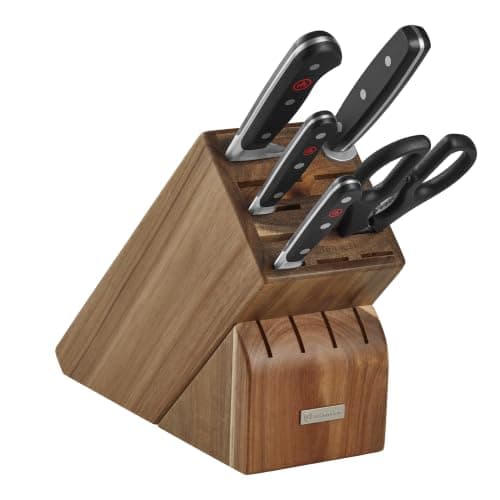
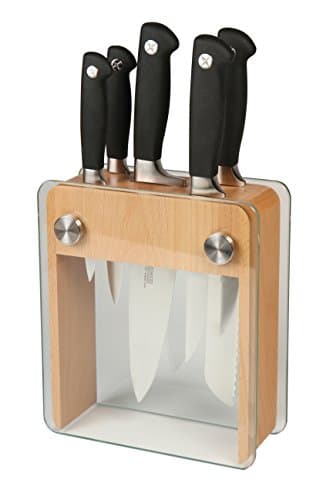
Register for the Mercer Genesis 6-Piece Forged Set. It is the best balance of genuinely forged blades, a lineup with no filler and a block that looks like furniture rather than clutter — which are the three things a registry set actually has to get right. A registry set is a strange purchase: the person paying has usually never watched the couple cook, does not know whose hand the knife will fit, and is choosing an object that will sit on a counter for ten years. That is a different problem from “which knives cut best”, and it ranks the field in a different order.
Three constraints shape this page and none of them appear on a normal knife-set roundup. The giver is not the user, so a set that depends on a particular grip or a right-handed contour is a gamble nobody should take on someone else's behalf. A newly combined household is dishwasher-prone— two people, new routines, and at least one of them will put a knife in the machine within a month — so steel and handles that tolerate abuse score above steel that rewards care. The block is furniture, visible every day on a counter, which is the only context where how a knife set looks is a legitimate ranking criterion rather than a vanity.
We should also say the uncomfortable thing early, because it is true and a registry is the one moment where acting on it is easy: three separate good knives beat almost any set at the same money. Our are knife sets worth it page does that arithmetic in full, and the last section here explains how to put individual knives on a registry without making guests feel they are buying you cutlery piecemeal. If you want sets ranked purely on cutting merit instead, that is best chef knife sets— a different rubric and a different winner.
The method is on how we review. We have not hands-on tested these sets; the scores read published specifications — construction, steel, tang, piece count, block material — against value at the live price. The Quick Picks table carries the live price and the date.
The honest answer: register for three knives, not a set
Every set on this page spreads its budget across pieces, a block and a margin. Three individual knives spend all of it on blades. At the same total price, a couple who register for a good 8-inch chef's knife, a serrated bread knife and a paring knife will end up with better steel in the three knives they use ninety percent of the time, and no block holding six they do not.
The usual objection is that individual knives are awkward on a registry — nobody wants to be the guest who bought “one knife”. Two things fix that. Register for a magnetic strip or an in-drawer block as a separate item, which gives you storage without buying a set and makes the individual knives look like a deliberate collection rather than leftovers. And register for the maintenancealongside them — a honing rod, a board, a stone — which are inexpensive, genuinely useful, and make a perfectly good gift for someone with a small budget. Best knife storage ranks the strips and in-drawer blocks, and best honing rods the rods.
The three knives to register for, if you take this route: an 8-inch chef's knife (the only one that genuinely matters), a serrated bread knife (because nothing else cuts bread and you cannot sharpen it easily anyway), and a paring knife(cheap, and does the jobs a chef's knife does badly). Add steak knives only if the couple entertain.
What makes a set a bad registry gift
Anything that assumes a grip or a hand.A contoured D-shaped Japanese handle suits a right-handed pinch grip beautifully and is a gamble on someone else's behalf. A moulded finger guard is the same risk in reverse. Symmetrical, conventional handles are the right choice when you are not the user — see left-handed chef knives for who gets caught by this.
Hard Japanese steel, as a gift. A 60 HRC edge is wonderful and it chips on a chicken bone. Giving one to a household whose cooking habits you do not know is giving them a knife that needs a stone, a technique and a rule they have not agreed to. Our Japanese knives for beginners page is written around exactly this failure.
Sets whose piece count is the selling point.A twenty-piece block is usually a chef's knife, a bread knife and eighteen things to fill the slots — frequently including six steak knives counted individually. Count the pieces you would actually use, then judge the price against that number.
A dishwasher claim you will act on.Several of these sets are listed as dishwasher safe. It is still a bad idea: detergent dulls finishes and the knives knock against other steel. In a newly shared kitchen this will happen anyway, which is why survivability is a ranked metric here — but do not choose a set because of the claim. See can you put knives in the dishwasher.
The two things to register for that nobody does
A board, and the right kind.A couple who receive a Wusthof set and a glass board will have ruined the edges within a year. End-grain wood or soft plastic, as large as the counter allows — best cutting boards for knives.
A honing rod. It costs very little, it takes ten minutes to learn, and it is the difference between knives that still cut in year three and knives that do not. It is also the single most useful thing a guest on a small budget can send. How to use a honing steel is the ten-minute skill, and how often to sharpen knives the cadence.
How we ranked this page
Five metrics, all of them registry-specific. Giftabilityis how the set presents as a present and on a counter — the only page on this site where that is a legitimate criterion rather than a vanity. Household survivability asks what happens when the knives are treated imperfectly for two years: forgiving steel, tolerant handles, replaceable pieces, a real warranty. Blade quality reads construction, published steel and hardness, and tang. Coverage counts the pieces a couple will genuinely use, not the pieces in the box. Valueis all of the above against the live price. The overall is the mean to one decimal place, and ties break in favour of the cheaper set. None of these are lab measurements — see how we review.