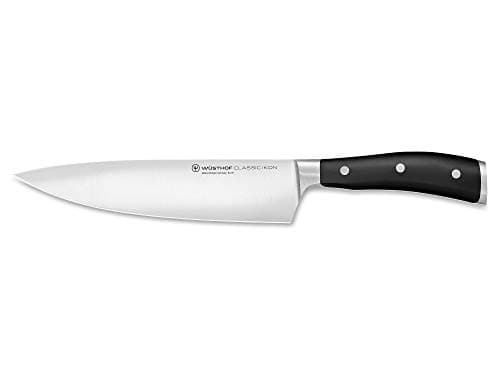
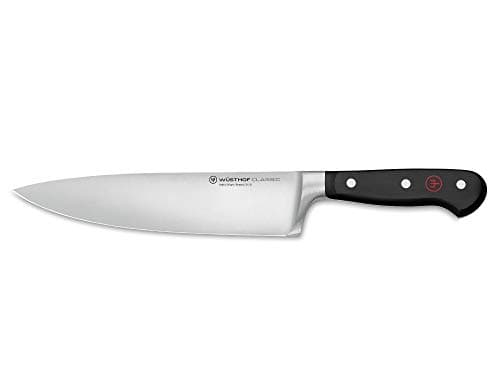
Buy the Wusthof Classic 8" if you have large hands and want one knife that fits them. It has the tallest blade of anything we have specified — 1.9 inches from edge to spine, a figure we can quote because Wusthof's own line gives us the comparison — a full bolster that fills the hand and keeps fingers off the blade, and enough forged weight that a big hand is not fighting a light knife. If your hands are large and you want a handle with a genuine contoured shape rather than a straight one, the Wusthof Classic Ikon is the alternative, and the trade is spelled out below: a better handle on a shallower blade.
The useful insight on this page is that "I need a bigger knife" is usually the wrong diagnosis. Three separate things go wrong for cooks with large hands, and only one of them is about length:
- Knuckle strike. Your knuckles hit the cutting board before the edge does. This is blade height — the vertical distance from edge to spine at the heel — and it is the specification that actually matters. A knife 1.9 inches tall gives noticeably more clearance than one 1.75 inches tall, and both numbers are published if you look.
- Cramped grip. Your fingers wrap all the way round the handle and overlap, or the pinch grip puts your index finger onto the blade. This is handle girth, handle length and whether there is a bolster to stop your hand sliding forward.
- Length, last. A 10-inch blade genuinely suits a cook with large hands and a big board, and it is the least common of the three problems. Every pick on this page is an 8-inch knife, because that is what our registry holds — we are not going to invent a product to fill a slot. If you have worked out that length is your issue, buy the 10-inch version of whichever knife below you like, which most of these brands make.
This page is the deliberate mirror of our best knives for small handsguide, and the criteria invert almost exactly: that page wants a short, light, shallow blade with a slim handle, and this one wants the opposite. If you are between the two, read both — the overlap is where most people actually sit, and "big hands" covers a much wider range than knife marketing admits.
One thing to settle before the list: weight is not the same as size. A heavy knife is not automatically a big-hands knife — a forged blade with its mass at the bolster will feel front-heavy regardless of your hand size, and some cooks with very large hands prefer a light Japanese blade precisely because they can steer it without effort. Our Shun versus Global comparison covers the light end of the market if that describes you better.
How these are scored. Every pick here is scored on one rubric built for this question — knuckle clearance, handle size and grip, balance under a large hand, build and value — and ranked strictly by the resulting average, with the house tiebreak (at an equal average, the cheaper knife ranks first). The published specifications are unchanged from the pages that established them; only the rubric is specific to this page. See how we review for the standing methodology.
Blade height: the number to look for, and where it hides
Blade height is the vertical measurement from edge to spine at the heel, and it is the single specification that determines whether your knuckles clear the board. It is almost never on the front of a listing. Where it is published, the differences are smaller than they feel: Wusthof gives the Classic at 1.9 inches and the Classic Ikon at 1.75, which is four millimeters and is noticeable in use.
If a maker does not publish it — and most do not — two proxies work. A tall-heeled profile is visible in a straight-on product photograph: look at how far the spine sits above the heel relative to the handle. And blade type tells you a lot, because some shapes are inherently tall: a nakirior a Chinese vegetable cleaver has far more height than any chef's knife, which is why some cooks with large hands end up preferring one for board work. Our cleaver roundup covers that family, and chef knife versus nakiri is the honest comparison.
Handles: girth, length and what a bolster does
Three variables, and makers publish the least useful one. Published handle lengths in this category are unreliable — Wusthof lists 4.5 inches for the Classic, the Classic Ikon and the Classic Half Bolster alike, while retailer sheets give different figures for each — so we do not build arguments on them and neither should you.
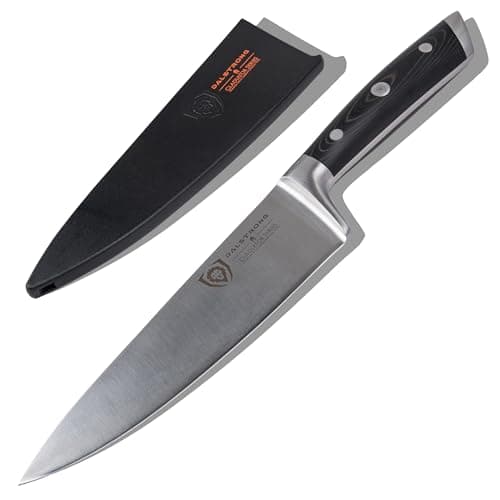
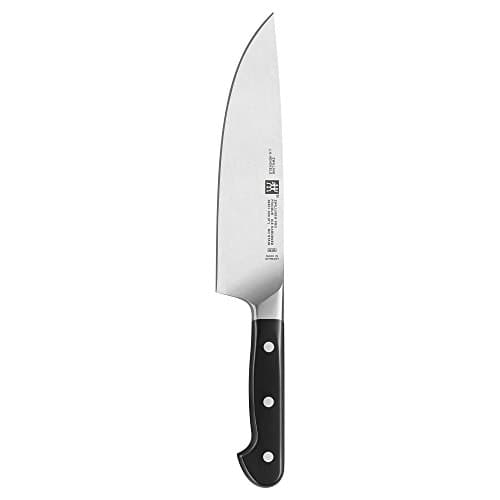
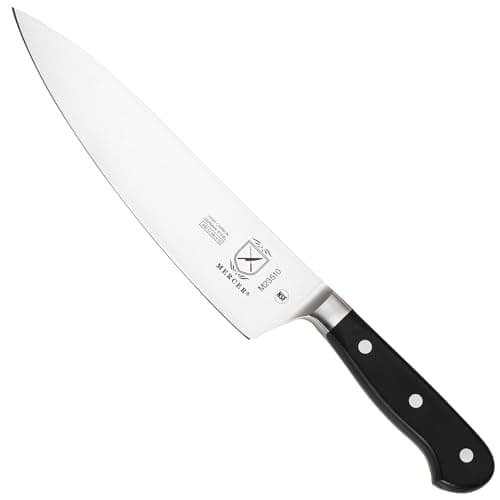
What is reliable is material and form. A G-10 or composite laminate handle (Dalstrong) is textured and typically fuller in the hand than a smooth polymer. A contoured handle with a double bolster (the Ikon) is shaped to fill a palm rather than to be a straight stick. A full bolster (Classic, Professional S, Renaissance) is a steel collar that physically stops a large hand sliding forward onto the edge, which is a genuine safety benefit for anyone whose fingers overlap the handle. A curved or sloped bolster (Zwilling Pro) is the compromise: it supports a high pinch grip without the collar getting under your index finger. Our handle materials guide covers the full range, and how to hold a chef knife matters here more than usual, because grip style changes which of these helps.
What we are NOT recommending, and why
A longer blade as the first move.A 10-inch chef's knife is a real answer for a cook with large hands and a large board, and it solves none of the knuckle clearance problem. Height and length are independent. Buy the longer blade once you have established that reach, not clearance, is what is failing you. See chef knife sizes for the full length-by-length breakdown.
A heavier knife for the sake of weight. Mass helps a big hand push through dense food and tires it over a long session, and the front-heavy balance of a forged bolstered knife is a separate variable from its total weight. Several of the picks above are heavy; none of them is recommended because it is heavy.
A knife set.Fit is per-knife and per-hand, and a block set commits you to one maker's handle across six pieces before you have held any of them. Our are knife sets worth it guide covers the general case; for this problem specifically, buy one knife, use it for a month, then decide.
Left-handed, and large
Worth flagging because the two problems compound. Every pick on this page is a symmetrical Western double bevel and is handed-neutral. Japanese knives frequently are not: Shun's D-shaped PakkaWood handle is contoured for a right hand, and an asymmetric grind will steer. If you are left-handed, read our left-handed chef knives guide before you shortlist anything Japanese, and note that a one-piece symmetrical steel handle — like the Global G-2's — has no handedness at all, though it is also the slimmest handle in the category and therefore the wrong direction for this page.
Try before you buy, and what to do if you cannot
Fit is the one thing a specification sheet cannot settle, and we will not pretend otherwise: the handle scores above are judgments from published shape, material and construction, not measurements of your hand. If you can get to a shop with these on a rack, ten minutes there beats any amount of reading.
If you cannot, buy from a retailer with a real returns policy and test on an onion at home: three or four rock-chops through a halved onion will tell you immediately whether your knuckles clear and whether the handle cramps. Our where-to-buy guide covers which retailers take knives back. And whatever you choose, keep it sharp — a dull knife needs more force, and more force is where large strong hands do damage. A honing rod is the cheapest upgrade on this page.