Skip to content
The Edge Bench

Stones, sharpeners & how-to · Sharpening

Sharpening steel vs honing steel

Two names, one shelf, and a distinction that actually matters: a honing steel is always steel, while a sharpening steel carries an abrasive. One of those removes metal from your knife.

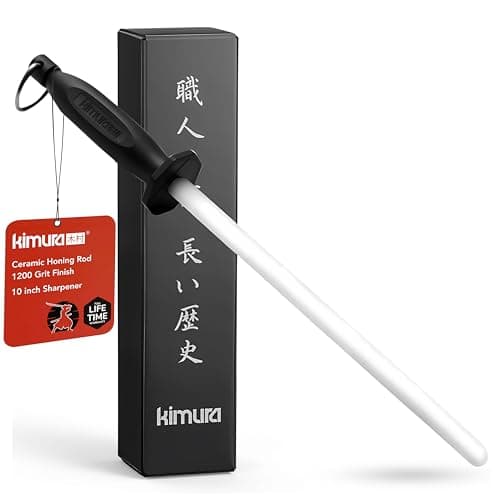
Kimura Kimura Professional Ceramic Honing Rod, 10 in

Our top pick · Best of both

Kimura Professional Ceramic Honing Rod, 10 in

8.5

The rod that satisfies both names, which is why it wins this page. Ceramic at 1200 grit realigns like a honing steel and abrades just enough to count as light sharpening - and with no ridges it is the only one of the three that is safe on both soft Western and hard Japanese steel.

$29.99Amazon

#ad · Full ranking below

By Stephen V.Updated How we review
#ad

We earn a commission when you buy through our Amazon links, at no extra cost to you. It never changes a verdict, and we say so when the cheaper knife is the better buy. How this works.

In an American kitchen store, they are the same thing. The rod in your knife block is sold as a "sharpening steel" by roughly half the market and a "honing rod" by the other half, and both descriptions point at the same object. If you came here to find out whether you bought the wrong one, you did not.

But the two words describe two different jobs, and the industry that makes these tools does draw a line. A honing steel is made of steel and realigns an edge that has rolled over; it removes essentially no metal. A sharpening steel carries an abrasive— a ceramic or diamond surface — and genuinely cuts, which means it removes metal every time you use it. Both are rod-shaped. Both live in the same drawer. Only one of them is slowly making your knife smaller.

Honing steel (plain steel rod)Sharpening steel (abrasive rod)
SurfaceRidged or polished steelCeramic or diamond
MechanismBends a rolled apex back into lineAbrades metal away to make a new apex
Metal removedEssentially noneA little (ceramic) to a real amount (diamond)
Fixes a worn edge?NoPartly — diamond genuinely does
Safe to use daily?YesCeramic yes, diamond no

So the useful version of the question is not "which name is correct" but which of the three surfaces should be in your hand. One pick below for each.

The short answer

Quick picks

#KnifeBest forScorePrice
01
Kimura Kimura Professional Ceramic Honing Rod, 10 in
Kimura Professional Ceramic Honing Rod, 10 in

The rod that satisfies both names, which is why it wins this page. Ceramic at 1200 grit realigns like a honing steel and abrades just enough to count as light sharpening - and with no ridges it is the only one of the three that is safe on both soft Western and hard Japanese steel.

Best of both
8.5
$29.99Amazon
02
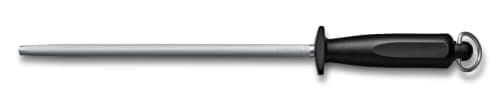
Victorinox Victorinox Swiss Classic Fibrox Honing Steel, 10 in
Victorinox Swiss Classic Fibrox Honing Steel, 10 in

A honing steel in the strict sense: fine-cut steel, no abrasive, no metal removed. On a Western edge that is exactly right, and it is the tool you can use every single day for twenty years without thinning the blade by any amount you could measure.

The true honing steel
8.2
$28.00Amazon
03
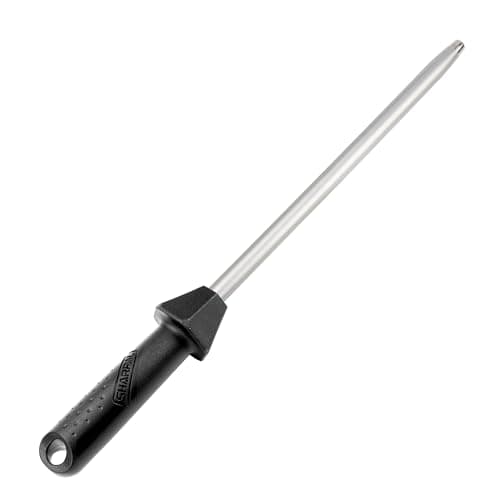
SHARPAL SHARPAL 119N Diamond Sharpening Steel
SHARPAL 119N Diamond Sharpening Steel

A sharpening steel in the literal sense - 1200-grit monocrystalline diamond on a 10-inch rod, with angle guides built into the handle. It cuts steel of any hardness, which makes it the only rod here that can bring back a genuinely worn edge, and the only one that will thin a knife if you treat it as a daily habit.

When you want it to actually sharpen
8.1
$22.99Amazon

#ad · Live prices from the Amazon Product API, as of Sep 6, 2026. Where we have no verified live price, we show none — a gap beats a number that has rotted.

In detail

The picks, in full

01
Kimura Kimura Professional Ceramic Honing Rod, 10 in

Best of both

Kimura Professional Ceramic Honing Rod, 10 in

1200-grit ceramic10 inRealigns and lightly abradesSafe to 62 HRC
8.5/10

The rod that satisfies both names, which is why it wins this page. Ceramic at 1200 grit realigns like a honing steel and abrades just enough to count as light sharpening - and with no ridges it is the only one of the three that is safe on both soft Western and hard Japanese steel.

Effectiveness
9
Versatility
8.5
Blade safety
8.5
Length & reach
8
Value
8.5

Pros

  • Does something for a hard edge that a plain steel rod cannot
  • Removes so little metal that daily use is not a problem
  • The only surface here that is correct for a mixed drawer

Cons

  • Brittle - a drop on tile can end it
  • Loads up with steel residue and needs occasional cleaning

Don't buy this if…

you own only soft Western knives and want the toughest possible tool - a steel rod is unbreakable and does that job fully.

$29.99View on Amazon

Price as of Sep 6, 2026. Prices change — Amazon's at checkout is the one that counts.

#ad · we may earn a commission from this link to Kimura Professional Ceramic Honing Rod, 10 in

02
Victorinox Victorinox Swiss Classic Fibrox Honing Steel, 10 in

The true honing steel

Victorinox Swiss Classic Fibrox Honing Steel, 10 in

Fine-cut steel rod10 inNo abrasiveRealigns only
8.2/10

A honing steel in the strict sense: fine-cut steel, no abrasive, no metal removed. On a Western edge that is exactly right, and it is the tool you can use every single day for twenty years without thinning the blade by any amount you could measure.

Effectiveness
8.5
Versatility
6.5
Blade safety
8
Length & reach
8.5
Value
9.5

Pros

  • Removes essentially no metal, so daily use costs the knife nothing
  • Effectively indestructible next to a ceramic rod
  • Fine cut is the right aggression for 55-58 HRC Western steel

Cons

  • Barely engages hard Japanese steel, and the ridges can chip it
  • Cannot improve an edge that is worn rather than rolled

Don't buy this if…

your block is Japanese or mixed - the ceramic above is the safer single rod.

$28.00View on Amazon

Price as of Sep 6, 2026. Prices change — Amazon's at checkout is the one that counts.

#ad · we may earn a commission from this link to Victorinox Swiss Classic Fibrox Honing Steel, 10 in

03
SHARPAL SHARPAL 119N Diamond Sharpening Steel

When you want it to actually sharpen

SHARPAL 119N Diamond Sharpening Steel

1200-grit diamond10 in rod, 15 in overallMonocrystalline diamondBuilt-in angle guides
8.1/10

A sharpening steel in the literal sense - 1200-grit monocrystalline diamond on a 10-inch rod, with angle guides built into the handle. It cuts steel of any hardness, which makes it the only rod here that can bring back a genuinely worn edge, and the only one that will thin a knife if you treat it as a daily habit.

Effectiveness
8.5
Versatility
9
Blade safety
6
Length & reach
8.5
Value
8.5

Pros

  • Genuinely restores a dulled edge in a way no steel or ceramic rod can
  • Cuts high-hardness modern steel that stalls other rods
  • Angle guides on the handle, which most rods do not bother with

Cons

  • Removes real metal on every pass - this is not a daily tool
  • 1200-grit diamond leaves a coarser finish than a fine ceramic rod

Don't buy this if…

you want a rod for before every prep session - use a steel or ceramic for that and keep this for occasional rescues.

$22.99View on Amazon

Price as of Sep 6, 2026. Prices change — Amazon's at checkout is the one that counts.

#ad · we may earn a commission from this link to SHARPAL 119N Diamond Sharpening Steel

Why the names got tangled

Because for most of the tool's history there was only one kind. A butcher's steel was steel, it was used constantly through a shift, and calling it a "sharpening steel" was near enough — a knife that would not cut before you used it cuts afterwards, which is what sharpening means to anyone not splitting hairs. Ceramic and diamond rods arrived much later, kept the same shape and the same shelf, and inherited both names indiscriminately.

The result is that the label on the box tells you almost nothing. Read the surface materialinstead: steel, ceramic or diamond. That single spec predicts the mechanism, the metal loss, which knives it is safe on, and how often you can use it — and no product name predicts any of those. Honing rods: steel vs ceramic vs diamond is the deep version of that comparison.

The distinction that survives the pedantry

It matters in exactly one situation, and it is a common one: you have a rod, you use it, and the knife is not coming back. If it is a plain steel rod, that is diagnostic — the edge is worn rather than rolled, and no amount of honing will help, so stop and get a stone. If it is a diamond rod, the same non-result means something different, because a diamond rod that is not improving an edge usually means the edge is damaged beyond what a rod-shaped abrasive can reach. Knowing which tool is in your hand turns a frustration into a diagnosis. The two-test diagnostic formalises it.

Ridged, polished, ceramic, diamond — ranked by how much they take

Every rod sits somewhere on one axis: how much metal it removes per pass. A polished steel removes none and purely burnishes. A ridged (fine-cut) steel removes almost none but bites enough to move a rolled apex briskly. Ceramic removes a very small amount, which is why it works on hard steel that does not roll. Diamondremoves a real amount and is a sharpening tool wearing a honing tool's shape. Match the position on that axis to how often you intend to use it: the more it takes, the less often you should. Grooved vs smooth settles the first two against each other.

What neither of them is

Neither is a substitute for a stone. Every rod on this page is a maintenance tool that works on the last few microns of an edge; none of them can reset a bevel, remove a chip or thin a blade that has thickened behind the edge. When honing has stopped working — properly stopped, not "did not seem to do much" — a whetstone or a sharpener is the next purchase, and the rod goes back to keeping the result.

How we picked

We did not lab-test these knives

Everyone in this category says they tested twenty knives in a professional kitchen. We have not hands-on tested any of these, and we say so. What we did instead: compiled the published specifications — steel type and hardness (HRC), edge angle, blade geometry, weight and build — applied established sharpening standards, ran the value math (spec quality ÷ live price), and scored each product against a published rubric. The scores are judgments from documented research — not measurements we took, because we do not have a test lab and we will not pretend we do. Where a number came from someone else's work, we name them in Sources.
Questions

Frequently asked

Is a sharpening steel the same as a honing steel?
In US kitchen retail, yes — the two names are used for the same rod. Technically a honing steel is made of steel and removes essentially no metal, while a sharpening steel carries an abrasive (ceramic or diamond) and does remove some. Read the surface material, not the product name.
Which one came with my knife block?
Almost certainly a plain steel honing rod — block sets bundle steel rods, not ceramic or diamond ones. If your knives are Western, it is very probably the correct tool and you should be using it. If they are hard Japanese steel, it is the wrong one.
Does a sharpening steel actually sharpen?
A ceramic one lightly does; a diamond one genuinely does. A plain steel one does not at all — it realigns. That is the whole reason the naming confusion is worth resolving before you buy.
Can I use a diamond rod every day?
You can, and it will measurably thin the blade over a few years, because it removes real metal on every pass. Keep a diamond rod for deliberate occasional touch-ups and use a steel or ceramic rod for the routine.
If I only buy one rod, which surface?
Ceramic, around 1200 grit. It is the only surface that is safe on both soft Western and hard Japanese steel and it satisfies both meanings of the name — it realigns and it lightly refreshes.

Keep reading

Receipts

Sources

We do not run a testing lab, and we do not pretend to. Where a spec or a measured number came from someone else's work — a manufacturer's page, a published standard — we name them and link them. Where we could not verify something, we say so on the page rather than quietly leaving it out. Read our full method.