Skip to content
The Edge Bench

Roundups & reviews · Chef Knives

The best Japanese knives under $100

A hundred dollars is a real ceiling for a Japanese knife, because the two things that make one Japanese both cost money. Every knife here gives up one of them, and the page says which.

Misen Misen 8" Chef Knife

Our top pick · Hard steel and a keen edge under $100

Misen 8" Chef Knife

8.8

The best Japanese-style chef's knife under $100 and the hardest steel in the band. AUS-10 stainless at a published 60-61 HRC with a roughly 15-degree edge, a sloped bolster and a full tang - the complete Japanese specification in a Western-shaped knife, which is exactly the trade that gets it inside this ceiling.

$49.00Amazon

#ad · Full ranking below

By Stephen V.Updated How we review
#ad

We earn a commission when you buy through our Amazon links, at no extra cost to you. It never changes a verdict, and we say so when the cheaper knife is the better buy. How this works.

The Misen 8-inch is the best Japanese-style chef's knife under $100, and it is for someone who wants a hard, thin, keen knife and does not need a Japanese badge on it. AUS-10 stainless at a published 60–61 HRC with a roughly 15-degree edge, a sloped bolster and a full tang — the hardest steel in this band by a clear margin. The budget pick is the Kai Seki Magoroku 165mm nakiri, a thin-stock Japanese-made vegetable knife for a fraction of everything else here.

Before the ranking, the finding that makes this a band page worth building rather than a cheaper version of our open Japanese roundup. Inside this ceiling, our registry contains exactly two full-size, gyuto-shaped Japanese-style chef's knives with a live price. That is not a gap in our research — it is what the sub-$100 Japanese market actually looks like, and the reason is mechanical.

The two properties that make a Japanese kitchen knife feel Japanese are a hard steel core, usually 60 HRC or above, and a thin, narrow grind finished at roughly 15 degrees a side or less. Hard steel costs money to buy and more to heat-treat without cracking it. A thin grind costs labour and produces more rejects. Under a hundred dollars, makers give up one of the two, and the interesting part of this page is watching which one each knife surrenders.

Every pick was inside the $100 ceiling with a live price at our last price check. We do not print numbers in prose, so the Quick Picks table carries the live price and the date we pulled it.

What each knife here gives up

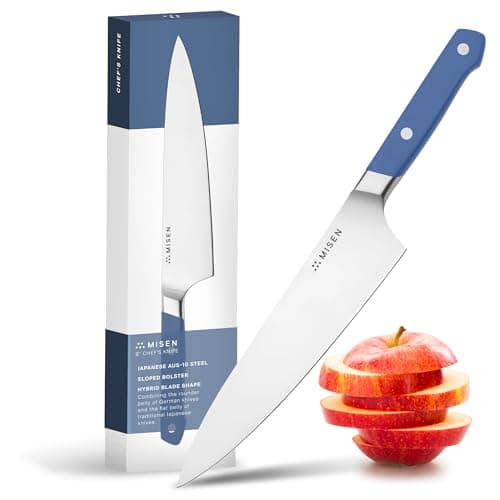
Misen gives up the badge.It keeps hard monosteel — AUS-10 at a published 60–61 HRC — and a published ~15-degree edge, which is the full Japanese specification. What it does not have is Japanese design language: the bolster is sloped in a Western way and the handle is a Western shape.

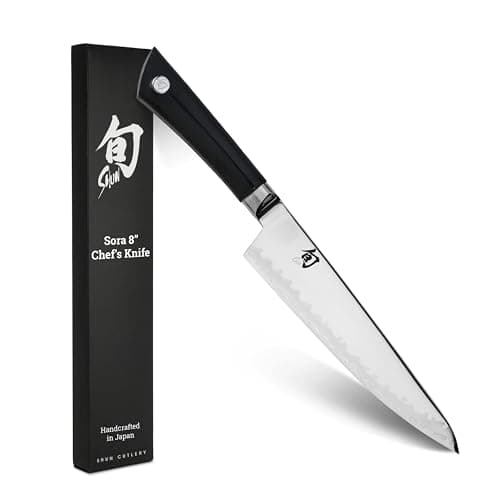
Shun's Sora gives up monosteel construction.It keeps a genuine VG10 cutting edge and Japanese manufacture, and achieves the price by welding that VG10 edge to a 420J stainless upper — Shun's published Composite Blade Technology. The part that cuts is premium; the part that does not cut is not.

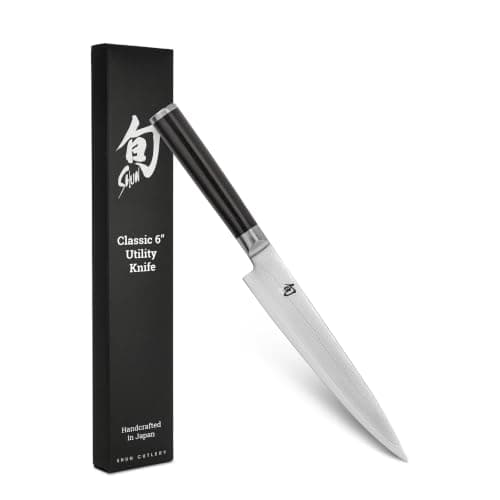
Shun's Classic 6-inch utility gives up size.It keeps the full VG-MAX core and the published 16-degree edge of the flagship Classic line. What you give up is blade length: this is a 6-inch utility knife, not a chef's knife.

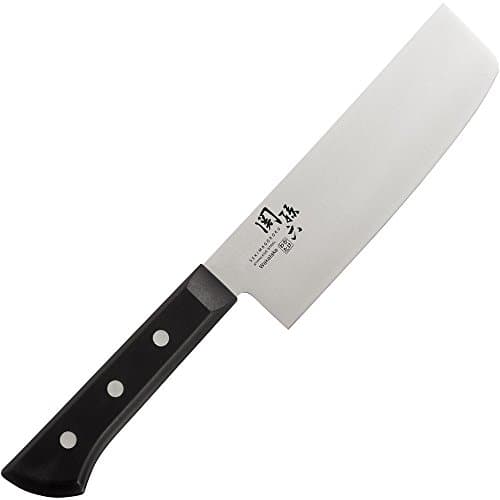
Kai's nakiri gives up both hardness disclosure and versatility. It keeps Seki manufacture and genuinely thin stock, at a price that makes the rest of this page look expensive. Kai publishes no hardness figure for it, which we score as unpublished.

How we ranked them

Five metrics, the same five across all four, scored as judgments from published specifications rather than measurements — how we review sets out the basis.

Steel & hardness is what the cutting edge is made of and how hard it is, with unpublished figures scored as unpublished rather than assumed. Grind & geometry is how thin and how narrow the edge is. Build is construction, including whether the blade is one steel or two. Handling is weight, balance and handle shape. Value is what you get inside this ceiling.

Knife hardness explained and Japanese vs German chef knives are the two background pages that make these metrics meaningful.

The short answer

Quick picks

#KnifeBest forScorePrice
01
Misen Misen 8" Chef Knife
Misen 8" Chef Knife

The best Japanese-style chef's knife under $100 and the hardest steel in the band. AUS-10 stainless at a published 60-61 HRC with a roughly 15-degree edge, a sloped bolster and a full tang - the complete Japanese specification in a Western-shaped knife, which is exactly the trade that gets it inside this ceiling.

Hard steel and a keen edge under $100
8.8
$49.00Amazon
02
Shun Shun Sora 8" Chef Knife
Shun Sora 8" Chef Knife

The Japanese-made knife inside this ceiling, and a clever piece of engineering rather than a compromised one. A genuine VG10 cutting edge welded to a 420J stainless upper - Shun's published Composite Blade Technology - so the money goes into the part that cuts and not the part that does not.

A genuine VG10 edge, made in Japan
8.1
$87.95Amazon
03
Shun Shun Classic 6" Utility Knife (DM0701)
Shun Classic 6" Utility Knife (DM0701)

The way to own the real Shun Classic specification inside this ceiling, as long as you accept a 6-inch blade. Full VG-MAX core, a published 16-degree edge and 2.7 ounces of weight - the flagship line's steel and grind in the only Classic shape that fits under $100.

Flagship Japanese steel in a small blade
8.3
$96.55Amazon
04
Kai Kai Seki Magoroku Nakiri 165mm
Kai Seki Magoroku Nakiri 165mm

The budget pick and the cheapest genuinely Japanese knife in the band by a wide margin. Japanese stainless with Seki manufacture, a 165mm nakiri profile and thin blade stock - a flat-edged vegetable knife that pushes straight through an onion without the rocking a chef's knife needs.

Budget pick and vegetable prep
8.2
$18.55Amazon

#ad · Live prices from the Amazon Product API, as of November 23, 2026. Where we have no verified live price, we show none — a gap beats a number that has rotted.

In detail

The picks, in full

01
Misen Misen 8" Chef Knife

Hard steel and a keen edge under $100

Misen 8" Chef Knife

AUS-10 stainless~60-61 HRC~15 deg edgeSloped bolster, full tang
8.8/10

The best Japanese-style chef's knife under $100 and the hardest steel in the band. AUS-10 stainless at a published 60-61 HRC with a roughly 15-degree edge, a sloped bolster and a full tang - the complete Japanese specification in a Western-shaped knife, which is exactly the trade that gets it inside this ceiling.

Steel & hardness
9.5
Grind & geometry
9
Build
8.5
Handling
8
Value
9

Pros

  • A published 60-61 HRC is 4 to 6 points harder than any German knife at this price, and it holds a keen edge accordingly
  • A published ~15-degree edge - the actual Japanese grind rather than a 20-degree bevel on a Japanese-looking knife
  • Monosteel construction: one steel through the whole blade, no weld line, nothing to delaminate
  • The sloped bolster is a genuinely good piece of design and does not block the heel on a sharpener
  • Already ranked on our open Japanese roundup and our under-$100 chef knife page, so this is a consistent verdict

Cons

  • Not a Japanese-made or Japanese-designed knife, which matters to some buyers and is the honest reason it is cheaper
  • A 60-61 HRC edge chips if you twist it, hit bone or cut on anything hard - this is a board-discipline knife
  • Western handle and bolster, so it does not feel like a Japanese knife in the hand even though it cuts like one
  • Needs a 15-degree-capable sharpener, which rules out most consumer electrics

Don't buy this if…

…you want a Japanese knife as an object as much as a tool - the Shun Sora below is made in Japan with a genuine VG10 edge, and that is a different kind of purchase.

It wins on the two metrics that define the category, and it wins them on published numbers. A 60–61 HRC monosteel blade with a 15-degree edge is the specification you would expect at twice this price, and the reason it is available here is that Misen does not sell Japanese provenance alongside it.

Whether that matters is a genuine question rather than a rhetorical one. If what you want is a knife that stays frighteningly sharp through a week of prep and resharpens to that state quickly, hardness and grind angle are what deliver it and this has both. If part of what you want is a knife made in Seki or Sakai by people who have done it for generations, no specification on this list substitutes for that and the Shun below is your knife.

One practical warning that applies to any 60-plus HRC blade: hardness and toughness trade against each other. This edge will chip on a bone or a frozen edge where a German knife would roll and recover. Keep it on wood or soft composite — best cutting boards for knives is the page that matters most for a knife like this.

$49.00View on Amazon

$74.2534% off

Price as of November 23, 2026. Prices change — Amazon's at checkout is the one that counts.

#ad · we may earn a commission from this link to Misen 8" Chef Knife

02
Shun Shun Sora 8" Chef Knife

A genuine VG10 edge, made in Japan

Shun Sora 8" Chef Knife

VG10 edge, 420J stainless upperComposite Blade Technology8 in. gyuto-style profileTextured polymer handle
8.1/10

The Japanese-made knife inside this ceiling, and a clever piece of engineering rather than a compromised one. A genuine VG10 cutting edge welded to a 420J stainless upper - Shun's published Composite Blade Technology - so the money goes into the part that cuts and not the part that does not.

Steel & hardness
8
Grind & geometry
8.5
Build
7.5
Handling
8
Value
8.5

Pros

  • A genuine VG10 cutting edge - the same steel family as knives costing several times this - made in Japan
  • Composite construction is an honest way to hit a price: premium steel where it cuts, cheap steel where it does not
  • A proper 8-inch gyuto profile, so it is a real chef's knife rather than a shortened one
  • Shun's Japanese manufacture and service network behind it, which no other pick in the band has
  • Already ranked third on our Japanese-knives-for-beginners page

Cons

  • A welded blade has a visible join line and two steels that wear differently - it will never feel like a monosteel knife
  • Shun does not publish a hardness figure for the Sora line, so the VG10 edge's temper is unstated and we score it as unpublished
  • Textured polymer handle is functional and plain against the Classic line's pakkawood
  • Costs more than the harder, monosteel Misen above

Don't buy this if…

…you want one homogeneous blade - the Misen is monosteel at a published 60-61 HRC and costs less, and a weld line is a real thing to dislike.

Second, and the pick for a reader whose question was specifically about Japanese knives rather than Japanese-style ones. It is the only full-size chef's knife in this band that is actually made in Japan.

The composite construction deserves a fair hearing because it is often dismissed. VG10 is expensive, and the top three-quarters of a kitchen blade never touches food. Welding a VG10 edge onto a cheap stainless body puts the money where the cutting happens. The honest costs are that you can see the join, the two steels polish and patinate differently, and over many sharpenings you eventually work into the weld region.

The missing number is hardness. Shun publishes no HRC figure for the Sora line, so we score that as unpublished rather than borrowing the Classic line's figure. VG10 is typically run hard, but "typically" is not a specification and we will not print one. Best Shun knives places the Sora against the Classic and premier lines, and alternatives to Global is where it is ranked against other Japanese alternatives.

$87.95View on Amazon

$109.9520% off

Price as of November 23, 2026. Prices change — Amazon's at checkout is the one that counts.

#ad · we may earn a commission from this link to Shun Sora 8" Chef Knife

03
Shun Shun Classic 6" Utility Knife (DM0701)

Flagship Japanese steel in a small blade

Shun Classic 6" Utility Knife (DM0701)

6 in bladeVG-MAX core16 degree edge2.7 oz
8.3/10

The way to own the real Shun Classic specification inside this ceiling, as long as you accept a 6-inch blade. Full VG-MAX core, a published 16-degree edge and 2.7 ounces of weight - the flagship line's steel and grind in the only Classic shape that fits under $100.

Steel & hardness
9
Grind & geometry
9
Build
9
Handling
7.5
Value
7

Pros

  • The genuine Shun Classic specification - VG-MAX core and a published 16-degree edge, not a value-line substitute
  • 2.7 ounces, so it is the lightest and most nimble knife in the band by a wide margin
  • A 6-inch utility blade is the most under-bought useful shape in a home kitchen
  • Pakkawood handle and Classic-line finish - the only pick here that feels like a premium object
  • Already ranked fifth on our utility-knife roundup

Cons

  • It is a 6-inch utility knife, not a chef's knife - it does not answer the query most people arrive with
  • Too short and too light for a large board of vegetables or a squash
  • VG-MAX run hard at a 16-degree edge is the chippiest edge here, and it genuinely punishes bad board habits
  • Costs nearly the top of the band for the least versatile shape in it

Don't buy this if…

…this is your only knife - a 6-inch utility blade cannot do an 8-inch chef's knife's work, and the Misen or the Sora is the right first purchase.

Third on the rubric, and the only pick here that would score the same on a page with no price ceiling at all — because it is not a budget knife, it is a flagship knife in a small size. VG-MAX and a published 16-degree edge are the real Shun Classic specification.

The reason it does not win is handling and value, and specifically shape. The question this page answers is about Japanese knives under a hundred dollars, and the knife most readers want is one they can do a whole evening's prep with. A 6-inch utility blade at 2.7 ounces is a beautiful thing and it is not that knife.

Where it is unbeatable: if you already own a chef's knife you like and you want to find out what a genuinely hard, thin, finely ground Japanese edge feels like, this is the cheapest honest way to do it. It is also the best knife here for fruit, small proteins and anything fiddly. Best utility knives ranks it against the Western alternatives.

$96.55View on Amazon

Price as of November 23, 2026. Prices change — Amazon's at checkout is the one that counts.

#ad · we may earn a commission from this link to Shun Classic 6" Utility Knife (DM0701)

04
Kai Kai Seki Magoroku Nakiri 165mm

Budget pick and vegetable prep

Kai Seki Magoroku Nakiri 165mm

Japanese stainless, Seki manufacture165mm nakiri profileThin blade stockLightweight handle
8.2/10

The budget pick and the cheapest genuinely Japanese knife in the band by a wide margin. Japanese stainless with Seki manufacture, a 165mm nakiri profile and thin blade stock - a flat-edged vegetable knife that pushes straight through an onion without the rocking a chef's knife needs.

Steel & hardness
7
Grind & geometry
8.5
Build
7.5
Handling
8.5
Value
9.5

Pros

  • A fraction of the price of everything else here and still made in Seki, Japan
  • Thin stock is the property that makes a Japanese knife feel Japanese, and this has it
  • A nakiri's flat edge and squared tip push cleanly through a whole onion or cabbage in one motion - a chef's knife cannot do that
  • 165mm and light, so it is genuinely pleasant for long vegetable sessions
  • Already ranked on our nakiri roundup, so this is a consistent verdict

Cons

  • Kai publishes no hardness figure for this knife, so the steel is scored as unpublished rather than assumed hard
  • A nakiri has no curved belly and no point - it cannot rock-chop, carve, or do tip work
  • Thin stock and a light build mean it is not a knife for hard squash or bone
  • Single-purpose, so it adds to a kitchen rather than furnishing one

Don't buy this if…

…you need one knife to do everything - a nakiri is a vegetable specialist with no point and no belly, and our nakiri-versus-chef-knife page explains the limits honestly.

The budget pick and fourth on the rubric, and the two facts are not in tension: it carries the highest value score on the page and the lowest steel score, because Kai publishes no hardness figure for it and we do not fill gaps with estimates.

What it genuinely offers is the single property most people actually notice about Japanese knives, which is thinness. A thin blade wedges less, so it falls through a tomato or a potato instead of splitting it. That is a bigger part of the Japanese-knife experience than hardness is, and this is the cheapest way to have it.

Be clear about the shape. A nakiri is flat-edged with a squared end: no rocking, no tip work, no carving. Chef knife vs nakiri and santoku vs nakiri set out what it can and cannot do, and best nakiri knives ranks it against the Shun and Zwilling alternatives above the ceiling.

$18.55View on Amazon

Price as of November 23, 2026. Prices change — Amazon's at checkout is the one that counts.

#ad · we may earn a commission from this link to Kai Seki Magoroku Nakiri 165mm

Which one, under $100?

You want the hardest, keenest chef's knife the money buys.The Misen 8-inch. A published 60–61 HRC and a ~15-degree edge, and it is not close.

You want a Japanese knife, made in Japan. The Shun Sora 8-inch. Genuine VG10 edge, composite build, proper gyuto profile.

You already own a chef's knife and want to try a real Japanese edge. The Shun Classic 6-inch utility. Flagship steel and grind, small blade.

You do a lot of vegetables and want to spend very little. The Kai Seki Magoroku nakiri.

You want a Japanese chef's knife and $100 is not a hard limit.Spend a little more. The jump from this band to the $100–200 band buys monosteel VG-MAX and Japanese manufacture in the same knife, which nothing here manages — Japanese chef knives is the open page and best chef knives under $200 is the next ceiling.

The sharpener problem nobody mentions

If you buy a hard, thin, 15-degree Japanese edge, most of the sharpening equipment in an ordinary kitchen is wrong for it. A pull-through sharpener is set near 20 degrees and will grind your 15-degree bevel to its own geometry. A smooth honing steel is designed for a soft edge that rolls, not a hard one that chips. Fixed-angle electrics are almost all 20 degrees.

Budget for the right tool at the same time as the knife. A whetstone, or a guided system that can be set to 15 degrees, plus a ceramic rod rather than a steel one. Best knife sharpeners for Japanese knives and best honing rods for Japanese knives are the two pages that matter, and best Work Sharp sharpeners is where the guided systems that reach 15 degrees are ranked.

What this ceiling will not buy

A monosteel VG-MAX or SG2 blade made in Japan. A hand-finished grind. A damascus-clad blade from an established maker. A single-bevel traditional knife. All four exist and all four start above this band — damascus steel knives explained is honest about which damascus listings are worth anything, which matters because the sub-$100 market is full of them.

How we picked

We did not lab-test these knives

Everyone in this category says they tested twenty knives in a professional kitchen. We have not hands-on tested any of these, and we say so. What we did instead: compiled the published specifications — steel type and hardness (HRC), edge angle, blade geometry, weight and build — applied established sharpening standards, ran the value math (spec quality ÷ live price), and scored each product against a published rubric. The scores are judgments from documented research — not measurements we took, because we do not have a test lab and we will not pretend we do. Where a number came from someone else's work, we name them in Sources.

Questions

Frequently asked

Can you get a good Japanese chef's knife for under $100?
Yes, with a trade. Our registry holds two full-size Japanese-style chef's knives inside the ceiling: the Misen keeps hard monosteel and a 15-degree edge but is not Japanese-made, and the Shun Sora is Japanese-made with a genuine VG10 edge welded to a cheaper upper. Both are good knives; neither gives you everything.
Is the Misen a Japanese knife?
It is Japanese-style rather than Japanese. The specification is Japanese in the ways that affect cutting — AUS-10 at a published 60–61 HRC and a roughly 15-degree edge — while the bolster and handle are Western in shape, and the brand is not a Japanese maker. That trade is most of why it fits inside this ceiling.
What is Shun's Composite Blade Technology?
Shun's published name for welding a VG10 cutting edge to a 420J stainless upper, so the premium steel is only in the part that cuts. It is an honest way to hit a price. The costs are a visible join line and two steels that wear differently.
Will my existing sharpener work on these knives?
Probably not well. A 15- or 16-degree Japanese edge needs a sharpener that can be set to that angle, and most pull-throughs and consumer electrics are fixed near 20 degrees — they will regrind your bevel to their geometry. Plan on a whetstone or a 15-degree-capable guided system, plus a ceramic rod rather than a steel one.

Keep reading

Receipts

Sources

We do not run a testing lab, and we do not pretend to. Where a spec or a measured number came from someone else's work — a manufacturer's page, a published standard — we name them and link them. Where we could not verify something, we say so on the page rather than quietly leaving it out. Read our full method.