Skip to content
The Edge Bench

Decision guides · Buying Guides

The best knife for cutting cheese

Cheese is not one job - it is four, sorted by texture rather than by price. Six tools ranked on texture coverage, release and clean cutting, with an honest note on what a cheese knife cannot do.

By Stephen V.Updated How we review
#ad

We earn a commission when you buy through our Amazon links, at no extra cost to you. It never changes a verdict, and we say so when the cheaper knife is the better buy. How this works.

Buy the BOSKA Copenhagen three-knife set. If you only ever cut one kind of cheese, buy the single tool that matches its texture instead and spend a third as much. Cheese is the rare kitchen job where the right answer genuinely is a small set rather than one good blade, and the reason is physical: the thing that defeats a knife in soft cheese is the exact opposite of the thing that defeats it in a two-year cheddar.

Soft cheese sticks — it welds itself to a flat blade face and tears instead of slicing. Hard cheese does not stick at all; it cracks, and a thin flexible blade either skates off it or bends. Semi-firm block cheese wants an even thickness you cannot hold by hand, which is a plane's job rather than a knife's. And fresh crumbly cheese — feta, young goat, fresh mozzarella — falls apart under any blade at all and wants a wire. Four textures, four mechanisms, and no single edge geometry that handles all of them well.

An honesty note this page needs more than most. Every score elsewhere on this site is built from three published figures: a named steel, a hardness in HRC, and an edge angle. No maker in the cheese-tool category publishes any of the three.So this page judges on what is actually published — blade geometry, coating, stated dimensions, dishwasher rating — plus the texture mechanism above, which is not in dispute. See how we review: we do not have a test lab, we have not handled every tool here, and where a claim is the maker's rather than ours we say so. If that sounds like a weaker basis than our knife pages, it is, and you should know that before you read the numbers.

What actually matters, in order

1. Texture coverage.The single most useful question is not “which is best” but “how many of the four textures does this handle.” A dedicated soft-cheese knife is superb at brie and useless on parmesan. That is not a flaw — it is the design — but it is why the rank-1 pick on this page is a set, and why every single-purpose tool below it scores lower on this metric no matter how well it does its own job.

2. Release.How readily cheese lets go of the blade. This is the difference between slicing brie and smearing it, and it is the whole reason cheese knives look strange: the holes, the skeleton cut-outs, the narrow blades and the non-stick coatings all exist to reduce the contact area between a sticky paste and a flat face. It is the same suction problem a Granton edge addresses on a chef's knife, explained properly in why knives have holes in the blade.

3. Clean cutting. Does the cut face come out intact, or crushed and crumbled? On hard cheese this is about rigidity and a stout point you can lever with. On fresh cheese it is about how little the tool displaces as it passes through, which is why a wire beats every blade on feta.

4. Build and care.Mostly a dishwasher question, because cheese residue is greasy and nobody hand-washes a cheese knife lovingly. Every tool here is stainless and most are rated dishwasher safe by their maker. There is no edge to protect in the way there is on a chef's knife, which is a genuine convenience.

5. Value. The live price against what the tool covers, the same way we score everything else.

The thing nobody selling cheese knives will tell you

A cheese knife is not a knife in the sense the rest of this site means. These are stamped stainless tools with no published hardness and no published edge angle, and they are effectively not sharpenable— there is no bevel worth maintaining and no maker offering a service. When one stops cutting well you replace it. That is fine at these prices and it is a different proposition from a chef's knife you keep for twenty years, so do not evaluate them against the same standard. The checklist that applies to real knives is in how to tell if a knife is good quality, and most of it simply does not apply here.

The honest corollary: the chef's knife in your drawer already does a lot of this.A thin, sharp 8-inch blade cuts hard and semi-firm cheese perfectly well — better than any tool on this page, in fact, because it is actually sharp. Where it struggles is soft paste, where it welds, and fresh crumbly cheese, where it compresses. If your cheese habit is a weekly block of cheddar, you do not need anything on this page; you need the knife from best chef knives and a board. Buy from this page when you are serving cheese rather than cooking with it, or when brie and feta are regulars.

Why four of six picks are one brand.Boska has made cheese tools and essentially nothing else since the nineteenth century, and it is the only maker selling a texture-matched range at sane money — a soft knife, a hard knife, a plane and a wire that are designed as a system. The alternative would have been padding this page with unbranded six-piece charcuterie sets whose listings name no maker, no material grade and no dimensions, which we have no basis to rank. We would rather tell you the field is narrow than pretend it is wide.

The short answer

Quick picks

#KnifeBest forScorePrice
01
BOSKA BOSKA Cheese Knife Set Copenhagen (3-piece)
BOSKA Cheese Knife Set Copenhagen (3-piece)

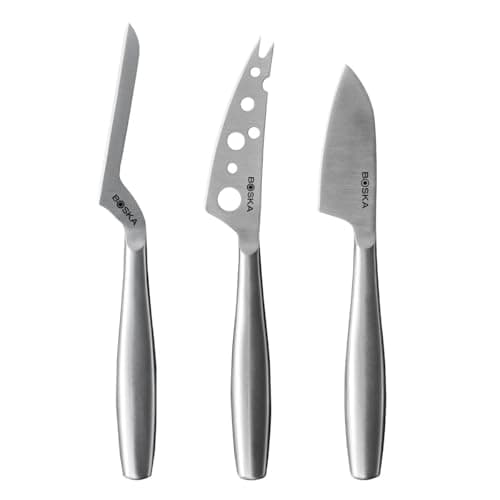
The right answer for anyone who serves cheese rather than just cooks with it, and the only pick here that covers more than one texture. Three stainless Copenhagen tools with a non-stick finish, dishwasher safe, for a little more than one Wusthof cheese knife costs on its own.

Best overall
8.6
$29.99Amazon
02
BOSKA BOSKA Soft Cheese Knife Copenhagen Nr.1
BOSKA Soft Cheese Knife Copenhagen Nr.1

The best single answer to brie, camembert and anything with a paste rather than a crumb - and the cheapest tool on this page. A narrow 230mm stainless blade built so that as little of it as possible touches the cheese, which is the entire problem with soft cheese solved directly.

Best for soft cheese
8.3
$11.99Amazon
03
BOSKA BOSKA Wire Cheese Slicer Monaco+
BOSKA Wire Cheese Slicer Monaco+

The only tool here that beats a blade outright, and it does it on fresh and crumbly cheese. A wire displaces almost nothing as it passes through, so feta, fresh mozzarella and young goat come out as slices instead of rubble. Boska rates it for semi-soft through hard.

Best for crumbly and fresh
8.3
$19.99Amazon
04
BOSKA BOSKA Cheese Slicer Copenhagen
BOSKA Cheese Slicer Copenhagen

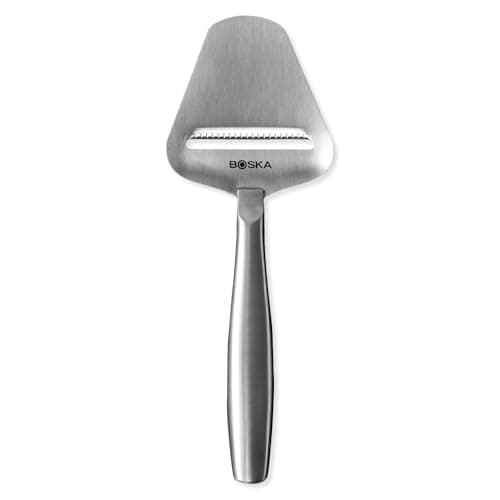
The answer to 'best knife for cutting cheese block', and the one job a knife genuinely cannot do by hand: even slices, every time. A stainless plane that regulates thickness mechanically instead of asking your wrist to - which is why Dutch and Scandinavian kitchens have one and American kitchens mostly do not.

Best for block cheese
8.2
$11.99Amazon
05
BOSKA BOSKA Cheese Knife Copenhagen Nr.2
BOSKA Cheese Knife Copenhagen Nr.2

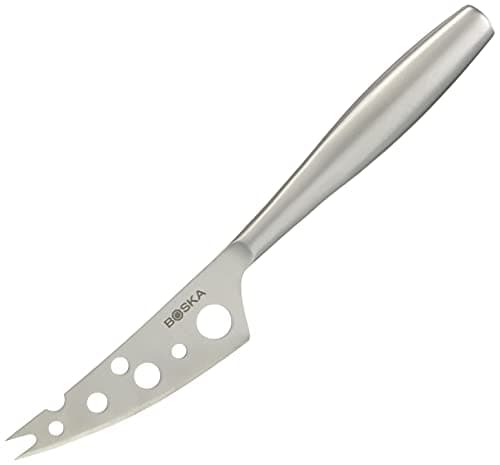
The one-tool compromise, bought by people who do not want a set. Boska describes it as multi-functional and for all types of cheese, and that is a fair description of something that is adequate across three textures and best at none. Buy it if the three-knife set is more cheese tooling than you want to own.

Best single tool
8.0
$11.99Amazon
06
Wusthof Wusthof Gourmet 4.5" Hard Cheese Knife
Wusthof Gourmet 4.5" Hard Cheese Knife

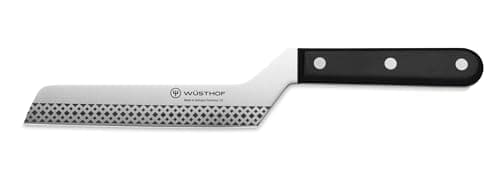
The best-made tool here and the worst value, which is the usual shape of a Solingen entry in a cheap category. A short, stout 4.5-inch blade from Wusthof's stamped Gourmet line, built to lever and crack an aged cheese rather than slice it - the right answer for parmesan, manchego and a two-year cheddar.

Best for hard cheese
7.8
$60.00Amazon

#ad · Live prices from the Amazon Product API, as of November 12, 2026. Where we have no verified live price, we show none — a gap beats a number that has rotted.

In detail

The picks, in full

01
BOSKA BOSKA Cheese Knife Set Copenhagen (3-piece)

Best overall

BOSKA Cheese Knife Set Copenhagen (3-piece)

3-piece Copenhagen rangeStainless steel, non-stickMulti-texture coverageDishwasher safe (maker's rating)
8.6/10

The right answer for anyone who serves cheese rather than just cooks with it, and the only pick here that covers more than one texture. Three stainless Copenhagen tools with a non-stick finish, dishwasher safe, for a little more than one Wusthof cheese knife costs on its own.

Texture coverage
9.5
Release
8
Clean cutting
8.5
Build & care
8
Value
9

Pros

  • The only pick on this page that covers soft, semi-firm and hard in one purchase
  • Boska designs the Copenhagen tools as a system, so the three shapes do not duplicate each other
  • Non-stick finish is the single most useful feature on anything that touches soft cheese
  • Dishwasher safe by the maker's rating, which matters because cheese residue is greasy
  • Costs about half what one premium single-texture cheese knife costs

Cons

  • Three tools means three things to store and lose; a single knife is tidier
  • Like everything in this category it publishes no steel grade, no hardness and no edge angle
  • Not sharpenable in any meaningful sense - these are replace-not-maintain tools
  • Light and thin, so none of the three has the rigidity for a very old, very dry hard cheese
  • If you only ever cut cheddar you are paying for two tools you will not use

Don't buy this if…

…your cheese is always the same kind. A single texture-matched tool from further down this page does that one job as well and costs a third as much.

This wins on the structure of the problem rather than on being the finest object here. “Best cheese knife set” is the second-ranked autocomplete variant under “best cheese knife” for a reason: people intuit that one blade will not do it, and they are right. A set is the honest answer and this is the one we would buy.

Boska's Copenhagen line is its mainstream range — stainless, non-stick, dishwasher-rated, and cheap enough that losing one in a drawer is not an event. The three shapes are differentiated by texture rather than by size, which is the thing generic charcuterie sets get wrong: a six-piece set of near-identical small spreaders covers one texture four times.

Where it genuinely falls short is the extreme hard end. None of the three has the rigidity or the lever geometry of the Wusthof further down, so a very dry aged cheese will defeat it — you will crack rather than cut, which is actually the correct technique for parmesan but not what you want on a manchego you meant to slice. If aged hard cheese is the main event, read the Wusthof entry and consider owning both.

$29.99View on Amazon

Price as of November 12, 2026. Prices change — Amazon's at checkout is the one that counts.

#ad · we may earn a commission from this link to BOSKA Cheese Knife Set Copenhagen (3-piece)

02
BOSKA BOSKA Soft Cheese Knife Copenhagen Nr.1

Best for soft cheese

BOSKA Soft Cheese Knife Copenhagen Nr.1

230 x 25 x 13 mm (maker's figure)Narrow soft-cheese geometryStainless steelCopenhagen range
8.3/10

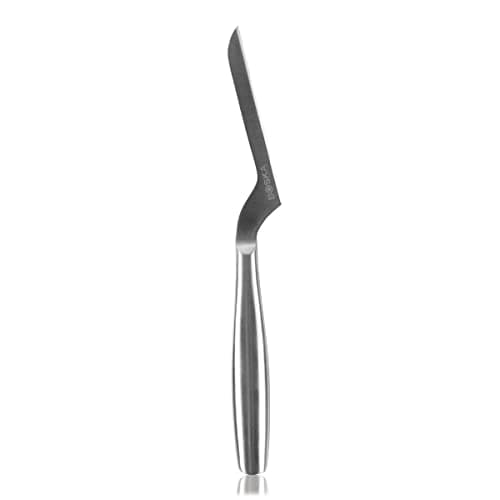
The best single answer to brie, camembert and anything with a paste rather than a crumb - and the cheapest tool on this page. A narrow 230mm stainless blade built so that as little of it as possible touches the cheese, which is the entire problem with soft cheese solved directly.

Texture coverage
6
Release
9.5
Clean cutting
9
Build & care
7.5
Value
9.5

Pros

  • Best release score on the page alongside the wire - soft cheese genuinely lets go of it
  • The one tool here whose exact dimensions the maker publishes (230 x 25 x 13 mm)
  • Narrow blade at 25 mm means minimal contact area, which is the whole mechanism
  • Cheapest thing on this page by a wide margin
  • Long enough at 230 mm to cross a whole wheel of camembert in one stroke

Cons

  • Texture coverage score of 6: it is a soft-cheese tool and genuinely poor at anything firm
  • Thin and narrow, so it flexes - it will not lever a hard rind
  • No published steel, hardness or edge angle, like everything in this category
  • Build is the plainest here; it reads as a tool rather than as tableware for a cheese course

Don't buy this if…

…your cheese drawer is mostly cheddar and parmesan. This is a specialist and it is honest about it - on hard cheese it is the worst pick on the page.

Soft cheese is the one texture where an ordinary kitchen knife is genuinely bad, which makes this the most useful single purchase on the page for a lot of people. Press a chef's knife through a ripe brie and the paste adheres to both faces, drags, and comes away as a smear. The cut is ruined before the blade is halfway down.

The fix is contact area, and this tool is nothing but that fix: a long, narrow, thin-profiled blade whose published dimensions — 230 by 25 by 13 millimeters — tell you most of what you need to know. Twenty-five millimeters of blade height is less than half what a paring knife carries. There is simply not much surface for the cheese to stick to.

It is the cheapest thing we rank in any category, and the honest framing is that it solves exactly one problem completely. If brie, camembert, taleggio or a washed-rind are regulars at your table, buy this and stop thinking about it. If they are not, skip it — and note that the three-knife set above includes a soft-cheese tool, so buying both is redundant.

$11.99View on Amazon

Price as of November 12, 2026. Prices change — Amazon's at checkout is the one that counts.

#ad · we may earn a commission from this link to BOSKA Soft Cheese Knife Copenhagen Nr.1

03
BOSKA BOSKA Wire Cheese Slicer Monaco+

Best for crumbly and fresh

BOSKA Wire Cheese Slicer Monaco+

Cutting wire, not a bladeNon-stick BSF treatmentSemi-soft to hard (maker's rating)Ergonomic handle
8.3/10

The only tool here that beats a blade outright, and it does it on fresh and crumbly cheese. A wire displaces almost nothing as it passes through, so feta, fresh mozzarella and young goat come out as slices instead of rubble. Boska rates it for semi-soft through hard.

Texture coverage
7
Release
9.5
Clean cutting
9
Build & care
7.5
Value
8.5

Pros

  • A wire displaces far less than any blade, so crumbly cheese holds together through the cut
  • Ties the soft-cheese knife for the best release on the page - there is almost no surface to stick to
  • Non-stick BSF treatment on the frame, per Boska's own description
  • Also the right tool for cheesecake and for anything you would otherwise cut with floss
  • Boska rates it across semi-soft to hard, so it is less single-purpose than it looks

Cons

  • The wire is a consumable - it stretches and eventually breaks, and that is the design
  • No good on a very hard aged cheese despite the rating; the wire binds rather than cuts
  • You cannot lever, point or spread with it, so it never replaces a knife at a cheese board
  • Build & care scores 7.5: more moving structure to clean than a flat blade

Don't buy this if…

…you want one tool for a cheese board. A wire cutter is a preparation tool, not a serving tool - nobody hands a guest a wire slicer.

Worth including because it is the one place where the whole premise of this page — that you need a knife — is wrong. Fresh cheese fails under a blade not because the blade is blunt but because a blade has thickness, and thickness has to push the cheese sideways to make room for itself. On feta or fresh mozzarella that sideways push is enough to break the curd structure. A wire has almost no thickness, so there is nothing to push.

The same logic is why bakers cut cheesecake with floss and why a wire is the right answer to the second-ranked autocomplete variant on this topic. If “best knife for cutting cheesecake” is what brought you here, this is the answer and a knife is not.

Two honest limits. Boska rates the Monaco+ from semi-soft through hard, and our reading of the mechanism is that the hard end of that range is generous — a wire needs to part the cheese, and a very dry aged cheese does not part, it fractures, so the wire binds. And the wire itself is a wear part. That is normal for the format rather than a defect, but it means this is a tool with a service life rather than a lifetime object.

$19.99View on Amazon

Price as of November 12, 2026. Prices change — Amazon's at checkout is the one that counts.

#ad · we may earn a commission from this link to BOSKA Wire Cheese Slicer Monaco+

04
BOSKA BOSKA Cheese Slicer Copenhagen

Best for block cheese

BOSKA Cheese Slicer Copenhagen

Plane-type slicerStainless steel, non-stickSemi-firm block cheeseDishwasher safe (maker's rating)
8.2/10

The answer to 'best knife for cutting cheese block', and the one job a knife genuinely cannot do by hand: even slices, every time. A stainless plane that regulates thickness mechanically instead of asking your wrist to - which is why Dutch and Scandinavian kitchens have one and American kitchens mostly do not.

Texture coverage
6.5
Release
8.5
Clean cutting
9
Build & care
7.5
Value
9.5

Pros

  • Delivers an even thickness no hand-held knife can match on a block of Gouda or Edam
  • The correct tool for sandwich cheese, which is most of the cheese most households buy
  • Stainless with a non-stick finish and dishwasher-rated by the maker
  • Lightweight and flat, so it stores in a drawer alongside a peeler
  • Among the cheapest tools on the page

Cons

  • Texture coverage score of 6.5: semi-firm block only. Hopeless on soft, pointless on crumbly
  • Needs a flat-faced block to work; it cannot follow a wedge or a wheel
  • The slot gums up with a sticky younger cheese and needs rinsing mid-job
  • Thin stamped stainless with no published grade, and the cutting lip dulls with no way to restore it

Don't buy this if…

…you buy cheese as wedges rather than blocks. A plane needs a flat face to ride on and a wedge does not give it one.

A cheese plane is standard equipment across the Netherlands and Scandinavia and almost unknown in American kitchens, which is a straightforward cultural accident rather than a verdict on the tool. If you buy semi-firm cheese in blocks — Gouda, Edam, Jarlsberg, a young cheddar — it does something no knife does: it makes every slice the same thickness without any skill at all, because the thickness is set by the geometry and not by your hand.

That matters more than it sounds for sandwiches, where uneven cheese is the difference between a slice that melts evenly and one that does not. It is the same argument as a mandoline against a knife for vegetables, at a tenth of the risk.

The limits are strict and worth respecting. It needs a flat face to ride on, so a wedge cut from a wheel defeats it. It gums up on anything young and sticky. And the cutting lip is thin stamped stainless with no published grade and no route to restoring it — when it stops biting, it is finished. At this price that is a reasonable deal, and it is worth knowing before you expect a decade out of it.

$11.99View on Amazon

Price as of November 12, 2026. Prices change — Amazon's at checkout is the one that counts.

#ad · we may earn a commission from this link to BOSKA Cheese Slicer Copenhagen

05
BOSKA BOSKA Cheese Knife Copenhagen Nr.2

Best single tool

BOSKA Cheese Knife Copenhagen Nr.2

Multi-functional geometryStainless steel, non-stickCopenhagen Nr.2Dishwasher safe (maker's rating)
8.0/10

The one-tool compromise, bought by people who do not want a set. Boska describes it as multi-functional and for all types of cheese, and that is a fair description of something that is adequate across three textures and best at none. Buy it if the three-knife set is more cheese tooling than you want to own.

Texture coverage
8
Release
7.5
Clean cutting
7.5
Build & care
7.5
Value
9.5

Pros

  • Covers more textures than any other single tool here - best coverage score outside the set
  • Non-stick finish, so it copes with a soft cheese better than a kitchen knife does
  • One thing to store, one thing to wash, one thing to find in a drawer
  • Dishwasher-rated by the maker and priced at the floor of the category
  • Looks presentable enough to put on a board in front of guests

Cons

  • Best at nothing: it scores lower than the specialists on both release and clean cutting
  • Not the soft-cheese answer - the Nr.1 above beats it clearly on paste
  • Not the hard-cheese answer either - no lever geometry, and it will skate on an aged rind
  • Same category-wide gap: no published steel, hardness or edge angle

Don't buy this if…

…you have identified which texture you actually cut most. A specialist is better at your job and usually cheaper; this tool exists to avoid making that decision.

Every category needs the honest middle, and this is it. Boska's own description calls the Copenhagen Nr.2 multi-functional and suitable for all types of cheese, and our reading of that is neither cynical nor enthusiastic: it is a generalist, it is genuinely usable across soft, semi-firm and hard, and a specialist beats it on each one.

It is on the page because “I do not want three cheese knives” is a completely reasonable position and the alternative to serving that reader honestly is letting them buy a generic six-piece set instead. If one tool is the constraint, this is the one tool.

The sharper advice, though: if you are already willing to own one dedicated cheese tool, you probably know which cheese you actually buy. Look at your fridge, pick the texture that dominates, and buy that specialist — you will get a better cut for less money. This is the pick for people who genuinely cut everything.

$11.99View on Amazon

Price as of November 12, 2026. Prices change — Amazon's at checkout is the one that counts.

#ad · we may earn a commission from this link to BOSKA Cheese Knife Copenhagen Nr.2

06
Wusthof Wusthof Gourmet 4.5" Hard Cheese Knife

Best for hard cheese

Wusthof Gourmet 4.5" Hard Cheese Knife

4.5 in bladeWusthof stamped Gourmet lineStout hard-cheese geometrySolingen-made
7.8/10

The best-made tool here and the worst value, which is the usual shape of a Solingen entry in a cheap category. A short, stout 4.5-inch blade from Wusthof's stamped Gourmet line, built to lever and crack an aged cheese rather than slice it - the right answer for parmesan, manchego and a two-year cheddar.

Texture coverage
6.5
Release
7
Clean cutting
9.5
Build & care
9.5
Value
6.5

Pros

  • Best clean-cutting and best build scores on the page by a clear margin
  • Short stout blade is built to lever and fracture rather than slice, which is correct for aged cheese
  • An actual cutlery maker with published construction, a service network and a warranty behind it
  • Answers the 'cheddar', 'hard cheese' and 'manchego' autocomplete variants directly
  • 4.5 inches is a sensible serving length - it looks right on a cheese board

Cons

  • Costs several times the Boska tools and covers one texture, which is why it finishes last here
  • Release score of 7, the weakest on the page: a flat uncoated face is the wrong thing for soft cheese
  • Texture coverage 6.5 - do not expect it to handle brie or feta
  • Wusthof publishes construction and provenance but not a hardness or edge angle for this tool
  • Stamped rather than forged, like the rest of the Gourmet line - fine here, but not a forged knife at a forged price

Don't buy this if…

…hard cheese is an occasional thing in your house. A thin, sharp chef's knife handles aged cheese perfectly well, and the money is better spent on sharpening the knife you own.

The one entry here from a company that makes actual knives, and it shows in everything except the price-to-coverage arithmetic our rubric rewards. Wusthof's stamped Gourmet line is the same family as the Gourmet 8" chef knife we review, and the construction logic carries over: stamped rather than forged, no bolster, Solingen-made, backed by a real service network.

Its job is narrow and it does it better than anything else on the page. Aged hard cheese is not sliced, it is fractured — you drive a short stout point in and lever, and the cheese breaks along its own grain. That takes rigidity and a blade short enough to control, which is exactly what a 4.5-inch hard-cheese knife is. Try it with the thin flexible soft-cheese knife above and you will bend the blade.

It finishes last because this page is weighted for coverage and value, and it is a single-texture tool at several times the price of the single-texture Boskas. That is a rubric outcome rather than a criticism of the object: if aged cheese is genuinely your thing, this is the one to buy and the ranking should not talk you out of it. If it is not, note the honest alternative — a sharp chef's knife does aged cheese well, and learning to sharpen the knife you own costs less and improves everything else you cut.

$60.00View on Amazon

Price as of November 12, 2026. Prices change — Amazon's at checkout is the one that counts.

#ad · we may earn a commission from this link to Wusthof Gourmet 4.5" Hard Cheese Knife

The best knife for cutting cheese, by texture

Soft and ripened — brie, camembert, taleggio, washed rinds. A narrow, thin, low-contact blade, ideally coated. The Boska Nr.1 above, or the soft knife in the three-piece set. The failure mode you are avoiding is adhesion: the paste grabs a flat face and tears. A kitchen knife run under hot water and wiped between cuts is a serviceable improvisation and gets tiresome fast.

Semi-firm block — Gouda, Edam, young cheddar, Jarlsberg.A plane, if you want even slices, or any sharp knife if you do not. This is the texture an ordinary chef's knife handles best, so the plane is a convenience rather than a necessity — but it is a real convenience if the cheese ends up in sandwiches.

Hard and aged — parmesan, manchego, aged cheddar, pecorino. Something short, stout and rigid that you can lever with, like the Wusthof. The technique is fracture rather than slice: set the point and press, and let the cheese split along its grain. A long thin blade is actively unsafe here, because the force needed to make it cut is the force that makes it slip.

Fresh and crumbly — feta, fresh mozzarella, young goat. A wire, or failing that unflavored dental floss. Any blade thick enough to be a blade will crush the curd structure. This is the one texture where the best tool is not a knife at all.

Do you actually need a cheese knife?

If the cheese you cut is mostly semi-firm or hard, honestly no. A sharp 8-inch chef's knife out-cuts everything on this page on those two textures, because it is the only tool in the conversation with a real edge. The money is better spent on a stone than on a dedicated cheese tool, and that purchase improves every other thing you cut.

Buy from this page in three situations. You serve cheese to people— a cheese board wants small tools that look right and that guests can use without a lesson, and a chef's knife on a board is both wrong and a little alarming. Soft cheese is a regular— this is the real functional case, because adhesion is a problem a sharp edge does not solve. You want even slices without skill— the plane does something your hand cannot.

Everything else is optional, and we would rather say so than sell you a six-piece set. The same reasoning drives are knife sets worth it and what knives a kitchen actually needs.

What to avoid in this category

Unbranded six-piece charcuterie sets.The commonest thing sold under this search, and the hardest to justify. They typically contain four near-identical small spreaders, name no maker, state no material grade and publish no dimensions — which means four tools for one texture and nothing to evaluate. If a listing will not tell you who made it or what it is made of, that is the finding. The channel-reading version of this argument is in best chef knives on Amazon.

Marble or slate cheese boards with matching knives.The board is the problem, not the knives. Stone destroys an edge faster than any other surface a knife meets, and although these tools have little edge to lose, the chef's knife you reach for next does. Use wood and put the slate under the cheese if you like the look — the full argument is in best cutting boards for knives.

Ceramic cheese knives. They exist and the reasoning that applies to ceramic kitchen knives applies here: no published material grade, chips rather than dulls, and no route to maintenance. See are ceramic knives worth it.

Expecting serrations to help.A serrated edge saws, and sawing is the wrong motion for every cheese texture: it tears soft paste and it crumbles hard cheese. Serrations earn their place on bread and on tomato skin, not here — serrated vs straight edge knives sets out where the line falls.

Looking after tools that cannot be sharpened

The care routine is genuinely simpler than for a real knife, and the reason is the thing this page keeps returning to: there is no fine edge to protect. Most of these are dishwasher-rated by their makers and a dishwasher is fine for them, which is emphatically not true of the knives in can you put knives in the dishwasher.

Two things do matter. Rinse soft-cheese residue off before it sets, because dried paste in a hole or a skeleton cut-out is unpleasant to shift and is the main reason these tools get thrown away. And keep them away from your real knives in storage — not because they will damage anything, but because a drawer full of mixed metal is how a good edge gets chipped, which is the argument of best knife storage.

When a cheese tool stops cutting cleanly, replace it. There is no bevel to restore, no maker service, and at these prices no sensible argument for trying. That is a different ownership model from the one in knife care and maintenance, and it is the fairest way to think about the whole category.
How we picked

We did not lab-test these knives

Everyone in this category says they tested twenty knives in a professional kitchen. We have not hands-on tested any of these, and we say so. What we did instead: compiled the published specifications — steel type and hardness (HRC), edge angle, blade geometry, weight and build — applied established sharpening standards, ran the value math (spec quality ÷ live price), and scored each product against a published rubric. The scores are judgments from documented research — not measurements we took, because we do not have a test lab and we will not pretend we do. Where a number came from someone else's work, we name them in Sources.

Questions

Frequently asked

What is the best knife for cutting cheese?
For a mixed cheese drawer, the BOSKA Copenhagen three-knife set — it is the only pick here that covers more than one texture. For a single texture, buy the matching specialist: a narrow soft-cheese knife for brie, a plane for block, a short stout knife for aged hard cheese, a wire for feta. One tool genuinely cannot do all four well.
What knife do you use for hard cheese like parmesan or cheddar?
A short, stout, rigid blade you can lever with — the Wusthof Gourmet 4.5-inch on this page is built for exactly that. Aged cheese is fractured rather than sliced: set the point and press, and let it split along its grain. A long thin blade is the wrong and less safe tool, because the force needed to make it cut is the force that makes it slip.
What knife do you use for soft cheese like brie?
A narrow, thin, low-contact blade, ideally with a non-stick coating or cut-outs. The problem is adhesion rather than sharpness — soft paste welds to a flat blade face and tears the cut. That is why cheese knives have holes, and the mechanism is explained in why knives have holes in the blade.
What is the best knife for cutting cheesecake?
Not a knife — a wire, or unflavored dental floss. A blade has thickness and has to push the filling sideways to make room for itself, which is what drags the cut face. A wire has almost no thickness, so there is nothing to push. The Boska Monaco+ wire slicer on this page is the right tool.
Can I just use my chef's knife for cheese?
For semi-firm and hard cheese, yes — and it will out-cut everything on this page, because it is the only tool in the conversation with a real edge. It struggles on two textures: soft paste, which sticks to the flat faces, and fresh crumbly cheese, which it compresses. Those two are the genuine functional case for buying a cheese tool.
Are cheese knives sharpenable?
Not in any meaningful sense. These are stamped stainless tools with no published hardness or edge angle and no maker service behind them — there is no bevel worth maintaining. Replace rather than restore. That is reasonable at these prices and it is a different proposition from the knives the rest of this site covers.
Is a cheese knife set worth it, or should I buy one knife?
A set is worth it if your cheese drawer is mixed, because the textures need different geometry and a three-piece set costs less than one premium single-texture knife. One knife is worth it if you know which texture you actually buy most — the specialist will cut better and cost less. What is not worth it is a generic six-piece charcuterie set of near-identical spreaders.
Why do so many picks here come from one brand?
Because Boska is the only maker selling a texture-matched cheese-tool range at sensible money, and the alternative was padding the page with unbranded sets whose listings name no maker, no material and no dimensions. We would rather tell you the field is narrow than pretend it is wide. The one non-Boska pick is the Wusthof, and it wins the hard-cheese job.

Keep reading

Receipts

Sources

We do not run a testing lab, and we do not pretend to. Where a spec or a measured number came from someone else's work — a manufacturer's page, a published standard — we name them and link them. Where we could not verify something, we say so on the page rather than quietly leaving it out. Read our full method.