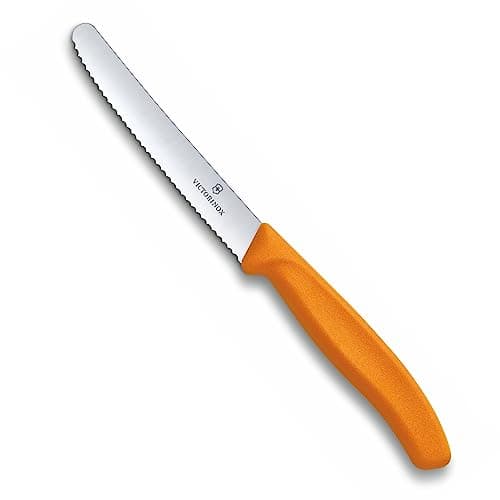
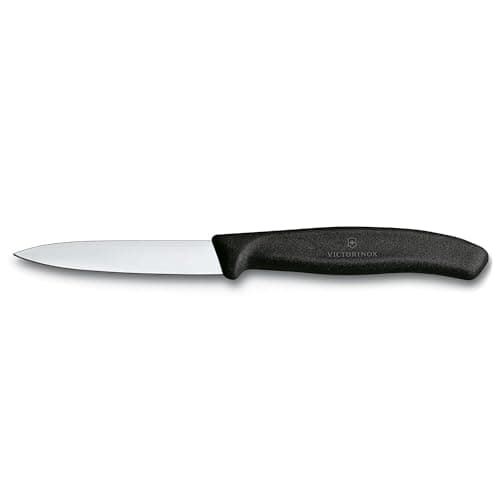
For most children learning to cook, buy the Victorinox Swiss Classic 3.25-inch paring knife — about eight dollars, short, properly sharp and easy to steer. For a younger child, buy the round-tipped tomato and table knife instead and ignore the ranking order below. The counter-intuitive part, and the thing almost every “kids knife” product gets wrong: a dull knife is more dangerous than a sharp one. A dull edge does not bite, so it needs force, and force plus a blade that suddenly skates off a carrot is how people get cut. The safety variables that actually matter are blade length, tip shape and grip security— not bluntness.
The limits of this page, plainly: we are not child-safety specialists and this is not supervision advice.Whether a particular child is ready for a real knife is a judgment for the adult who knows them, and every recommendation here assumes an adult is standing next to them. What we can do honestly is the geometry: which blade shapes ask for the least force, which tips cannot puncture, which handles stay put in a small wet hand, and which steels come back to sharp with no skill. That is what is ranked below, from published specifications and the value math — see how we review. We have not cooked with these knives and we do not have a test lab.
What makes a knife suitable for a learner
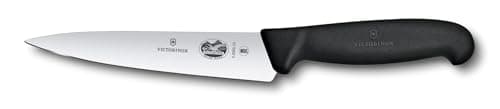
Short.A 3-to-4-inch blade is a short lever: it goes where the hand puts it, and there is far less blade to lose track of. An 8-inch chef's knife in a small hand is unsteerable, which is why it is not the first knife even though it is the most useful knife.
Round-tipped, if you can take the trade. Almost every knife injury to a beginner is either a slip off the food or a jab. A round tip removes the second category entirely. The cost is that you lose piercing and detail work, which for a child learning to slice a banana is not a loss at all.
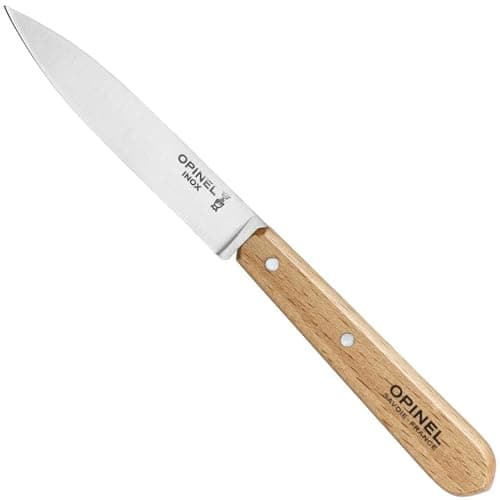
Grippy, not pretty. Wet hands, fruit juice and a smooth wooden handle are a bad combination. Textured polypropylene costs nothing and does not move.
Soft steel, deliberately.A knife that goes blunt is a knife that needs sharpening, and soft Western steel comes back on a honing rod in ten seconds with no technique at all — so the knife stays in the safe state. Hard Japanese steel holds its edge longer and chips if it is dropped or twisted, which is exactly what happens to a knife a child is learning with.
The three things to buy alongside the knife
A board that cannot slide.This is the single biggest safety upgrade on the page and it is not a knife. A board that moves under a tentative cut is how a blade ends up somewhere unexpected. Either a heavy board or a light one on a damp cloth — our cutting board guide ranks the options and covers how board hardness affects the edge.
A honing rod, used by an adult.All four knives here are soft steel on purpose, which means they go blunt and come back easily. Ten seconds before a session keeps the knife in the state that needs least force — how to use a honing steel has the method and honing rods ranks the field, including angle-guided rods that remove the technique. We would not hand a rod to a child to use; it is a long steel spike.
Somewhere the knife lives.Not loose in a drawer where a hand goes looking for something else. An in-drawer organiser or a sheath for one knife solves it for very little — see knife storage.
Why we do not recommend plastic or “safety” knives
Nylon and plastic training knives exist and some families get on with them. We will not rank them, for the same reason we decline to rank novelty-handled cutlery elsewhere on this site: the makers do not publish a steel, a hardness or an edge geometry, because there is not one, and a blade that cannot cut a carrot teaches a child to push hard — which is the habit that causes the injury later with a real knife. If the goal is to keep a very young child busy in the kitchen, they are fine. If the goal is to teach knife skills, the skill being taught by a blunt blade is the wrong one.
The order to teach things in, which the knife does not decide
Grip first (the pinch gripand the claw for the other hand), then flat-faced food only — a halved mushroom, a banana, a courgette cut in two so it cannot roll. Round things get cut in half by an adult first. That single rule removes most of what goes wrong. After that the limiting factor is sharpness, not technique: how to tell if a knife needs sharpening is the test to run before each session.
How we picked
We did not lab-test these knives
Everyone in this category says they tested twenty knives in a professional kitchen. We have not hands-on tested any of these, and we say so. What we did instead: compiled the published specifications — steel type and hardness (HRC), edge angle, blade geometry, weight and build — applied established sharpening standards, ran the value math (spec quality ÷ live price), and scored each product against a published rubric. The scores are judgments from documented research — not measurements we took, because we do not have a test lab and we will not pretend we do. Where a number came from someone else's work, we name them in Sources.