Skip to content
The Edge Bench

Stones, sharpeners & how-to · Sharpening

Knife sharpener reviews: seven types, one rubric

One representative from every family of sharpening tool, re-scored on the same five metrics - so a pull-through, a whetstone and an electric can finally be read against each other.

By Stephen V.Updated How we review
#ad

We earn a commission when you buy through our Amazon links, at no extra cost to you. It never changes a verdict, and we say so when the cheaper knife is the better buy. How this works.

Almost every knife sharpener review compares a tool against its own kind: whetstones against whetstones, electrics against electrics. That is useful once you have already picked a family, and useless before you have. The question most people actually arrive with is the one nobody answers — which kind of sharpener should I own at all — and you cannot answer it by reading seven separate reviews whose scores were never built to be compared.

So this page does something the rest of the site deliberately does not. It takes one representative from each of the seven families we cover, throws away the family-specific rubrics, and re-scores all seven on the same five metrics: edge quality, ease of use, speed, versatility and value. The ranking below is the order those scores fall out in, not an order we chose first and justified afterward. Where a tool ranks lower than you expect, the metric breakdown on its card will show you exactly which metric cost it.

Two things to know before the list. First, the picks are not new: each one is the tool that already leads its own category page here, so the deep review of any of them is one click away. Second, and more important, a cross-family score is a blunt instrument by design. A honing rod scores badly on versatility because it cannot sharpen a dull knife — that is not a criticism of the rod, it is the rod doing its job. Read the metric you care about, not just the average. If you are still working out what these tools even do differently, start with sharpening vs honing and why knives go dull, then come back.

The short answer

Quick picks

#KnifeBest forScorePrice
01
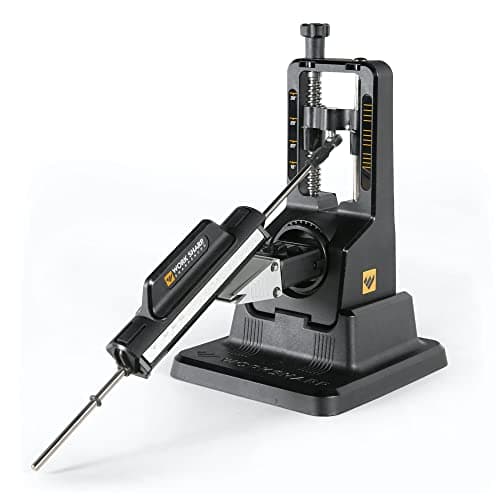
Work Sharp Work Sharp Precision Adjust
Work Sharp Precision Adjust

Top of this list because it loses the fewest points anywhere. A clamp holds the blade, you set the angle anywhere from 15 to 30 degrees, and a rotating Tri-Brasive carries 320- and 600-grit diamond plus a fine ceramic across the edge. It gives you most of what a stone gives you, minus the one skill that stops people learning to use a stone.

Best guided system
8.2
$69.95Amazon
02
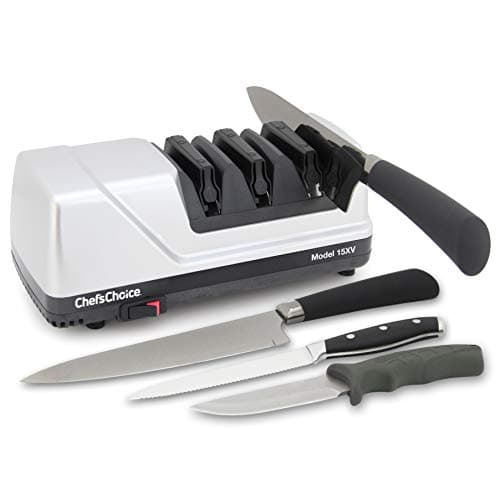
Chef'sChoice Chef'sChoice Trizor 15XV Electric Sharpener
Chef'sChoice Trizor 15XV Electric Sharpener

The fastest way to rescue a drawer of neglected knives, and the most expensive way to own them for a decade. Three stages of 100% diamond abrasives regrind a 20-degree factory edge into Chef'sChoice's keener 15-degree Trizor XV geometry in about a minute, with spring guides holding the angle from heel to tip.

Best electric
7.9
$165.99Amazon
03
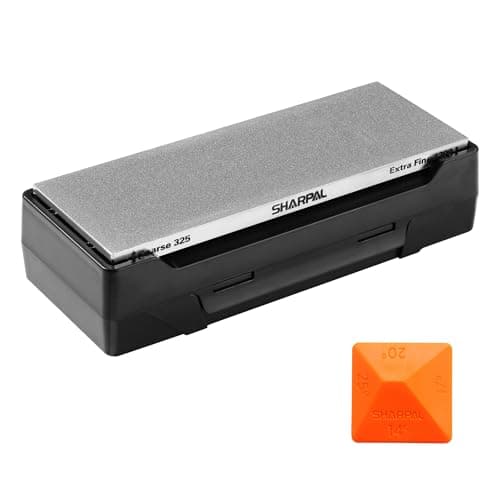
SHARPAL SHARPAL 162N Double-Sided Diamond Stone
SHARPAL 162N Double-Sided Diamond Stone

The bench tool with no upkeep at all. Coarse 325 diamond on one face, fine 1200 on the other, bonded to a rigid 8 by 3 inch plate that never soaks and never needs flattening because it does not dish. It is the fastest hand method for a chipped or badly worn edge, and it is not a finishing stone.

Best diamond plate
7.8
$62.99Amazon
04
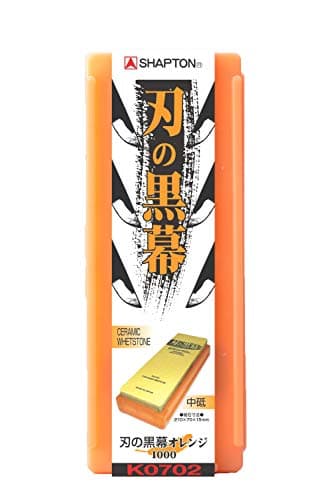
Shapton Shapton Kuromaku 1000 (Orange)
Shapton Kuromaku 1000 (Orange)

The highest ceiling on this page and the steepest climb to reach it. A hard splash-and-go ceramic stone made in Japan: a splash of water and you are cutting, it bites fast, and it holds its shape far longer than a soft soaking stone. Nothing here produces a better edge - and nothing here asks more of you.

Best whetstone
7.7
$39.88Amazon
05
Messermeister Messermeister 12" Ceramic Rod
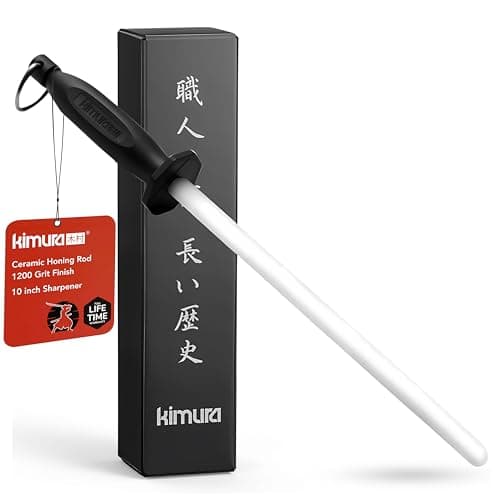
Messermeister 12" Ceramic Rod

The only tool here you should use every week. A 1200-grit ceramic rod has no ridges, so it works by very light abrasion rather than brute realignment - it straightens a rolled edge and lightly refreshes it, which is the correct behavior for hard Japanese steel that a ridged steel rod can chip. Twelve inches reaches any kitchen blade.

Best ceramic rod
7.7
Check price →
06
SHARPAL SHARPAL 205H Double-Sided Leather Strop Kit
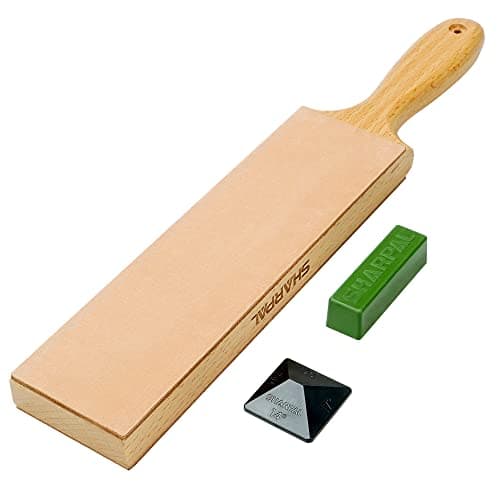
SHARPAL 205H Double-Sided Leather Strop Kit

The step most home cooks skip, on the cheapest tool that does it. Genuine cowhide over a block, smooth on one face and suede on the other, with green polishing compound and a plastic angle guide in the box. It removes the burr a stone leaves behind and polishes the apex - which is often the difference between sharp and unnervingly sharp.

Best strop
7.6
$22.99Amazon
07
KitchenIQ KitchenIQ Edge Grip 2-Stage Sharpener
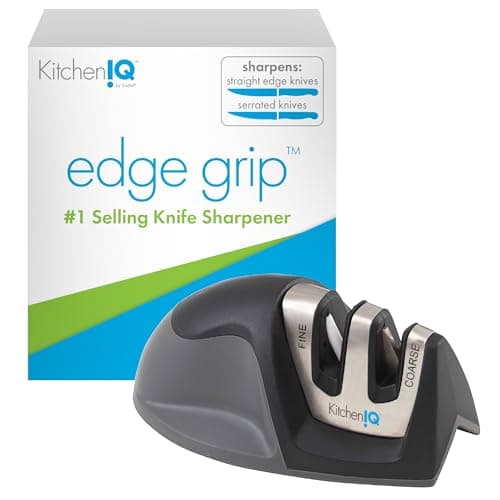
KitchenIQ Edge Grip 2-Stage Sharpener

Last on this page, and still worth owning for one specific job. A coarse carbide slot tears a usable edge back onto a truly wrecked knife in seconds, a fine ceramic slot tidies it, and the grip hooks over the counter edge so it stays put. Treat it as an emergency tool, not a habit.

Best pull-through
7.3
$10.07Amazon

#ad · Live prices from the Amazon Product API, as of Sep 2, 2026. Where we have no verified live price, we show none — a gap beats a number that has rotted.

In detail

The picks, in full

01
Work Sharp Work Sharp Precision Adjust

Best guided system

Work Sharp Precision Adjust

Manual guided system15-30 degree range320 + 600 diamond, fine ceramicV-Block clamp
8.2/10

Top of this list because it loses the fewest points anywhere. A clamp holds the blade, you set the angle anywhere from 15 to 30 degrees, and a rotating Tri-Brasive carries 320- and 600-grit diamond plus a fine ceramic across the edge. It gives you most of what a stone gives you, minus the one skill that stops people learning to use a stone.

Edge quality
9
Ease of use
7.5
Speed
6.5
Versatility
9.5
Value
8.5

Pros

  • The locked angle removes the single hardest part of sharpening
  • 15 to 30 degrees covers keen Japanese and wide Western edges on the same tool
  • Diamond then ceramic is a genuine sharpen-and-refine progression, not one abrasive doing both jobs

Cons

  • Slow next to anything with a motor - budget several minutes per knife
  • Clamping and stroking consistently takes a few knives to learn
  • The clamp was designed around pocket and hunting blades, so very tall or very thin knives sit awkwardly

Don't buy this if…

you want a knife sharpened in ten seconds without paying attention - this asks for your hands and a few minutes.

$69.95View on Amazon

Price as of Sep 2, 2026. Prices change — Amazon's at checkout is the one that counts.

#ad · we may earn a commission from this link to Work Sharp Precision Adjust

02
Chef'sChoice Chef'sChoice Trizor 15XV Electric Sharpener

Best electric

Chef'sChoice Trizor 15XV Electric Sharpener

3-stage electric100% diamond abrasivesConverts 20 to 15 degreesTrizor XV triple-bevel edge
7.9/10

The fastest way to rescue a drawer of neglected knives, and the most expensive way to own them for a decade. Three stages of 100% diamond abrasives regrind a 20-degree factory edge into Chef'sChoice's keener 15-degree Trizor XV geometry in about a minute, with spring guides holding the angle from heel to tip.

Edge quality
8
Ease of use
9.5
Speed
9.5
Versatility
6
Value
6.5

Pros

  • Restores a badly dulled edge faster than anything else here
  • Spring guides make the result repeatable with essentially no skill
  • Diamond abrasives cut modern high-alloy stainless properly, where ceramic wheels glaze

Cons

  • Removes far more steel per sharpening than a stone or a guided system
  • Imposes its own geometry, so a knife you did not want reground gets reground anyway
  • The most expensive tool on this page by a wide margin

Don't buy this if…

you own single-bevel Japanese knives, ceramic blades or a full-bolstered knife - none of those belong in a slot sharpener.

$165.99View on Amazon

Price as of Sep 2, 2026. Prices change — Amazon's at checkout is the one that counts.

#ad · we may earn a commission from this link to Chef'sChoice Trizor 15XV Electric Sharpener

03
SHARPAL SHARPAL 162N Double-Sided Diamond Stone

Best diamond plate

SHARPAL 162N Double-Sided Diamond Stone

Coarse 325 + fine 1200 gritDiamond bonded to a rigid plate8 in x 3 inNo soaking, no flattening
7.8/10

The bench tool with no upkeep at all. Coarse 325 diamond on one face, fine 1200 on the other, bonded to a rigid 8 by 3 inch plate that never soaks and never needs flattening because it does not dish. It is the fastest hand method for a chipped or badly worn edge, and it is not a finishing stone.

Edge quality
7
Ease of use
6.5
Speed
9
Versatility
9
Value
7.5

Pros

  • Cuts any steel, including the hard alloys that stall a water stone
  • Stays flat for its life, so the bevel you grind is the bevel you meant
  • Nothing to maintain - no soak, no lapping plate, no pencil grid

Cons

  • Stops at 1200 diamond mesh, so it cannot leave a polished finish
  • Diamond grit ratings are not comparable to Japanese waterstone numbers, which trips up beginners
  • Freehand, so it demands the same angle control a whetstone does

Don't buy this if…

you want a keen polished apex - finish on a fine water stone or a strop instead.

$62.99View on Amazon

$69.9910% off

Price as of Sep 2, 2026. Prices change — Amazon's at checkout is the one that counts.

#ad · we may earn a commission from this link to SHARPAL 162N Double-Sided Diamond Stone

04
Shapton Shapton Kuromaku 1000 (Orange)

Best whetstone

Shapton Kuromaku 1000 (Orange)

1000 grit ceramicSplash-and-go, no soakHard binder, holds flatMade in Japan
7.7/10

The highest ceiling on this page and the steepest climb to reach it. A hard splash-and-go ceramic stone made in Japan: a splash of water and you are cutting, it bites fast, and it holds its shape far longer than a soft soaking stone. Nothing here produces a better edge - and nothing here asks more of you.

Edge quality
9
Ease of use
6
Speed
6.5
Versatility
9.5
Value
7.5

Pros

  • The keenest, cleanest edge of any tool on this page
  • Works on any steel at any angle you choose, on any blade shape
  • Splash-and-go means no planning - wet it and start

Cons

  • Freehand, so a beginner's first several knives will come out worse than a guided system's
  • A single 1000 grit, so there is no built-in polishing step
  • Hard stones give less tactile feedback than a soft one, which slows the learning curve further

Don't buy this if…

you will not put in the practice - an unlearned stone is the one tool here that produces a duller knife than you started with.

$39.88View on Amazon

Price as of Sep 2, 2026. Prices change — Amazon's at checkout is the one that counts.

#ad · we may earn a commission from this link to Shapton Kuromaku 1000 (Orange)

05
Messermeister Messermeister 12" Ceramic Rod

Best ceramic rod

Messermeister 12" Ceramic Rod

1200-grit ceramic12 in rodHones and lightly sharpensSuits 58-62 HRC steel
7.7/10

The only tool here you should use every week. A 1200-grit ceramic rod has no ridges, so it works by very light abrasion rather than brute realignment - it straightens a rolled edge and lightly refreshes it, which is the correct behavior for hard Japanese steel that a ridged steel rod can chip. Twelve inches reaches any kitchen blade.

Edge quality
7
Ease of use
8
Speed
9.5
Versatility
6.5
Value
7.5

Pros

  • Thirty seconds of work restores most of the bite a week of cutting took away
  • Ceramic refreshes as it straightens, where a plain steel rod only straightens
  • Longer than any kitchen blade, so the whole edge gets stroked

Cons

  • Cannot sharpen a genuinely dull knife - when honing stops working, you need a stone
  • Ceramic chips or cracks if you drop it on a hard floor
  • Needs wiping down as steel residue loads the surface

Don't buy this if…

you were looking for a sharpener - a rod maintains an edge that already exists and restores nothing that is truly gone.

Check price on Amazon →

No buyable offer at the last price check (Sep 2, 2026). We show nothing rather than a stale number.

#ad · we may earn a commission from this link to Messermeister 12" Ceramic Rod

06
SHARPAL SHARPAL 205H Double-Sided Leather Strop Kit

Best strop

SHARPAL 205H Double-Sided Leather Strop Kit

13.2 in x 2.44 in blockSmooth + suede cowhide facesGreen polishing compound includedAngle guide included
7.6/10

The step most home cooks skip, on the cheapest tool that does it. Genuine cowhide over a block, smooth on one face and suede on the other, with green polishing compound and a plastic angle guide in the box. It removes the burr a stone leaves behind and polishes the apex - which is often the difference between sharp and unnervingly sharp.

Edge quality
7
Ease of use
8.5
Speed
9
Versatility
5
Value
8.5

Pros

  • Turns a competent stone edge into a noticeably keener one in under a minute
  • Two leather faces cover deburring and final polishing on one block
  • The cheapest meaningful upgrade available to anyone who already sharpens

Cons

  • Sharpens nothing - it only refines an edge that is already there
  • Stropping backwards, into the edge instead of spine-first, rounds the apex and undoes the work
  • The included compound loads up and the leather needs recharging periodically

Don't buy this if…

you do not own a stone or a guided system yet - stropping is the last step of a process you have not started.

$22.99View on Amazon

Price as of Sep 2, 2026. Prices change — Amazon's at checkout is the one that counts.

#ad · we may earn a commission from this link to SHARPAL 205H Double-Sided Leather Strop Kit

07
KitchenIQ KitchenIQ Edge Grip 2-Stage Sharpener

Best pull-through

KitchenIQ Edge Grip 2-Stage Sharpener

2-stage pull-throughCoarse carbide + fine ceramicEdge-grip counter baseThe cheapest tool here
7.3/10

Last on this page, and still worth owning for one specific job. A coarse carbide slot tears a usable edge back onto a truly wrecked knife in seconds, a fine ceramic slot tidies it, and the grip hooks over the counter edge so it stays put. Treat it as an emergency tool, not a habit.

Edge quality
5.5
Ease of use
8.5
Speed
8
Versatility
5.5
Value
9

Pros

  • Costs less than a takeout lunch and needs no skill whatsoever
  • The carbide stage revives a knife nobody has touched in years
  • The edge-grip base makes it stable and safe to pull one-handed

Cons

  • Carbide tears metal away rather than grinding it, so the edge it leaves is coarse and dulls quickly
  • The fixed angle is wrong for keen Japanese edges and will regrind them wider
  • Used weekly it will visibly shorten the life of a good knife

Don't buy this if…

you care about the knives you own - every other tool on this page is kinder to steel than this one.

$10.07View on Amazon

Price as of Sep 2, 2026. Prices change — Amazon's at checkout is the one that counts.

#ad · we may earn a commission from this link to KitchenIQ Edge Grip 2-Stage Sharpener

The five metrics, and what actually moves them

A cross-family score is only honest if you can see the rubric, so here it is in full. Edge qualityis the best edge the tool can produce in competent hands — a ceiling, not an average. Ease of use is how much skill stands between you and that ceiling, which is why the whetstone and the electric sit at opposite ends of the same page. Speed is wall-clock time from dull knife to sharp knife, including setup. Versatility is the range of steels, angles and blade shapes the tool handles, and it is where single-purpose tools like the rod and the strop lose points that are not really faults. Value is capability against the live price shown on the card, which is the metric most likely to move without a word of this page changing.

Averaging those five is a deliberate flattening. It puts a tool that is excellent at one thing below a tool that is good at five, which is the right answer for a reader choosing a first sharpener and the wrong answer for a reader who already knows they want a polished Japanese edge. If you are in the second group, read the edge quality row and ignore the average entirely.

Why the guided system wins and the whetstone does not

The stone has the highest edge-quality score on this page and finishes fourth. That is not a hedge, it is the arithmetic: freehand sharpening costs it three points of ease of use and gives nothing back on speed, and four of five metrics do not care how good your edges will be in two years. The guided system reaches nearly the same ceiling with the angle held for you, which is the difference between a tool most people master and a tool most people abandon in a drawer.

None of that means buy the guided system. It means that if you are honest with yourself about whether you will practice, the answer is already obvious. People who will practice should buy the stone — it is cheaper, it outlasts everything else here, and its ceiling is genuinely higher. People who will not should buy the guided system and stop feeling bad about it. Our guided systems roundup and whetstone roundup go deep on each field.

What each family is actually for

Whetstone. Restores an edge from scratch, at whatever angle you hold, on any steel. The reference tool, and the one with a learning curve. The step-by-step whetstone guide walks the motion, and whetstone grits explained decodes the numbers.

Guided system. The same job as a stone with the angle set mechanically. The specification that matters is angle range: a system whose keenest setting is 17 degrees will slowly thicken a 15-degree Japanese edge every time you use it.

Electric.Motorized abrasive wheels, fixed geometry, about a minute per knife. Check the machine's angle before anything else, and never feed it a serrated, single-bevel or ceramic blade. See the electric sharpener roundup for the full field.

Diamond plate. Industrial diamond on a rigid backing. Cuts anything, never dishes, tops out coarser than a fine water stone. The right tool for chip repair and for people who will not maintain a stone. Best diamond sharpening stones compares the plates.

Honing rod. Maintenance, not sharpening. It straightens an edge that has rolled and removes little or no metal, which is why it feels miraculous on a week-old edge and does nothing for a genuinely worn one. Honing rod materials explains why ridged steel, smooth steel, ceramic and diamond are four different tools wearing the same shape.

Strop.The finishing step. Leather, usually charged with a fine compound, stroked spine-first away from the edge to remove the burr sharpening leaves and polish the apex. Optional, cheap, and the fastest improvement available to anyone who already sharpens — sharpening vs stropping covers the mechanism.

Pull-through. A carbide slot that tears metal and a ceramic slot that tidies up after it. Genuinely useful once, on a knife nobody has maintained in years, and corrosive to a good blade if it becomes the routine.

The two claims to distrust in any sharpener review

The first is a tested-edge claim with no method attached. Publishers routinely report that a sharpener "produced a sharper edge" without naming a measurement, and a sharpness figure with no test protocol behind it is a vibe with a number stapled to it. We do not run a lab either, which is exactly why nothing on this page claims a measured sharpness result — the scores here are judgments from published specifications and established sharpening standards, and how we review sets out the method in full.

The second is a grit number quoted across abrasive types as if it meant one thing. A 325-grit diamond plate, a 325-grit Japanese water stone and a 325-grit belt are three different rates of metal removal, because the scales are not the same scale. When a review ranks tools by grit number alone, it is comparing measurements that were never commensurable. Buy by intent — repair, sharpen, refine, polish — and treat grit numbers as within-family shorthand only.

Buy one of these, then buy the rod

If you take one thing from this page: the highest-return purchase in the whole category is not the sharpener, it is the pairing. One tool that restores an edge — stone, guided system, diamond plate or electric — plus a rod you use weekly. The rod is what keeps you off the sharpener for months at a time, and months between sharpenings is what actually preserves a knife, because every sharpening is metal you never get back. How often to sharpen knives puts real intervals on that, and the cutting board guide covers the single largest variable in how fast your edge dies in the first place.
How we picked

We did not lab-test these knives

Everyone in this category says they tested twenty knives in a professional kitchen. We have not hands-on tested any of these, and we say so. What we did instead: compiled the published specifications — steel type and hardness (HRC), edge angle, blade geometry, weight and build — applied established sharpening standards, ran the value math (spec quality ÷ live price), and scored each product against a published rubric. The scores are judgments from documented research — not measurements we took, because we do not have a test lab and we will not pretend we do. Where a number came from someone else's work, we name them in Sources.

Questions

Frequently asked

What is the best type of knife sharpener?
Scored across all five of our metrics, a guided angle system comes out ahead: it reaches close to whetstone edge quality with the angle held mechanically, and it handles both Japanese and Western angles. A whetstone has a higher ceiling and costs less, but only if you will practice freehand. An electric is faster and far more forgiving, at the cost of substantially more steel removed from every knife.
Why does the whetstone rank below the electric here?
Because four of the five metrics are not about the best edge achievable. The stone scores highest on edge quality and versatility and lowest on ease of use, and the average flattens that. If edge quality is what you care about, read that row and disregard the overall — the ranking is a starting point for people choosing a first sharpener, not a verdict on which tool is capable of more.
Do I need a honing rod as well as a sharpener?
Yes, and it is the cheaper half of the pair. Honing realigns an edge that has rolled over with use and removes essentially no metal, so it restores most of the bite in about thirty seconds and can be done weekly. Sharpening grinds a new apex and costs you steel permanently. Doing the first often is what lets you do the second rarely — sharpening vs honing covers the distinction properly.
Are pull-through sharpeners really that bad?
For a good knife, yes. The carbide stage tears metal away instead of grinding it, leaving a coarse edge that dulls quickly, and the fixed angle regrinds a keen 15-degree Japanese edge to a wider Western one. As a one-off rescue for a knife that is already ruined, it is the fastest cheap fix available. As a weekly ritual it will noticeably shorten a knife's life.
Is a strop worth buying?
Only if you already sharpen. A strop removes the burr left by a stone and polishes the apex, which is a real and noticeable improvement — but it cannot sharpen anything, so it is a finishing step for a process you have to already be doing. If you own a stone or a guided system, it is the cheapest worthwhile upgrade on this page.
Can one sharpener handle both Japanese and German knives?
A whetstone, a diamond plate and a guided system all can — the first two because you set the angle with your hands, the third because you set it with a dial. Fixed-angle electrics and pull-throughs cannot: they impose one geometry on whatever you feed them. Knife sharpening angles explains the roughly 15-degree versus 20-degree split and how to hold each.
How do you score these without testing them?
We compile the manufacturer's published specifications — abrasive type and grit, angle range, stage count, materials and dimensions — apply established sharpening standards to what those specifications imply, and run value math against a live price pulled daily. We do not have a test lab and we do not claim measured sharpness results. The full method is at how we review.

Keep reading

Receipts

Sources

We do not run a testing lab, and we do not pretend to. Where a spec or a measured number came from someone else's work — a manufacturer's page, a published standard — we name them and link them. Where we could not verify something, we say so on the page rather than quietly leaving it out. Read our full method.