Skip to content
The Edge Bench

Decision guides · Buying Guides

The best wood cutting boards, ranked by species and grain

Wooden boards are sold on looks and decided by two numbers. Janka hardness tells you how much the surface abrades an edge; grain direction tells you how the blade enters it.

Teakhaus Teakhaus Edge-Grain Teak 18 x 14 x 1 (Medium)

Our top pick · Best overall and the cheapest here

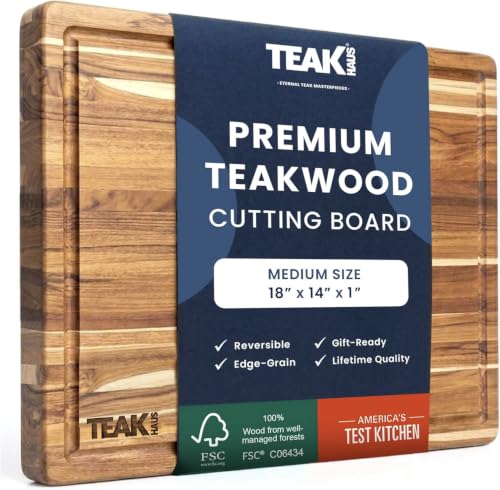
Teakhaus Edge-Grain Teak 18 x 14 x 1 (Medium)

8.5

The best wood cutting board for most kitchens, and the cheapest board on this page. Edge-grain teak at a published ~1,070 lbf Janka - meaningfully softer than hard maple's 1,450 - FSC certified, 18 by 14 inches with a juice groove and grip handles, reversible, and naturally oily enough to forgive the treatment you will forget.

$57.00Amazon

#ad · Full ranking below

By Stephen V.Updated How we review
#ad

We earn a commission when you buy through our Amazon links, at no extra cost to you. It never changes a verdict, and we say so when the cheaper knife is the better buy. How this works.

The Teakhaus edge-grain teak 18"x14" is the best wood cutting board for most kitchens, and the most useful thing about it is that it is also the cheapest board on this page. Teak is published at roughly 1,070 lbf on the Janka scale against hard maple's 1,450, so it abrades an edge measurably less; it has the largest working area here at 18 by 14 inches; it is FSC certified and reversible; and because teak is a naturally oily species it forgives the missed oiling that kills most hardwood boards. If you own a hard Japanese knife, the upgrade is the Sonder Alfred end-grain walnut — the only end-grain board here and the kindest surface on the page by construction.

Having the top pick and the budget pick be the same board is unusual and we are naming it rather than inventing a separate "value" winner to tidy up the page. The cheapest wood board in our registry that does the job properly is also the one that scores highest on our rubric, and that is a genuinely useful result.

We do not print a price in the prose, because prices move and a sentence cannot. The Quick Picks table carries the live price and the date we pulled it, with a Check price button on every row.

The two published facts that decide a wooden board

Hardwood boards are marketed on grain patterns, provenance stories and finish. The two things that actually determine what the board does to your knife are both published, and neither is usually on the listing.

Janka hardness, which is the species. The Janka test measures the force needed to embed a steel ball halfway into a sample, and it is the standard number for comparing timber hardness. The three species on this page, as published by The Wood Database: black walnut at about 1,010 lbf, teak at about 1,070 lbf and hard maple at about 1,450 lbf. A softer surface lets the edge sink in fractionally and come out unharmed; a harder one abrades the apex on every stroke. Walnut and teak are meaningfully kinder to a knife than maple, and the difference is not small — maple is roughly 40 per cent harder than either.

One honesty note on the teak figure. Janka values for teak vary by source and by whether the timber is native or plantation-grown; The Wood Database publishes 1,070 lbf and other charts run from roughly 1,000 to 1,155. We use the published 1,070 and treat the spread as real uncertainty rather than quoting the most flattering number.

Grain direction, which is the construction. End grain presents the cut ends of the fibers upward, so the blade enters between them like bristles in a brush and the fibers close again afterwards. It is the kindest surface a hardwood board can have, and it is the most expensive to make because it is dozens of small blocks glued face to face. Edge grain presents the long sides of the fibers, so the blade cuts across them. Less kind than end grain, far kinder than any hard surface, and what the great majority of good boards in real kitchens are.

When the two facts conflict — which is most of the time

This is the interesting part of the category and it is why a wood-only page is worth building. The two properties do not line up.

The kindest board here is end-grain walnut: the softest species, in the best grain orientation. It should win on edge kindness alone and it does, scoring a ten. But it costs roughly three times the teak board, needs regular oiling because end-grain construction has far more exposed fiber to dry out, and has a smaller working surface.

The most durable board here is edge-grain hard maple: the hardest species, at 1.25 inches thick and eight pounds, resurfaceable for decades. It is the one that will still be in your kitchen in twenty years, and it is the harshest surface on the page.

Teak sits in the middle and wins because it is nearly as soft as walnut, needs the least maintenance of any species here, gives you the biggest surface, and costs the least. On a rubric that counts all five things rather than edge kindness alone, that combination is hard to beat.

What about bamboo?

Do not buy it, and this is the one board material we actively advise against. Bamboo is a grass rather than a timber; it is harder than the hardwoods used for good boards, it contains abrasive silica, and the glue lines between its strips are harder again. A bamboo board is a hard surface sold as a wooden one. There is no bamboo board on this page for that reason, not because the registry lacks one.

How we ranked them — and why the scores differ from our other board pages

Five metrics, the same five for all five boards, and they are judgments from published specifications rather than lab measurements — how we review says so in those words.

Edge kindness is what the surface does to a blade, from Janka hardness and grain direction. Grain & species is the quality of the material and construction choice itself. Stability is whether it stays put under real work. Maintenance is how much oiling it needs and how forgiving it is when you forget. Value is working area and expected life against price.

Two of these boards also appear on best cutting boards for knives and three on best cutting boards under $100, and their scores here are different. That is deliberate and it is because the rubric is different. Those pages score across all materials and weigh build; this one introduces grain and species as a metric in its own right and adds maintenance, which only means something when every candidate is wood. Scoring the same board against different metrics and getting the same number would be the dishonest outcome, not this one.

The short answer

Quick picks

#KnifeBest forScorePrice
01
Teakhaus Teakhaus Edge-Grain Teak 18 x 14 x 1 (Medium)
Teakhaus Edge-Grain Teak 18 x 14 x 1 (Medium)

The best wood cutting board for most kitchens, and the cheapest board on this page. Edge-grain teak at a published ~1,070 lbf Janka - meaningfully softer than hard maple's 1,450 - FSC certified, 18 by 14 inches with a juice groove and grip handles, reversible, and naturally oily enough to forgive the treatment you will forget.

Best overall and the cheapest here
8.5
$57.00Amazon
02
Sonder Los Angeles Sonder Los Angeles Alfred End-Grain Walnut Board
Sonder Los Angeles Alfred End-Grain Walnut Board

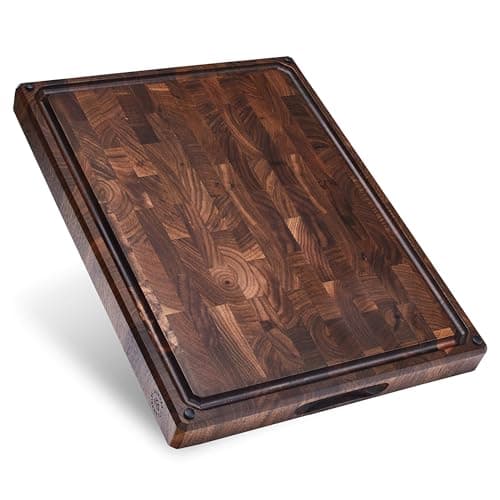
The kindest surface on this page and the right board for a hard Japanese knife. End-grain black walnut - the softest species here at a published ~1,010 lbf Janka, in the grain orientation that lets a blade enter between the fibers rather than across them - 17 by 13 by 1.5 inches, reversible with a juice groove.

A hard Japanese knife, and the kindest surface available
8.4
$179.99Amazon
03
John Boos John Boos Chop-N-Slice Maple 18 x 12 x 1.25
John Boos Chop-N-Slice Maple 18 x 12 x 1.25

The board that will outlive every other on this page, and the hardest surface on it. Edge-grain Northern Hard Rock Maple at a published ~1,450 lbf Janka, 1.25 inches thick and 8 pounds, made in the USA - thick enough to be sanded flat and re-oiled for decades, which is what separates a twenty-year board from a three-year one.

Stability and a twenty-year life
8.1
$56.31Amazon
04
John Boos John Boos R-Board Walnut 18 x 12
John Boos R-Board Walnut 18 x 12

The soft species in Boos's build quality, and the most expensive board on this page. Edge-grain American black walnut at a published ~1,010 lbf Janka, 18 by 12 inches and reversible - the kindest edge-grain surface here, from the oldest butcher-block maker in the US, at a price that is hard to justify against the teak.

Walnut in edge grain, from an American maker
7.6
$158.91Amazon
05
Virginia Boys Kitchens Virginia Boys Kitchens Walnut Board (8 x 17, with handle)
Virginia Boys Kitchens Walnut Board (8 x 17, with handle)

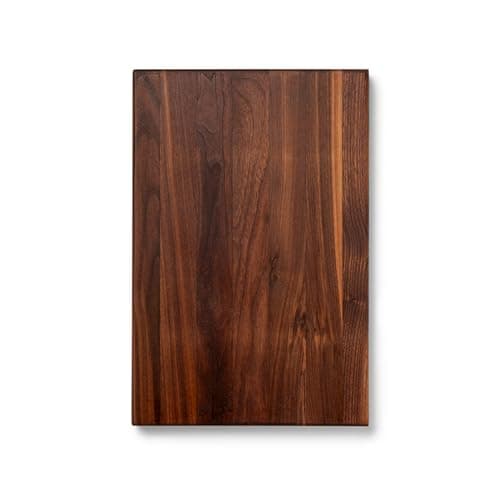
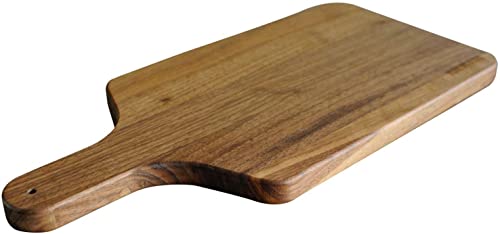
Solid American black walnut at the softest published hardness on the page, in the narrowest format on it. One piece of walnut at ~1,010 lbf Janka, 8 by 17 inches including an integrated handle, made in the USA - a kind surface and a serving-board footprint rather than a prep-board one.

A kind surface in a narrow, serving-board format
7.6
$67.95Amazon

#ad · Live prices from the Amazon Product API, as of November 23, 2026. Where we have no verified live price, we show none — a gap beats a number that has rotted.

In detail

The picks, in full

01
Teakhaus Teakhaus Edge-Grain Teak 18 x 14 x 1 (Medium)

Best overall and the cheapest here

Teakhaus Edge-Grain Teak 18 x 14 x 1 (Medium)

Edge-grain teak, FSC certified18 x 14 x 1 in, reversibleJanka ~1,070 lbfJuice groove + grip handles
8.5/10

The best wood cutting board for most kitchens, and the cheapest board on this page. Edge-grain teak at a published ~1,070 lbf Janka - meaningfully softer than hard maple's 1,450 - FSC certified, 18 by 14 inches with a juice groove and grip handles, reversible, and naturally oily enough to forgive the treatment you will forget.

Edge kindness
8.5
Grain & species
8
Stability
7
Maintenance
9.5
Value
9.5

Pros

  • A published ~1,070 lbf Janka against hard maple's 1,450 - a real, documented reduction in how hard the surface is
  • Largest working area on the page at 18 x 14 inches, and reversible so one face can stay groove-free
  • Teak's natural oil content means it tolerates far less frequent treatment than maple or walnut
  • Light for its size with cut-in grip handles - the easiest big board here to lift and carry to a sink
  • FSC certified, which is an audited chain-of-custody standard rather than a marketing adjective

Cons

  • One inch thick and light, so it shifts on a counter more than the 8-pound maple board - it wants a damp cloth underneath
  • Thinner stock means less resurfacing life than a 1.25-inch board
  • Edge grain rather than end grain, so it is not the kindest construction available at any price
  • Teak's silica content is a real concern for woodworking tools; it is harmless to kitchen knives, and it is why teak dulls saw blades

Don't buy this if…

…you chop hard and hate a board that moves - the John Boos maple below is three times the weight and stays exactly where you put it.

It wins on maintenance and value and finishes second on edge kindness, and that combination is the whole argument. The boards that beat it on surface kindness cost three times as much; the board that beats it on stability is harder on your knives and needs oiling more often.

The maintenance point is the practical one and it decides more purchases than people admit. Teak is a naturally oily, rot-resistant species — the reason it is used for boat decks — and in a kitchen that becomes a board that forgives a missed oiling in a way hard maple and walnut do not. If the reason you do not own a wooden board is that you know you will not look after it, this is the hardwood to try before giving up and buying plastic.

The 18 by 14 inch footprint also deserves credit. Working area is the specification people under-buy most often: a board too small to hold a broken-down chicken plus the bones forces you to work in stages. This is the largest here and the lightest big board here, which is a rare pair.

Its one real weakness is weight. At one inch and light for its size it moves under heavy chopping, and a damp cloth underneath fixes that completely — it is just a thing you have to remember.

$57.00View on Amazon

Price as of November 23, 2026. Prices change — Amazon's at checkout is the one that counts.

#ad · we may earn a commission from this link to Teakhaus Edge-Grain Teak 18 x 14 x 1 (Medium)

02
Sonder Los Angeles Sonder Los Angeles Alfred End-Grain Walnut Board

A hard Japanese knife, and the kindest surface available

Sonder Los Angeles Alfred End-Grain Walnut Board

End-grain walnut17 x 13 x 1.5 inReversible with juice grooveRequires oiling
8.4/10

The kindest surface on this page and the right board for a hard Japanese knife. End-grain black walnut - the softest species here at a published ~1,010 lbf Janka, in the grain orientation that lets a blade enter between the fibers rather than across them - 17 by 13 by 1.5 inches, reversible with a juice groove.

Edge kindness
10
Grain & species
9.5
Stability
9
Maintenance
6.5
Value
7

Pros

  • End grain plus the softest species on the page - the two properties that decide edge kindness, both maximized, which nothing else here manages
  • Black walnut's published ~1,010 lbf Janka is the lowest here, roughly 30 per cent softer than hard maple
  • 1.5 inches thick and heavy, so it is genuinely stable under hard work
  • End-grain construction partially self-heals: cut fibers close again rather than staying scored
  • Reversible with a juice groove, so one face can stay flat for general prep

Cons

  • Roughly three times the price of the teak board for a kinder surface and a smaller working area
  • End grain has far more exposed fiber end, so it dries out faster and genuinely needs oiling on a schedule
  • Heavy and thick, which is good for stability and awkward for storage and washing
  • 17 x 13 inches is smaller than the teak board, so you are paying more for less surface

Don't buy this if…

…you will not oil it on a schedule - a neglected end-grain board cracks along its glue lines and that is terminal, so the teak board is both cheaper and safer.

It scores a ten on edge kindness, the only ten on this page, and it does not win. That is worth explaining rather than glossing over, because it is the honest result of counting more than one thing.

On the surface itself nothing here is close. End-grain construction in the softest species available is the best possible combination for a knife edge, and if you own a 60-plus HRC Japanese blade with a 15-degree grind — the kind of edge that is keen precisely because there is very little steel at the apex — this is the board that preserves it. Our best Japanese knives under $100 page makes the same point from the knife side: board discipline matters more for a hard thin edge than for a soft German one.

What stops it winning is maintenance and value. End grain exposes vastly more fiber end to the air, so it dries and needs oil more often than any other construction, and neglect does not just dull the finish — it opens the glue lines, which ends the board. Combined with roughly three times the teak's price for a smaller surface, it is the specialist choice rather than the default one.

It is the top pick on best cutting boards for knives, where the rubric weighs build rather than maintenance and the comparison set includes rubber and composite. Both results are honest; they are answers to different questions.

$179.99View on Amazon

Price as of November 23, 2026. Prices change — Amazon's at checkout is the one that counts.

#ad · we may earn a commission from this link to Sonder Los Angeles Alfred End-Grain Walnut Board

03
John Boos John Boos Chop-N-Slice Maple 18 x 12 x 1.25

Stability and a twenty-year life

John Boos Chop-N-Slice Maple 18 x 12 x 1.25

Edge-grain Northern Hard Rock Maple18 x 12 x 1.25 in, 8 lbJanka ~1,450 lbfMade in the USA
8.1/10

The board that will outlive every other on this page, and the hardest surface on it. Edge-grain Northern Hard Rock Maple at a published ~1,450 lbf Janka, 1.25 inches thick and 8 pounds, made in the USA - thick enough to be sanded flat and re-oiled for decades, which is what separates a twenty-year board from a three-year one.

Edge kindness
7
Grain & species
7.5
Stability
9.5
Maintenance
7
Value
9.5

Pros

  • 8 pounds and 1.25 inches thick - it stays put under heavy work without a cloth underneath, the only board here that does
  • Thick enough to be scraped, sanded flat and re-oiled repeatedly, so knife scars are a maintenance item rather than the end of the board
  • John Boos has made American butcher block since the 1880s and publishes species, grain, thickness, weight and finish
  • Eased corners and finger grips, so 8 pounds is still liftable with wet hands
  • Published American manufacture, which the 'best wood cutting board brands' query is largely asking about

Cons

  • Hard maple at a published ~1,450 lbf is the harshest surface on this page - roughly 40 per cent harder than the teak or walnut boards
  • Needs mineral oil or board cream every month or two and will dry and split along its glue lines if neglected
  • Never dishwasher safe and must never be soaked
  • 18 x 12 inches is a smaller working area than the teak board for more money

Don't buy this if…

…your best knife is a hard, thin Japanese blade - maple is the hardest wood here and the walnut or teak boards are measurably kinder to that kind of edge.

Third, and it is the board to buy if your priority is a surface you will never replace. It scores highest here on stability and ties the teak on value, and it loses on the metric the page is organized around: it is the hardest wood on it.

Thickness is the specification people under-rate most. A 1.25-inch slab can be scraped and sanded flat several times over its life and re-oiled indefinitely, so a scored surface is a chore rather than a write-off. A half-inch board cannot be resurfaced at all. That is most of why this costs what it costs, and it is a genuinely good reason.

The hardness cost is real but it should be kept in proportion. Hard maple is harder than walnut or teak and dramatically softer than glass, stone, ceramic or bamboo. A knife used on maple and honed weekly will be sharper than the same knife used on walnut and never honed — why knives go dull puts board abrasion alongside the other causes, and how often to sharpen knives is the habit that matters more.

It is the top pick on best cutting boards under $100, where the comparison set includes plastic and rubber and the rubric weighs build rather than species.

$56.31View on Amazon

$59.956% off

Price as of November 23, 2026. Prices change — Amazon's at checkout is the one that counts.

#ad · we may earn a commission from this link to John Boos Chop-N-Slice Maple 18 x 12 x 1.25

04
John Boos John Boos R-Board Walnut 18 x 12

Walnut in edge grain, from an American maker

John Boos R-Board Walnut 18 x 12

Edge-grain walnut18 x 12 inReversibleRequires oiling
7.6/10

The soft species in Boos's build quality, and the most expensive board on this page. Edge-grain American black walnut at a published ~1,010 lbf Janka, 18 by 12 inches and reversible - the kindest edge-grain surface here, from the oldest butcher-block maker in the US, at a price that is hard to justify against the teak.

Edge kindness
8.5
Grain & species
8.5
Stability
8
Maintenance
6.5
Value
6.5

Pros

  • Black walnut's published ~1,010 lbf Janka is the softest species on this page - kinder to an edge than the maple board above
  • John Boos build quality and published American manufacture, with species and grain stated
  • Reversible, so one face can be kept for raw work and the other for prep
  • The best-looking board here by a distance, which is a legitimate reason to buy a board you will see every day
  • Edge grain rather than end grain means fewer glue lines to open up than the Sonder

Cons

  • The most expensive board on this page, for a surface the teak board nearly matches at a fraction of the cost
  • Walnut needs oiling as diligently as maple and has none of teak's natural oil content to fall back on
  • 18 x 12 inches is a smaller working area than the cheaper teak board
  • Thinner than the Chop-N-Slice, so less resurfacing life for more money

Don't buy this if…

…you are buying on merit rather than on looks - the teak board is softer-than-maple too, bigger, lower maintenance and far cheaper, which is most of this page's argument.

Fourth, and the board that most clearly illustrates what this page is for. On species and grain it scores above the maple Chop-N-Slice: walnut is roughly 30 per cent softer than hard maple and that is a published, documented difference. On price it is the highest here.

Put those together and the uncomfortable conclusion is that you are paying a substantial premium over the teak board for a surface of roughly equivalent kindness, a smaller working area and higher maintenance. The honest justification is appearance: walnut is a beautiful timber and a Boos walnut board is a nice object to have on a counter. That is a real reason and we are not going to pretend it is not, but it is not a performance reason.

It is ranked third on best cutting boards for knives. If what you want is walnut specifically and end grain is out of budget, this is the board; if what you want is the softest affordable surface, the teak at the top of this page is the better buy.

$158.91View on Amazon

$212.1125% off

Price as of November 23, 2026. Prices change — Amazon's at checkout is the one that counts.

#ad · we may earn a commission from this link to John Boos R-Board Walnut 18 x 12

05
Virginia Boys Kitchens Virginia Boys Kitchens Walnut Board (8 x 17, with handle)

A kind surface in a narrow, serving-board format

Virginia Boys Kitchens Walnut Board (8 x 17, with handle)

Solid American black walnut8 x 17 in incl. handleJanka ~1,010 lbfMade in the USA
7.6/10

Solid American black walnut at the softest published hardness on the page, in the narrowest format on it. One piece of walnut at ~1,010 lbf Janka, 8 by 17 inches including an integrated handle, made in the USA - a kind surface and a serving-board footprint rather than a prep-board one.

Edge kindness
8.5
Grain & species
8
Stability
6.5
Maintenance
7
Value
8

Pros

  • Walnut's published ~1,010 lbf Janka ties the softest species here - genuinely kind to an edge
  • Solid one-piece walnut rather than glued strips, so there are no glue lines to open up
  • Published American manufacture at the lowest price of any walnut board here
  • The integrated handle makes it the best board here for carrying food to a table
  • Narrow format stores upright easily, which a big square board does not

Cons

  • 8 inches wide including the handle is the narrowest working surface on this page by a long way - it is not a prep board
  • Light and narrow, so it slides under real chopping and needs a cloth underneath
  • Solid one-piece stock is more prone to cup and warp over time than a glued-up board
  • Needs oiling as often as any walnut board, with no natural oil content to help

Don't buy this if…

…this is your only board - the usable surface is too narrow for real prep, and the teak board gives you more than twice the working area for less money per square inch.

It ties the Boos R-Board on the rubric and sits last on a stated tie-break: the R-Board takes the position on working area and build, which are the two things that decide whether a board is a prep surface or an accessory. This one is an accessory, and a good one.

What it does well is genuinely useful. Walnut at the softest published hardness here, solid rather than glued, American-made, with a handle — it is the board you carry cheese, bread or a sliced steak to the table on, and the surface is kind enough that slicing on it costs your knife nothing.

What it cannot do is be your main board. Eight inches wide including the handle leaves very little room to work, and one-piece solid stock is more inclined to cup over the years than a properly glued-up board where alternating grain directions oppose each other.

It is ranked fifth on best cutting boards under $100 with the same reasoning: kindest wood in the set, narrowest format in it.

$67.95View on Amazon

$75.009% off

Price as of November 23, 2026. Prices change — Amazon's at checkout is the one that counts.

#ad · we may earn a commission from this link to Virginia Boys Kitchens Walnut Board (8 x 17, with handle)

Which wood board should you actually buy?

One board for everything.The Teakhaus 18"x14". Biggest surface, softer than maple, lowest maintenance, cheapest. Put a damp cloth under it.

You own a hard Japanese knife. The Sonder end-grain walnut. The kindest surface here by construction, and the one that preserves a 15-degree edge.

You want a board your grandchildren will use. The John Boos Chop-N-Slice maple. Hardest surface here, and the only one thick and heavy enough to be resurfaced for decades.

You want walnut and you want it to look beautiful. The Boos R-Board, understanding that you are paying for the timber and the maker rather than for performance.

You want something to serve from. The Virginia Boys walnut with the handle.

You cook a lot of chicken.Buy a wooden board for prep and a cheap plastic one for raw protein, because raw meat belongs on a surface that goes in a dishwasher and no wooden board does. That answers the "best wood cutting board for raw meat" variant honestly: the best wooden board for raw meat is a plastic one, and best cutting boards under $100 ranks the one we recommend.

What "non toxic" actually means here

The second-position autocomplete suggestion for this query is "non toxic", so it is worth answering plainly. All five boards here are solid timber or glued-up solid timber. The things to look for, in order:

A named species.Every board on this page publishes one — walnut, teak or hard maple. A listing that says only "wood" or "acacia-style" is telling you nothing about either hardness or what the timber is.

A stated finish. Mineral oil and beeswax-based board creams are food-safe and are what these boards are finished with. Avoid anything finished with a film-forming varnish, which chips into food.

Fewer glue lines, or a maker who specifies the adhesive. The solid one-piece Virginia Boys board has no glue lines at all. For glued boards, an established maker is the practical proxy for a food-safe adhesive, which is also why we do not rank unbranded end-grain listings.

Looking after a wooden board, in three sentences

Oil it with food-grade mineral oil or a beeswax board cream every month or two, and more often if it looks dry or pale. Never put it in a dishwasher and never leave it soaking or standing in water, because a board that absorbs water on one face only will cup. Dry it standing on an edge rather than flat, so both faces lose moisture at the same rate.

Knife care and maintenance covers the other half of looking after an edge, and best knife storage deals with the other surface that quietly damages knives, which is a drawer.
How we picked

We did not lab-test these knives

Everyone in this category says they tested twenty knives in a professional kitchen. We have not hands-on tested any of these, and we say so. What we did instead: compiled the published specifications — steel type and hardness (HRC), edge angle, blade geometry, weight and build — applied established sharpening standards, ran the value math (spec quality ÷ live price), and scored each product against a published rubric. The scores are judgments from documented research — not measurements we took, because we do not have a test lab and we will not pretend we do. Where a number came from someone else's work, we name them in Sources.

Questions

Frequently asked

What is the best wood for a cutting board?
For a knife edge, the softer the better: black walnut at a published ~1,010 lbf Janka and teak at ~1,070 are both meaningfully kinder than hard maple at ~1,450. For longevity, maple's hardness is an advantage. Teak adds a third property neither has — natural oil content, so it forgives missed maintenance.
Is end grain really better than edge grain?
For edge kindness, yes, and the mechanism is real: the blade enters between the fiber ends rather than cutting across them, and the fibers partly close again. The costs are price, weight, and much more exposed fiber to dry out, so end grain needs oiling on a schedule rather than when you remember.
Is bamboo a good cutting board?
No, and it is the one material we advise against. Bamboo is a grass, not a timber; it is harder than the hardwoods used for good boards, it contains abrasive silica, and the glue lines between its strips are harder still. It is a hard surface sold as a wooden one.
Can you use a wooden board for raw meat?
You can, and we would rather you did not, because no wooden board can go in a dishwasher. The practical answer for most kitchens is two boards: a wooden one for prep and a cheap dishwasher-safe plastic one for raw protein.
How often should I oil a wooden cutting board?
Every month or two with food-grade mineral oil or a beeswax board cream, and sooner if the surface looks dry or pale. End-grain boards need it most often; teak needs it least, because the species carries its own oil.

Keep reading

Receipts

Sources

We do not run a testing lab, and we do not pretend to. Where a spec or a measured number came from someone else's work — a manufacturer's page, a published standard — we name them and link them. Where we could not verify something, we say so on the page rather than quietly leaving it out. Read our full method.